
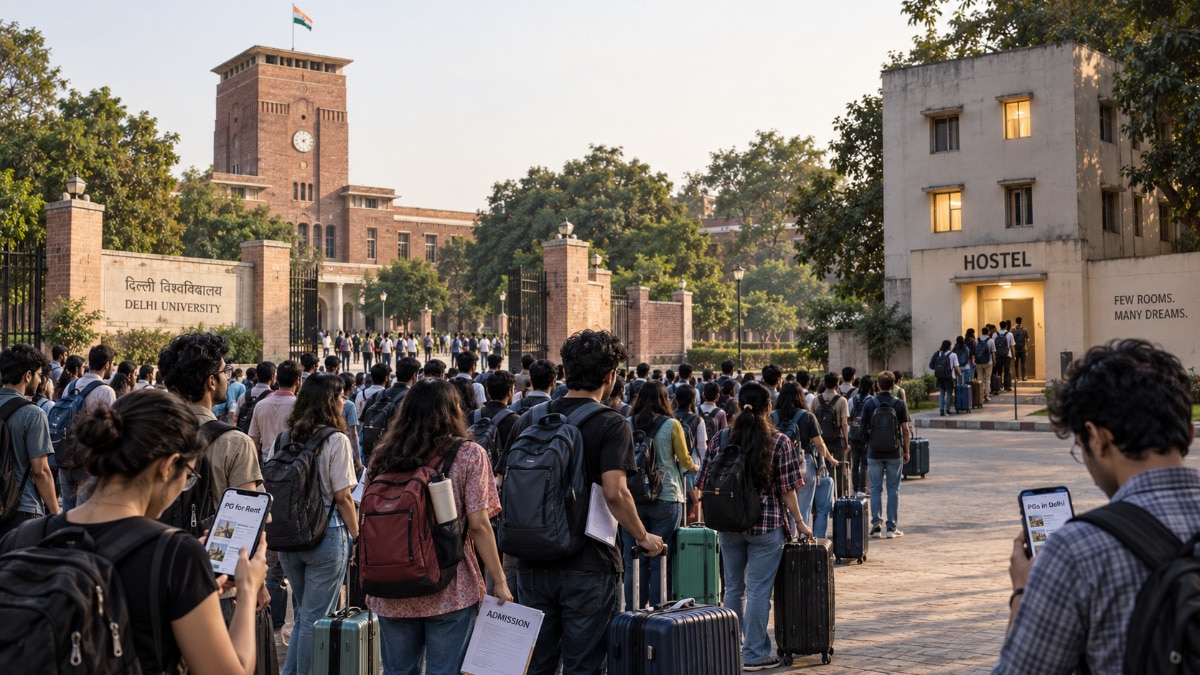
The collapse of a student PG in Satya Niketan has exposed the accommodation pressures facing Delhi University students. As hostel capacity falls far short of demand, private PGs and rented homes have become an essential part of the city's student housing ecosystem, bringing safety, affordability and accessibility into sharper focus.DU adds thousands of seats, but not hostel rooms: Where will students live? (AI-generated image)For an outstation student, getting into Delhi University is a moment of celebration. Then comes the next question: Where will I live? The search for a room often begins with a broker’s WhatsApp message, followed by lists of PGs, and security deposits. But these days, students and parents are asking a more basic question: Is the building safe?For students coming to Delhi from across the country, securing admission to DU is only the first hurdle. University hostels can accommodate only a small share of undergraduate students, leaving thousands dependent on PGs, rented rooms and shared flats in the private market. Around DU’s South Campus, such accommodation has become a common housing option for students.On Sunday, a five-storey PG building in Satya Niketan collapsed, leaving seven people dead, with rescue operations continuing at the site. The tragedy has put the safety of student accommodation under renewed scrutiny, highlighting the gap between the growing demand for housing and the infrastructure available to students.Getting into DU is difficult enough. Finding a safe and affordable place to live should not be.THE ADMISSION ENDS. THE ACCOMMODATION HUNT BEGINS The scale of Delhi University's undergraduate admissions makes the accommodation gap hard to ignore. For 2026-27, over 2.7 lakh candidates signed up on the Common Seat Allocation System, with 2,06,835 eventually submitting programme and college preferences.Against this, DU has around 71,000–71,600 undergraduate seats across its affiliated colleges. The competition for a classroom is visible and measurable. The competition for a bed is not. DU has around 4,000 hostel seats across central and college hostels, including 2,859 in central hostels. The university, however, does not publish a consolidated figure showing how many of those beds are available specifically to undergraduate students.For students coming from outside Delhi, particularly those joining South Campus colleges, private PGs and rental accommodation are therefore often the default.SOUTH CAMPUS HAS FEW HOSTELS, MANY STUDENTSThe contrast is particularly stark around South Campus, where several colleges have limited or no on-campus hostel accommodation for undergraduates. For many students at Jesus and Mary College, Atma Ram Sanatan Dharma College, Ram Lal Anand College, Motilal Nehru College and Aryabhatta College, finding accommodation outside campus is therefore necessary.Gargi College also does not have an in-college hostel, though its students can access a DU girls' hostel in Mukherjee Nagar. As a result, neighbourhoods such as Satya Niketan, Gautam Nagar, Green Park, Munirka and areas around Dhaula Kuan and Chanakyapuri have emerged as major student-housing hubs.There are some exceptions. Sri Venkateswara College has two TTD-supported hostels, Sri Balaji for boys and Sri Padmavati for girls, on its Dhaula Kuan campus. But their combined capacity covers only a small share of the college's student population. For 2026-27, the college has a sanctioned undergraduate intake of around 1,403 students.Maitreyi College has an on-campus girls' hostel, but its hostel has accommodation for only 27 first-year students in 2026-27. The hostel offers twin and triple-sharing rooms, boarding and other facilities at an annual cost of around Rs 1.8 lakh.For students without a hostel place, the search inevitably moves beyond the university gates.‘MORE THAN ACCOMMODATION, THIS IS ABOUT EQUITY’At Lady Shri Ram College for Women, the experience of reopening a hostel after years of closure has brought the issue of accommodation into sharp focus. LSR's hostel was shut for nearly four years after a ceiling collapsed, following which the residence hall underwent extensive repairs and renovation.It reopened on August 1 for first-year students, with 109 rooms accommodating around 150 students across categories. But even that is far from enough. “One hundred and fifty is too little, certainly. We have applied for grants. It is a long process,” said Professor Kanika K Ahuja, Principal of LSR.The college has invested heavily in repairing and upgrading the facility, but the number of students it can accommodate remains limited. For Ahuja, the importance of the hostel goes beyond providing a roof over a student's head.“More than accommodation, this is about equity. It’s about ensuring that talent is never limited by geography or by the cost of a PG in Delhi,” she said.The residence hall offers shared accommodation as the norm, while some single rooms are also available. But with space for only around 150 first-year students, many students who may need college accommodation will still have to look elsewhere.For Ahuja, a hostel can also shape how a young student experiences the transition from home to university. “For a young woman leaving home for the first time, a hostel room is confidence. It’s independence. It’s the basis from which she will go on to lead, create and change the world,” she said.AN INFRASTRUCTURE PROBLEM THAT HAS OUTGROWN OLD BUILDINGSThe hostel shortage is part of a larger infrastructure problem, says Professor V K Paliwal, Principal of Dyal Singh College. The institution's buildings were constructed several decades ago, when enrolment was considerably lower and most students came from Delhi and nearby areas.“Now, with the implementation of OBC reservations and a significant increase in enrolment, the number of students has grown substantially,” Paliwal said. The Dyal Singh campus currently has a capacity of around 10,000 students, with two colleges operating from the campus.But expanding and upgrading decades-old infrastructure remains a challenge.“We need faster approvals and timely funding. We are academicians, not technical experts, so we need support from civil engineers and other specialists who can assess the infrastructure requirements and guide us through the process,” Paliwal said.With timely funding and clearances, colleges could develop high-rise infrastructure and expand facilities, including hostels, he said.Paliwal also suggested creating a Special Purpose Vehicle (SPV) to speed up the process and ensure that necessary approvals from the Municipal Corporation of Delhi (MCD) are obtained on time.The larger problem, therefore, is not simply a lack of beds. It is a mismatch between an expanding and increasingly geographically diverse student population and infrastructure that was built for a very different university.WHEN THE PRIVATE PG BECOMES THE DEFAULTFor students who do not get a hostel room, a private PG is often the quickest answer. But it comes with uncertainties.Parents may have little ability to assess a building's structural condition from hundreds of kilometres away, while students may check the rent, location and facilities without knowing whether the building meets construction norms or has adequate emergency arrangements.The Satya Niketan collapse has brought these concerns into sharper focus. The MCD has ordered action against illegal constructions, while officials have faced questions over how such structures were allowed to operate.But if unsafe PGs are sealed, where do the students who depend on them go? The demand for accommodation does not disappear when a building is declared unsafe.THE COST OF A DU SEAT DOESN'T END WITH TUITIONFor an outstation student, the financial burden begins after admission: rent, food, security deposits, brokerage and the cost of living close enough to college to avoid long daily commutes.For students from Delhi, living at home can eliminate much of this expense. For those from other states, it cannot.This creates a second hurdle after admission. Getting a DU seat is structured through CSAS; finding a safe and affordable place to live often means navigating brokers, WhatsApp groups, online listings and word of mouth.The result is an uneven cost of access. A student may clear the same admission process as someone who lives in Delhi, but the cost of actually attending university can be dramatically different.And after the Satya Niketan collapse, that calculation has acquired another dimension: safety.IS THE BUILDING SAFE?That should not be a question an 18-year-old has to answer alone.Delhi University has expanded access to higher education for students from across the country. But unless the hostel and student-housing infrastructure expands alongside that access, the burden of making Delhi liveable, and safe, for those students will continue to fall largely on private landlords, PG operators and families.For thousands arriving in Delhi this year, getting a DU seat may have been the first hurdle. Finding a safe, affordable place to live is the second, and for many, the harder one.- EndsPublished By: Apoorva AnandPublished On: Sep 7, 2026 16:56 IST
DU adds thousands of seats, but not hostel rooms: Where will students live?
Full Article
Original Source
Read the full article at Indiatoday →KhanList aggregates and links to publicly available news content. We do not host full articles from third-party sources. Always verify important information with original sources.