
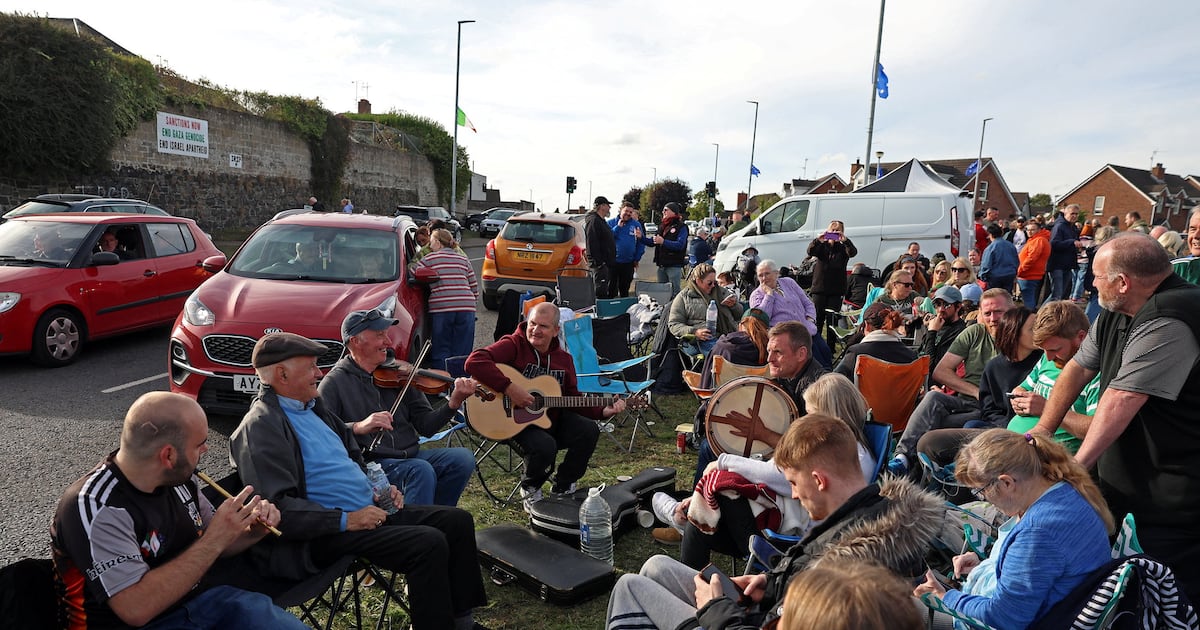
Dessie Traynor remembers travelling up the Garvaghy Road in April 1975 behind his mother’s coffin expecting the procession to continue on to the 200-year-old Catholic church that then served local Catholics.His 52-year-old mother, Dorothy, and his father, Malachy, had been shot in an attack by loyalists – believed to be part of the notorious Glenanne gang – as they walked home through a local park on the evening on April 1st. Dorothy was killed; Malachy was shot three times. The funeral cortege continued driving for about half a mile to the Protestant church at Drumcree, better known today for the violent events of 1995, and the starting point for the parade route the Orange Order wants to follow down the mainly nationalist Garvaghy Road. “She’s buried in the church ground. She was a Protestant. I come from a mixed background. I haven’t a sectarian bone in my body. My dad was a Catholic from West Belfast,” says Trainor.READ MORE“They had met in London. She was a country girl from around here. They met in England after the war. In any other circumstances they wouldn’t have met.”Dessie Trainor at the grave of his Protestant mother, Dorothy, in Drumcree in 2019. Photograph: Liam McBurney The family had been “put out” of their home on the other side of Portadown in 1971.“Then we came here,” he says. “Good Protestant people lived in the house that we were put into here. They were put out too. That’s the way it was. It was terrible.”Trainor is one of the Garvaghy Road residents who went to court to block the Orange Order from marching on the road.“I want to stop all this in its tracks. I have five grandchildren; it’s breaking my heart,” he says.Trainor is involved in the Theatre of Witness Network, which brings those who were involved, or affected by the Troubles into schools across Northern Ireland to tell them about the past.The work involves ex-soldiers, police, prison officers and community workers, and is supported by the Peace & Reconciliation fund.“Often the students are in shock when they’re told of the horrors that happened,” Trainor says.He is adamant that Garvaghy Road residents will never back down again to the Orangemen..“We were a united, disciplined community and we are the same today. We are going to get the Orange banned forever – no more marches, never again,” he says.After several thousand demonstrators dispersed late on Sunday night, small groups remained on duty through the night, lest any effort be made by the Orange Order to march.On Monday, the road showed the signs of the weekend protest. Bins overflowed with rubbish. Camp chairs had been piled up on the street, ready to be brought back into use. Two local schools, St John the Baptist’s College and Ballyoran Primary School, remained closed on Monday.Despite the standoff, normal life continued. Council maintenance workers worked on some basic repairs. A sign announced one road off Garvaghy Road would close for re-tarring. Broadband companies continued with installations.Everything on Garvaghy Road is still dominated by the march.Residents headed to the pastoral centre at St John the Baptist’s church by midafternoon to get a briefing from their representatives, who had earlier gone to Hillsborough, where they were exhorted to stay the course.Beyond this Catholic estate, the rest of Portadown continued about the business of a normal Monday. Shopping centre car parks were well occupied. Drumcree 2026 has echoes of the tense stalemates of Drumcree in the 1990s.[ Decades after flashpoints of the 1990s, Drumcree is just as dangerousOpens in new window ]Once again, Drumcree threatens the political stability of Northern Ireland’s powersharing government at Stormont as the Democratic Unionist Party (DUP) and Sinn Féin – the two parties that dominate the North’s Assembly and Executive – have exchanged angry words over the deadlock.Sinn Féin MP for Belfast North John Finucane, one of the many sleep-deprived protesters on the Garvaghy Road, urged people outside of Portadown to understand the feelings of the residents, who do not want the parade or the past returning.“We don’t want to be here at all. But when the Orange Order set in train the steps that have brought us here, you’ve no option,” he says. He shakes his head in disbelief that Drumcree is now dominating headlines once again.Less than a half a mile way on Drumcree hill, the world looked entirely different. Members of the Orange Order made their way down the hill a couple of times on Monday only to be stopped by police. It was purely for show; nobody expected them to be allowed march on.On the other side, people are equally dug in.Local Democratic Unionist MP Carla Lockhart is adamant they are not going anywhere either; their view is that the Orange Order has a court ruling on its side, and the police have a duty to enforce it – end of.“I am not sure what will happen if the Secretary of State tries to ban it – really I don’t,” she tells The Irish Times, referring to the Northern Secretary Chris Bryant, who is trying to find a resolution. “I don’t think we will be able to control people – the level of anger is such,” she adds, sitting on the wall alongside loyalist influencer and lawyer Jamie Bryson.
Drumcree standoff: ‘I want to stop all this in its tracks. I have five grandchildren; it’s breaking my heart’
Full Article
Original Source
Read the full article at Irishtimes →KhanList aggregates and links to publicly available news content. We do not host full articles from third-party sources. Always verify important information with original sources.