
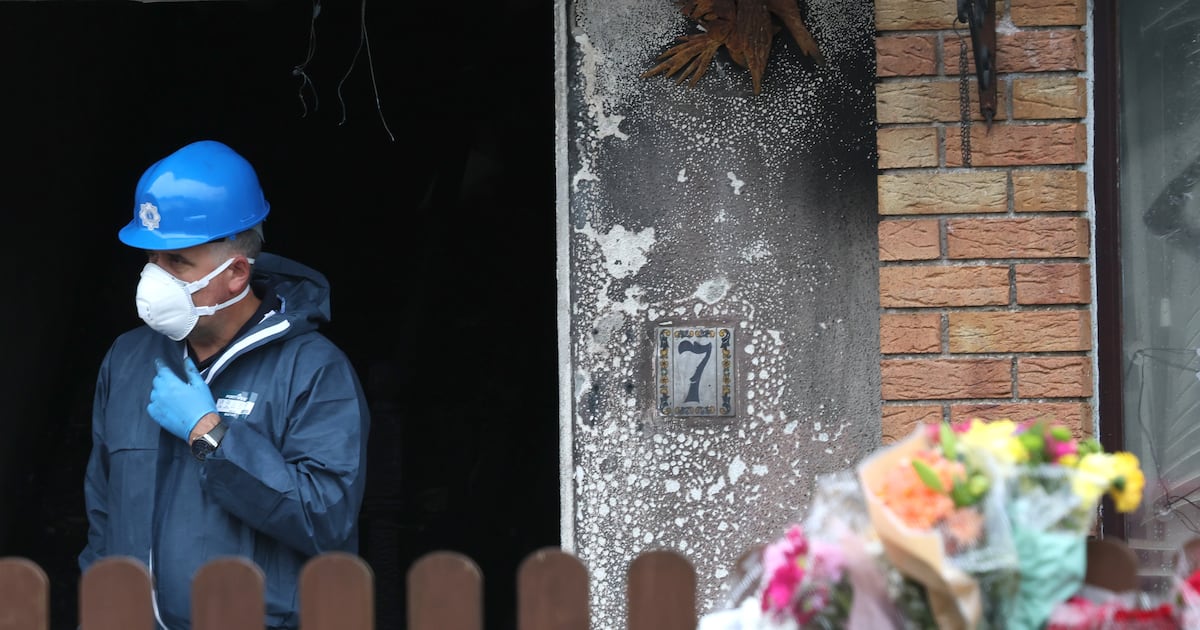
A well-known family-based drugs gang in Waterford is under investigation this weekend for the petrol bomb attack on the English family home in the city that killed four people, including two children. Philip and Kim English, and two of their sons, Callum (12) and Jayden (9), were murdered in an attack on the Birchwood estate, just south of the city. Two other children – a girl (14) and a boy (6) – were rescued by firefighters and remain critically ill in Children’s Health Ireland (CHI) Crumlin in Dublin.John James English, Philip English’s adult son from his first marriage, said the drug debt behind the arson attack had been incurred by somebody else, not his father, and that it had reached €20,000.READ MOREThe English family home had been targeted before, most recently in a petrol bombing last month. Even Philip English’s first wife, Anne, has had her house petrol bombed, as part of the same campaign of intimidation that has been ongoing for more than three years.The gang trying to collect the money has cornered a part of the lucrative drugs market in Waterford and the wider southeast region. It also has an intermittent presence in Spain. The group is family-based and has had no profile nationally – until this week.The Garda investigation team in Waterford, backed by the National Bureau of Criminal Investigation, moved quickly on Tuesday, carrying out a number of searches across Waterford city linked to the gang. They seized vehicles and mobile phones for examination. A garda at the house in which Philip and Kim English and their children Callum (12) and Jayden (nine) died in Tuesday's arson attack. Photograph: Stephen Collins/Collins Photos Another vehicle, driven by a woman, was also being sought this week for seizure and examination on suspicion it was used by the arsonist.On Thursday afternoon came news the first two arrests had been made. A man in his 20s and woman in her 30s were detained on suspicion of assisting a crime gang in the arson attack on Birch Avenue just after 5am on Tuesday.Gardaí suspect the attack on the English family home was intended to intimidate them, rather than take lives. The four deaths are now being investigated as murders.Gardaí believe an associate of Philip English ran up the drugs debt. While Philip English was not involved in crime, and the debt was not his, he was deemed by the gang as someone who could pay the money. And so pressure was applied to him, resulting in the tragedy that unfolded on Tuesday morning.Gardaí and people working in community organisations dealing with the fallout from the drugs trade are increasingly familiar with the dynamic Philip English and his family were trapped in.Over the past decade, gun crime has reduced and has, in large part, been replaced by petrol bombings.Gardaí believe crime gangs across the State were deterred from reverting to gun crime as a result of the Garda crackdown on the Hutch gang and the Irish-based section of the Kinahan cartel and the subsequent convictions in the wake of the Kinahan-Hutch feud.Petrol bombings have instead become a tactic of choice. Intended to intimidate rather than kill, they usually result in criminal damage rather than loss of life and so do not draw the same level of attention from national Garda units as a shooting.The Irish Times gathered data from 14 of the 31 local authorities nationwide showing 113 recorded arson attacks on council properties in the past five years, 50 of them last year. The four local authorities in Dublin recorded 59 attacks since 2022, with 35 occurring last year. Many were linked to drug-related intimidation.That intimidation stems most often from a young person running up a debt with a local drugs gang which they are unable to pay back, even after being subjected to extreme violence. The gang then moves on to the people around that person, often parents, threatening and attacking them until the debt is paid. [ Deaths in Waterford attack put focus on increase in drug-related intimidationOpens in new window ]Research by the Drive project, an inter-agency initiative, established in 2020 to tackle drug-related intimidation, describes the crime as being “pervasive” and “underreported”, with 1,027 recorded cases in 2024 and 2025. More than four in 10 cases – 43 per cent – took place in Dublin, but no other county accounted for more than 9 per cent of cases.[ ‘An everybody issue’: How drug-related intimidation affects all areas, urban and ruralOpens in new window ]Siobhán Maher, national co-ordinator of the Drive project, said people targeted by drugs-related intimidation could be young or vulnerable and forced to take on tasks for drugs gangs, including selling drugs or holding money, drugs or firearms.As they perform these high-risk tasks in order to pay off a debt, they may also be promised expensive clothing, such as designer jackets. Ultimately, the people around them, often parents or grandparents, can be targeted with violence to clear their young relative’s debt.“It manifests itself differently. It could be as extreme as what we know happened this week or it could be where a person is coerced or enticed into selling drugs,” Maher said, speaking at a conference on drug-related intimidation in Portlaoise, Co Laois, on Thursday. Det Supt Sé McCormack of the Garda National Drugs and Organised Crime Bureau told the conference that gardaí accepted the level of reporting of drug-related intimidation was low.“A significant proportion of people never come to An Garda Síochána, don’t want to come to us, or they don’t come at the first instance,” he said. “They may build up courage, or things may become too difficult and they may come after the second or third incident. But help is out there.”Det Supt Sé McCormack of the Garda National Drugs and Organised Crime Bureau. Photograph: Damien Eagers for The Irish Times The Drive project also carried out interviews with “research participants”, including those with “personal experience” of drug-related intimidation and others working in community-based services supporting victims across the country.Those interviewed spoke of how local dealers profiled families to establish whether they had the means to pay drug debts on behalf of others who were unable to pay.“These people aren’t stupid. They know who has money and who hasn’t,” said one interviewee. “They know who they can squeeze for a credit union loan, but they know they can’t do that again because they’re still paying it off, so they squeeze them for a cut of their weekly benefit payment.“When you’re paying a debt over time it’s never-ending because they might charge interest or they’re more likely to keep coming back because you’ve demonstrated that you can pay.”Other interviewees said victims were almost always reluctant to involve gardaí because they feared the local drugs gang so much and did not trust the Garda. Families were more likely to reach out to local community-run resource centres or other groups dealing with the fallout of the drugs trade.“Usually when people have ... lost their house, or the car’s been burnt out, or somebody has got shot in the leg ... then usually you’ll hear about it,” said one interviewee from a community-based service.When locals realise they are unwilling to challenge a local criminal’s child, it lands pretty quick with them the power that criminal has over them— Garda sourceAnother said the level of threat posed by gangs was too much for most people.“Everyone pays,” that person said. “And even though we would say we can put you in touch with the Garda liaison and you can meet them here in plain clothes, not one has ever met him. “It’s all fear; they have to live in the area and maybe the young lad that’s coming to the door lives in the area too.”The participants set out the streetwise tactics used by gangs to dominate particular areas, usually housing estates, in a bid to establish the fear they then wield. Groups of street dealers – boys and young men working under gang leaders – take up a controlling posture in communities by “patrolling neighbourhoods, cruising on scrambler bikes or hanging out on corners” to create “no-go areas”. It soon becomes clear to locals that these clusters of boys and young men are all part of the same group, supporting each other and ultimately working for a senior drug dealer.Another interviewee made the point that drugs gangs – like the group now suspected of the Waterford arson attack – were often large family-based units. [ Drug-related intimidation: why petrol bomb attacks are becoming more commonOpens in new window ]And they sought to subtly demonstrate their power by directing their own children to engage in the lowest-level antisocial behaviour, in the knowledge local people would feel they could not challenge the child.“The younger [family] members are sent off to kick balls at cars, for example – that’s how it starts,” said the interviewee.One Garda source said that when locals realise they are unwilling to challenge a local criminal’s child, “it lands pretty quick with them the power that [criminal] has over them”. One interviewee said a local drugs gang could create a “drugs economy”, benefiting and motivating others to protect the gang and shore up its strength by intimidation. “It’s the Robin Hood effect; drug dealers have a lot of money and they spread it around and then they’re glorified,” said the interviewee.Once a local drugs gang demonstrated they had the numbers to wield significant power in a community and were the most dominant group there, they could often do as they pleased and people would be reluctant to involve gardaí, participants said.“They will just choose a house at random, go in and make demands of the family to hold drugs, take their car or demand to be driven somewhere,” said one interviewee.[ RTÉ’s Kieran Cuddihy calls out cocaine-use hypocrisy after Waterford murdersOpens in new window ]A Garda source said he believed the murders of the English family in Waterford would result in criminal charges.“For them, this was another low-level incident, or so they thought. This wasn’t a planned murder like a gangland shooting would be; it was supposed to be a threat, but it went wrong,” he said. “So, they’ll have made mistakes. This is not something that was carefully planned and that’s what will catch them out.”
Drug-related intimidation: ‘When people lose their house or get shot in the leg, then they report it’
Full Article
Original Source
Read the full article at Irishtimes →KhanList aggregates and links to publicly available news content. We do not host full articles from third-party sources. Always verify important information with original sources.