
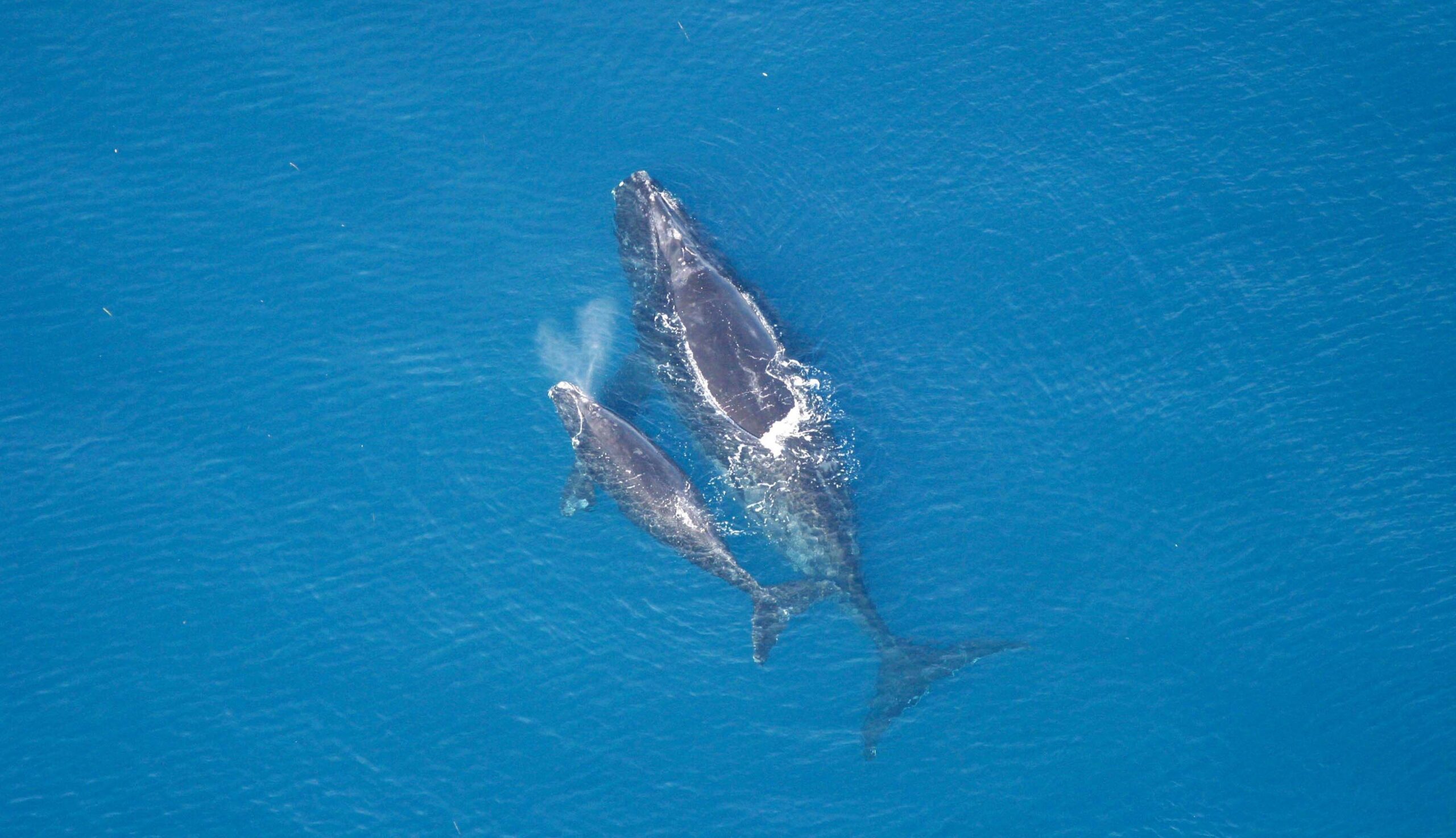
Critically endangered North Atlantic right whales continue to decline, with a new census counting just 382 in 2025.The survey, released at the start of the annual meeting of the North Atlantic Right Whale Consortium, included a small ray of hope: There was a record calving season in 2025, with 24 new calves born and three new mothers in the population.Numbers dropped by about 1.8% from 2024, with ongoing deaths and injuries caused by entanglement with fishing gear and collisions with speeding ships and boats.Recent regulatory rollbacks in the U.S. could make things worse for the imperiled whales, scientists say, including proposals to stop new fisheries regulations, amendments to restrictions on boat speeds and weakening of Endangered Species Act protections. North Atlantic right whales hover near extinction, with perhaps 382 remaining, according to a new census published today. Their numbers dropped from 389 in 2024, a 1.8% decline, though the number of female right whales of reproductive age has remained steady at 73. The survey was conducted and published by scientists at the New England Aquarium’s Anderson Cabot Center for Ocean Life, based in Massachusetts, and the National Oceanic and Atmospheric Administration (NOAA), the U.S. federal regulatory agency. North Atlantic right whales (Eubalaena glacialis) are among the world’s most endangered marine mammals, listed as critically endangered by IUCN, the global conservation authority. These numbers were released at the start of the annual meeting of the North Atlantic Right Whale Consortium, a collaboration that includes researchers, conservationists, shipping and fishing industry representatives, and U.S. and Canadian government agencies. The two-day meeting, is underway in Halifax, Canada, running through Nov. 17. Marine mammal scientist Heather Pettis said “seeing [the decline] is really disappointing.” She chairs this year’s meeting and leads the right whale research program at the Anderson Cabot Center. “There was a pretty significant decline following 2011 that sort of stopped in 2020, and we were starting to see this small, incremental uptick, which was fantastic. What [the latest census] says is the population is really not yet on a clear path to recovery.” North Atlantic right whales feed in the waters off Canada and the northeastern U.S. in the spring, summer and fall. They migrate to the shallow coastal waters of Georgia and Florida to birth their calves during the winter. It’s a protected species in both countries, listed under the federal Endangered Species Act in the U.S. and the Species at Risk Act in Canada. This 36-year-old north Atlantic right whale, named Silt, was spotted with her sixth known calf off Anticosti Island, Quebec, Canada, in September 2026. Image courtesy of Mingan Island Cetacean Study, under permits MPO-LEP-QUE-2026-M013B and QUE-MAMMIFÈRESMARINS-009B-2026. Before commercial whaling began in the 19th century, scientists say, between 9,000 and 21,000 right whales swam in the North Atlantic. By the 1890s, the population had been decimated, the cetaceans hunted for their baleen and blubber. No more than 100 remained. Right whale hunts were banned in 1935 through an international agreement, and formal protection under the International Convention for the Regulation of Whaling (ICRW) came in 1949. Their numbers increased slightly, but they haven’t bounced back. Fishing gear is one of the deadliest threats, particularly fishing ropes attached to traps and gillnets on the ocean floor. Once they’re caught in ropes or nets, whales can tow fishing gear for hundreds of miles, which cuts into their bodies, digging into blubber and bone, “and can lead to a long and painful death,” according to NOAA. The agency estimates more than 85% of North Atlantic right whales have been entangled in fishing gear at least once, and about 60% have been entangled multiple times. Ship strikes are also among the leading causes of death. Right whales often feed and rest at or near the water surface but are difficult to see: They’re dark in color and have no dorsal fin to signal their presence. Their home range is overlapped by busy shipping routes, and their migration pathway brings them near major ports along the U.S. East Coast. Collisions kill or injure whales in two ways — blunt force trauma or deep lacerations from boat propellers. Increasing ocean noise due to shipping, oil and gas exploration, and underwater construction interferes with “whale talk.” Right whales use low-frequency calls that overlap with the noise generated by ship engines and propellers, and research shows that human-generated noise shrinks the distance that they can communicate, increasing their stress levels and hindering their movements. Since 2017, scientists have observed an uptick in whale deaths, injuries and ill-health, and declared an Unusual Mortality Event, which is ongoing. Between 2017 and 2026, 43 whales were reported dead, 41 seriously injured, and 92 injured or in poor health, according to NOAA. Studies show that only a third of whales that die because of human activities are ever counted: Their bodies may simply sink to the ocean floor. So far in 2026, scientists have reported two right whale deaths. A 4-year-old male, named Division, was found dead off the coast of North Carolina on Jan. 27, caught in fishing gear that was traced to Canadian snow crab fisheries. On Feb. 10, a 3-year-old female whale was found dead off Virginia, but scientists do not yet know how she died. There have also been eight reported injuries: Seven entanglements and one ship strike. Right whales use low-frequency calls to communicate with each other, while migrating or foraging in groups. Ocean noise due to shipping, oil and gas exploration, and underwater construction are disrupting their communication and stressing them out. Image courtesy of Sea to Shore Alliance/NOAA via Flickr (Public domain). Declines come amid U.S. regulatory rollbacks This news of right whale declines comes amid regulatory setbacks in the U.S. In March 2026, NOAA issued a notice of intent to amend existing rules on vessel speeds in the North Atlantic to “reduce unnecessary regulatory and economic burdens.” Currently, the waters off the U.S. are sliced into ‘seasonal management areas’ at different times of the year, based on where the right whales are. Boats and ships longer than 20 meters (65 feet) navigating through these areas must slow down to 10 knots. NOAA now seeks to change that rule “with alternative management areas and advanced, technology-based, strike-avoidance measures.” “That’s not great news,” Anderson Cabot Center’s Pettis said. “We know that that rule has been effective in places and in times when it’s in effect … that’s disappointing to roll back what we know is working.” With these whales already threatened by ship strikes despite current rules, regulations need to be strengthened, not diminished, she said. An aerial image of Division, a North Atlantic right whale who was found off Jekyll Island, Georgia, on Dec. 3, 2025, entangled in fishing gear from Canadian snow crab fisheries. Image courtesy of the Florida Fish and Wildlife Conservation Commission, under NOAA permit #24359. Aerial survey funded by the USCG, U.S. Navy, USACE, and NOAA Fisheries. Rescuers try to free Division from fishing gear on Dec. 4, 2025; the whale died a month later. Entanglements in fishing gear are the biggest threat to critically endangered North Atlantic right whales. Image courtesy of Clearwater Marine Aquarium Research Institute, under NOAA permit #24359. Aerial survey funded by NOAA Fisheries and Georgia Department of Natural Resources. Despite the serious threat from entanglements related to fisheries, the U.S. House of Representatives passed a bill, H.R.9436, in 2026 that would delay what experts consider important protection for these right whales. It allows the National Marine Fisheries Service (NMFS) to postpone new regulations on certain lobster and crab fishing gear from 2028 to 2035. The bill has been sent to the Senate. “We know entanglements are still a really significant challenge … but we’ve got — right now — proposed legislation that would delay further any regulations,” Pettis said. In May, Canadian officials expressed concerns internally about how these proposed changes in the U.S. could impact the right whales, according to the CBC. This legislation could derail ongoing discussions between scientists, conservationists and industry on ways to protect whales while also helping fisheries thrive, Pettis said. “My worry is that if we now further extend the regulatory pause to 2035, that will shut down these discussions, which is not what I think the industry needs, or it’s not what the whales need, for sure.” In July 2026, the Trump Administration also finalized changes to the U.S. Endangered Species Act — removing habitat destruction from the Act’s definition of ‘harm.’ “That’s certainly a broad setback in terms of all endangered species, but certainly could touch North Atlantic right whales,” Pettis said. A dead North Atlantic right whale, killed by a ship strike in 2024. When vessels collide with whales, the impact can break bones, cause other grievous injuries, or kill them. Image courtesy of Clearwater Marine Aquarium Research Institute, under NOAA permit #24359. Record calving season brings hope There was some hopeful news in the new report. The 2025 survey counted 24 new calves — the highest since 2009, as well as three new mothers in the population. Right whales, like all other long-living mammals, reproduce late in life, at about 10 years of age, making it difficult for the small population to rebound. New calves needs to survive their early years until they are old enough to reproduce in order to increase numbers. “It’s one thing to be born into the population, but it’s another thing to survive to reproductive age, so that they can contribute to the population growth,” Pettis said. “So that is where the concern is.” Female right whales are particularly vulnerable to threats, and in recent years, they’ve birthed fewer calves, with a longer interval between pregnancies. Three years is considered normal, but that’s now increased to seven to 10 years, possibly because of the stress caused by entanglement in fishing gear and associated injuries. But when entanglements and ship strikes are reduced, these whales are resilient and they can bounce back, Pettis said. “These whales will do what it takes, that is within their control. It is on us as users of the oceans to allow them to do what they need to do and do it successfully.” North Atlantic right whale seasonal management areas for marine vessels. Image courtesy of NOAA. Banner image: A North Atlantic right whale and her calf. Image by NOAA/NMFS via Flickr (CC-BY 2.0). Spoorthy Raman is a staff writer at Mongabay, covering all things wild with a special focus on lesser-known wildlife, the wildlife trade, and environmental crime. As population ‘flattens,’ North Atlantic right whales remain at risk Can we stop ships from killing the Mediterranean’s last great whales? Citations: Knowlton, A. R., Clark, J. S., Hamilton, P. K., Kraus, S. D., Pettis, H. M., Rolland, R. M., & Schick, R. S. (2022). Fishing gear entanglement threatens recovery of critically endangered North Atlantic right whales. Conservation Science and Practice, 4(8). doi:10.1111/csp2.12736 Matthews, L. P., & Parks, S. E. (2021). An overview of North Atlantic right whale acoustic behavior, hearing capabilities, and responses to sound. Marine Pollution Bulletin, 173, 113043. doi:10.1016/j.marpolbul.2021.113043 FEEDBACK: Use this form to send a message to the author of this post. If you want to post a public comment, you can do that at the bottom of the page. Credits Topics
Drowned in fishing gear, struck by boats, North Atlantic right whales in serious trouble
Full Article
Original Source
Read the full article at News →KhanList aggregates and links to publicly available news content. We do not host full articles from third-party sources. Always verify important information with original sources.