
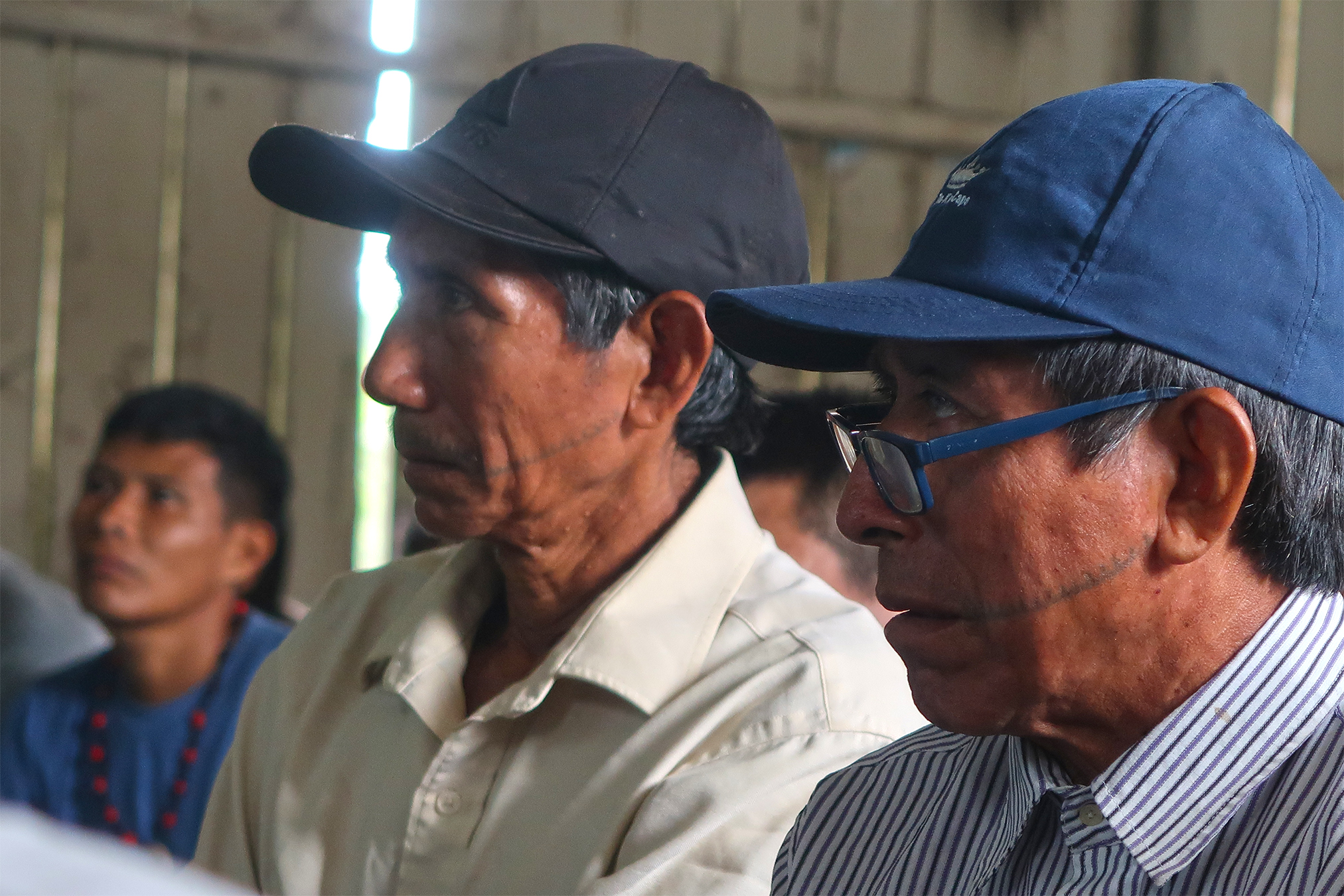
Since initiating contact with the outside world in 1969, the Matsés Indigenous people of the northeastern Peruvian Amazon have faced a barrage of epidemics.During a recent visit to the Matsés reserve, Mongabay found a population still suffering from outbreaks of deadly malaria and hepatitis B, exacerbated by state neglect and environmental threats like drought.Matsés leaders, anthropologists, and health experts warn that exposure could be fatal for isolated groups neighboring Matsés land, as well as those in nearby reserves across the wider Yavarí-Tapiche Territorial Corridor.Drought and an intensifying El Niño could further compound these health pressures by disrupting rainfall patterns, creating conditions that allow malaria-bearing mosquitoes to proliferate and affecting river transport for medical care. REQUENA, Peru — Until a century ago, few Matsés had ever been in contact with a white person before. The Indigenous people lived in a remote area of the Amazon Rainforest, along the border of Peru and Brazil, in seminomadic forest settlements between the Javari, Yaquerana and Gálvez rivers. There, wild meat was abundant — and they could hide from outsiders and rival groups. Roberto Necca Tumi Unan had just returned from a swim in the river when Mongabay arrived at his rectangular wooden stilt house for an interview. He’s one of the community’s last surviving elders, born before first voluntary contact with the outside world in the 1960s. Necca recalled how, on a few rare occasions, while cutting hunting trails through the dense jungle undergrowth alongside older men from his family, they would hear the alien sounds of outsiders. The men would quickly vanish into the undergrowth, covering themselves with damp leaves so the outsiders wouldn’t find them. “That had been a great fear for us because confrontation between mestizos and the Matsés before contact was dangerous,” he said. The Matsés, tired of conflict and displacement, said they chose to make contact with missionaries from the Summer Institute of Linguistics (SIL), an evangelical nonprofit, in 1969. While this initial contact brought some peace, it also marked the beginning of a decades-long struggle against deadly diseases. By 1981, the Matsés population, who had settled in Yaquerana district, in Peru’s Loreto department, was plagued by severe epidemics of influenza and pneumonia. Roberto Necca Tumi Unan is a 74-year-old member of the Matsés people who have for centuries inhabited the remote Amazonian rainforest border of Peru and Brazil, along the Javari, Yaquerana, and Gálvez rivers. Image by Aimee Gabay/Mongabay. More than half a century has passed since first voluntary contact, and a malaria and hepatitis B crisis is deepening, say anthropologists and health experts. While the deadly diseases were introduced by outsiders, they told Mongabay when we visited the reserve, environmental changes like drought and state neglect are worsening the impacts. Peruvian health ministry data point to a clear resurgence in malaria that has affected hundreds of Matsés. Recent droughts and the currently developing El Niño, intensified by climate change, make the situation worse by creating conditions that allow malaria-bearing mosquitoes to proliferate, health experts say. When it comes to hepatitis B, it is the communities themselves who are raising the alarm over a rising crisis. Drought hasn’t increased the transmission of hepatitis B, but it has made river transport difficult or impossible, keeping remote communities from accessing medical attention, health posts, and hospitals. While the government still has not yet tallied the numbers of those affected by hepatitis B, when it comes to recently contacted or uncontacted populations, a single detected case is sufficient to trigger an investigation and response. Multiple cases, as found here, signal a potential outbreak. “Before [voluntary contact], there weren’t many diseases,” Necca said, while his son-in-law translated from the Matsés to Spanish. Later, while Necca carefully put away his feather headdress, Mongabay asked his son-in-law why he wasn’t at the community assembly down the hill. “I’m recovering from malaria,” he said. Many infected people have no access to treatment for disease. Some communities have first-aid kits and trained community health workers. But as Henry Reyna Rodriguez from the San Mateo village told Mongabay in an interview, “What good is a trained health worker if the medication isn’t readily available?” During a video call with Mongabay after the trip, Matsés chief Leo Chuma Teca Beso expressed his concerns about the many deaths in the communities from malaria and hepatitis B: “It’s a mess.” From July 25-26, 2026, the Matsés held their bimonthly community assembly, which Mongabay attended, along with leaders from all 29 Matsés communities in Peru. Image by Aimee Gabay/Mongabay. Systemic abandonment Necca weaved around the five hammocks that slung across the room, collecting items he wished to show. He spoke of a time when the Matsés slept together in malocas, communal longhouses that were home to entire villages. That came to an end in the late 19th century, when rubber tappers and loggers expanded deep into Matsés ancestral land and triggered violent conflicts, causing temporary displacement and instability among the Indigenous families. In 1964, a group of Matsés attacked a Peruvian government commission inspecting the route for a proposed road through their territory. In response, Peru summoned the U.S. Air Force, based in Panama, to bomb Matsés villages with napalm. Those attacks, which cause severe burns and asphyxiation, forced families to abandon their malocas and flee deep into the forest. Each year, on Aug. 30, the Matsés celebrate the day their ancestors chose to make contact with the SIL. “For the Matsés, it’s very important,” Pepe Fasabi Rimacho, a former community leader, told Mongabay in an interview. “When the Matsés came to be civilized, it was a light that arrived for them — the evangelization of religious life, as well as the end of the pressure they felt from the military and from the people who exploited the rubber.” Fabio paused, slouching against the wall on one of the wooden benches in the assembly hall. He added, “For the Matsés, it was like freedom.” Today, communities are dealing with rising rates of disease and concerns of infecting their more vulnerable neighbors. The Matsés ancestral territory is surrounded by forests that are also home to Indigenous peoples still living in voluntary isolation from the rest of the world. This region, the Yavarí-Tapiche Territorial Corridor, spans 16 million hectares (40 million acres), an area twice the size of Scotland that’s a mosaic of protected areas, national parks, and Indigenous reserves scattered across both Peru and Brazil. It’s home to the world’s largest known concentration of recently contacted and voluntarily isolated peoples, often referred to by the acronym PIACI. At the same time, it’s also under pressure from extractive and large-scale industrial activities, which are encroaching closer into the forests long considered a refuge for these vulnerable groups, bringing risks of catastrophic epidemics through contact with outsiders. According to Beatriz Huertas, an anthropologist and senior policy adviser for isolated peoples at the Rainforest Foundation Norway, PIACI individuals haven’t developed adequate immune defenses against these diseases, meaning that an epidemic could wipe out entire communities. Malaria and respiratory diseases, such as whooping cough (also known as pertussis), are the most immediate and historically well-documented threats to PIACI populations. According to Peruvian health ministry data, malaria cases in Yaquerana district fell from 471 in 2020 to 263 in 2021, then more than doubled in 2022 to 579. In 2023, cases fell again sharply to 223, but then more than quadrupled to 962 a year later. The number of cases remained extremely high in 2025, at 1,455. To date this year, the ministry has recorded 851 cases. Matsés community members Mongabay interviewed said that whenever there’s a drought, they notice an increase in illness across communities. Many said they’re concerned about the predicted arrival of El Niño, a climate phenomenon that, in this part of the world, is associated with changes in rainfall and temperature patterns. Yury Wilson Escajadillo Fernandez, the deputy director of climate predictions at Peru’s meteorological agency, SENAMHI, told Mongabay via WhatsApp messages that the last El Niño event provided crucial lessons on how the next one might impact the Matsés. From 2023 to 2024, their river levels dropped, leaving families who depend on waterways for transport with less food, water, and access to health care. These impacts were reported by communities across the entire Amazon Basin. Some studies have shown how El Niño can exacerbate malaria transmission, as it creates conditions for mosquitoes to proliferate. Other research has found that drought and associated fires, which are more likely during El Niño, increase respiratory illness, particularly through exposure to smoke. Climate projections prepared by SENAMHI for Mongabay indicate that the Matsés ancestral land is likely to become significantly warmer by around 2050. Temperatures are projected to rise by roughly 1.6-2.0° Celsius (2.9-3.6° Fahrenheit), while some areas farther south, including Sierra del Divisor National Park, could see even higher increases, as well as a decline in annual precipitation by as much as 5-10%. SENAMHI warned that these changes could put additional stress on ecosystems, wildlife, natural resources, and local people, including through greater exposure to heat and changes in habitats and water availability. Forest loss can also influence the spread of diseases, according to research. One study examined the relationship between forest loss in the Peruvian Amazon and malaria, revealing that every 1,000 hectares (about 2,500 acres) of forest cover lost was associated with approximately 69 additional malaria cases. Another study suggested that at a certain level of transmission, malaria can reduce forest loss. In the case of hepatitis B, it’s more difficult for the disease to reach isolated communities as it’s often sexually transmitted, said Juan Carlos Celis Salinas, a tropical infectious disease doctor at Loreto Regional Hospital. “But if there were physical contact and closer interaction [between outsiders or other Indigenous people carrying the disease and PIACI], then hepatitis B, which is deadly, could spread,” Huertas said. “That would be terrible.” Wooden stilted houses in the San Mateo village, one of 29 Matsés communities in Peru, which lies on the banks of the Gálvez River. Image by Aimee Gabay/Mongabay. On paper, Peru’s health ministry recorded zero deaths in Yaquerana, where the Matsés live, from hepatitis B between January 2021 and August 2026. But Tabea Casique Coronado, who serves as the national secretary on the board of directors of Peru’s national Indigenous rights organization, AIDESEP, told Mongabay via WhatsApp that these numbers are wholly inaccurate. For 10 years, she’s been involved in a campaign to help the Matsés obtain a comprehensive health assessment and vaccinations to stop the spread of disease. “They have not conducted systematic interventions to gather information on hepatitis B in this community,” Casique wrote. She said that when a member of the Matsés dies, local health workers rarely record the accurate cause of death. Death certificates may say cirrhosis, a late-stage liver disease often caused by untreated chronic hepatitis B, masking the true extent of the problem. “That’s why there are far more deaths from hepatitis B than those officially registered by the [health ministry],” Casique said. She told Mongabay she knows of several families where all the children have died from hepatitis B. However, she didn’t have an estimate for the total number of Matsés who died due to the disease. Roberto Necca Tumi Unanone, one of the community’s last surviving elders, was born before first voluntary contact with the outside world in the 1960s. Image by Aimee Gabay/Mongabay. Celis echoed the concerns, telling Mongabay by WhatsApp voice messages that the absence of government records doesn’t mean the problem isn’t there. “Many times [Indigenous people] come from native communities all over Loreto to die with advanced cirrhosis,” he said. “They do indeed end up dying because advanced cirrhosis has very little chance of survival anywhere in the world.” He added national and regional statistics are generally organized by province and district, and studies of Indigenous populations are rare. A health ministry spokesperson told Mongabay via email that “epidemiological surveillance is based on information reported by health facilities, but in geographically dispersed areas, it can be difficult for all cases to reach the system in a timely manner.” In late 2025, the Matsés and several civil society groups, including AIDESEP and the Rainforest Foundation Norway, deployed a health brigade with regional officials to screen for hepatitis B, syphilis, and HIV in Matsés communities. The health ministry told Mongabay that the brigade screened 793 of the roughly 4,000 Matsés across Peru and identified 17 cases of hepatitis B. It said it expects the number to increase once the other 80% of the population have been screened. The effects of low water levels were already visible during Mongabay’s reporting trip in July. At several points, our boat scraped against the riverbed as we moved through the shallower stretches of the Gálvez River. For people living with hepatitis B, such conditions can turn an already serious health crisis into an even greater threat by making it harder to reach health posts and hospitals for treatment. The Matsés depend on rivers for transport, and the closest city, Colonia Angamos, can take up to two days to reach from some of the furthest communities and receives flights only twice a week. Image by Aimee Gabay/Mongabay. The San Mateo village, one of 29 Matsés communities in Peru, which lies on the banks of the Gálvez River. Image by Aimee Gabay/Mongabay. The defenseless Celis said vaccine availability alone isn’t enough to solve the problem, and that there needs to be adequate investment into implementation, which to date has been lacking. In addition, he said implementation often fails because medical teams don’t consider how infectious disease is culturally understood by each native group, such as whether they will believe in how a disease is transmitted or treated. These concepts can’t simply be translated in terms that are obvious to medical professionals from outside, he said, and instead must be adapted for each ethnic group and its worldview. “We know that gaps still exist, but we have also made concrete progress that allows us to improve the healthcare response,” the health ministry spokesperson said, adding this includes culturally appropriate health services, mobile health brigades, and regional health plans. “We are working to ensure that care not only reaches these communities, but that it is timely, continuous and culturally appropriate.” According to Casique, approximately 490 of 1,500 eligible Matsés received hepatitis B vaccines in December 2025. The next round is scheduled for this October. “Losing a family [member] is heartbreaking,” said Reyna, the San Mateo villager. “At the very least, we would like the patient to die in the hands of the doctors. For people to be dying on the streets, that doesn’t seem right to us. It’s as if [the state] doesn’t care about people’s health.” Peru has had a PIACI health protocol for almost two decades. The first dedicated health framework, approved in September 2007, included three closely related instruments aimed at reducing health risks, managing interactions with isolated peoples, and providing health care to recently contacted populations. These guides acknowledged that protecting isolated peoples didn’t have to mean vaccinating the isolated people themselves, but the populations surrounding them, including their contacted Indigenous neighbors. San Mateo village, one of 29 Matsés communities in Peru, on the banks of the Gálvez River. Image by Aimee Gabay/Mongabay. On May 16 this year, the health ministry’s Directorate-General of Strategic Public Health Interventions approved a replacement to the 2007 standard, which expanded its scope to cover not just people in isolation and initial contact, but recently contacted people too. Despite these standards, Huertas from the Rainforest Foundation Norway said the Peruvian health sector isn’t prepared to handle any health emergency affecting isolated people. “There are many problems implementing standards, disease prevention mechanisms, contingency mechanisms and mitigation mechanisms,” she said. Banner image: From July 25-26, 2026, the Matsés held their bimonthly community assembly in the San Mateo village, which Mongabay attended, along with leaders from all 29 Matsés communities in Peru. Image by Aimee Gabay/Mongabay. Malaria outbreak among Indigenous Pirahã linked to forest loss, satellite data find Citations: Walker, R. S., Sattenspiel, L., & Hill, K. R. (2015). Mortality from contact-related epidemics among Indigenous populations in greater Amazonia. Scientific Reports, 5(1). doi:10.1038/srep14032 Saavedra-Samillán, M., Burgos, F., García Huamán, F., Valdivia, H. O., Gamboa, D., & Chenet, S. M. (2024). Spatiotemporal dynamics of malaria and climate influence on its incidence in Condorcanqui province, 2005–2022. Malaria Journal, 23(1). doi:10.1186/s12936-024-05193-6 Machado-Silva, F., Libonati, R., Melo de Lima, T. F., Bittencourt Peixoto, R., De Almeida França, J. R., De Avelar Figueiredo Mafra Magalhães, M., … DaCamara, C. C. (2020). Drought and fires influence the respiratory diseases hospitalizations in the Amazon. Ecological Indicators, 109, 105817. doi:10.1016/j.ecolind.2019.105817 Aguirre, J., Rojas, P., Yu, T. E., & Yenerall, J. (2024). Spatial spillovers and the relationship between deforestation and malaria: Evidence from the Peruvian Amazon. Journal of Environmental Planning and Management, 68(7), 1497-1513. doi:10.1080/09640568.2023.2289102 MacDonald, A. J., & Mordecai, E. A. (2019). Amazon deforestation drives malaria transmission, and malaria burden reduces forest clearing. Proceedings of the National Academy of Sciences, 116(44), 22212-22218. doi:10.1073/pnas.1905315116 Barratt Heitmann, G., Wu, X., Nguyen, A.T. et al. (2026). Associations between weather and Plasmodium vivax malaria in an Amazonian elimination setting: a distributed lag analysis from 2017 to 2024. Malar J. doi:10.1186/s12936-026-06010-y Sanchez, J.F., Carnero, A.M., Rivera, E., Rosales, L.A., Baldeviano, G.C., Asencios, J.L., Edgel, K.A., Vinetz, J.M., Lescano, A.G. (2017). Unstable Malaria Transmission in the Southern Peruvian Amazon and Its Association with Gold Mining, Madre de Dios, 2001-2012. Am J Trop Med Hyg., 96(2):304-311. doi:10.4269/ajtmh.16-0030 FEEDBACK: Use this form to send a message to the author of this post. If you want to post a public comment, you can do that at the bottom of the page. Credits Topics
Drought is deepening a health crisis among Peru’s recently contacted Indigenous Matsés
Full Article
Original Source
Read the full article at News →KhanList aggregates and links to publicly available news content. We do not host full articles from third-party sources. Always verify important information with original sources.