
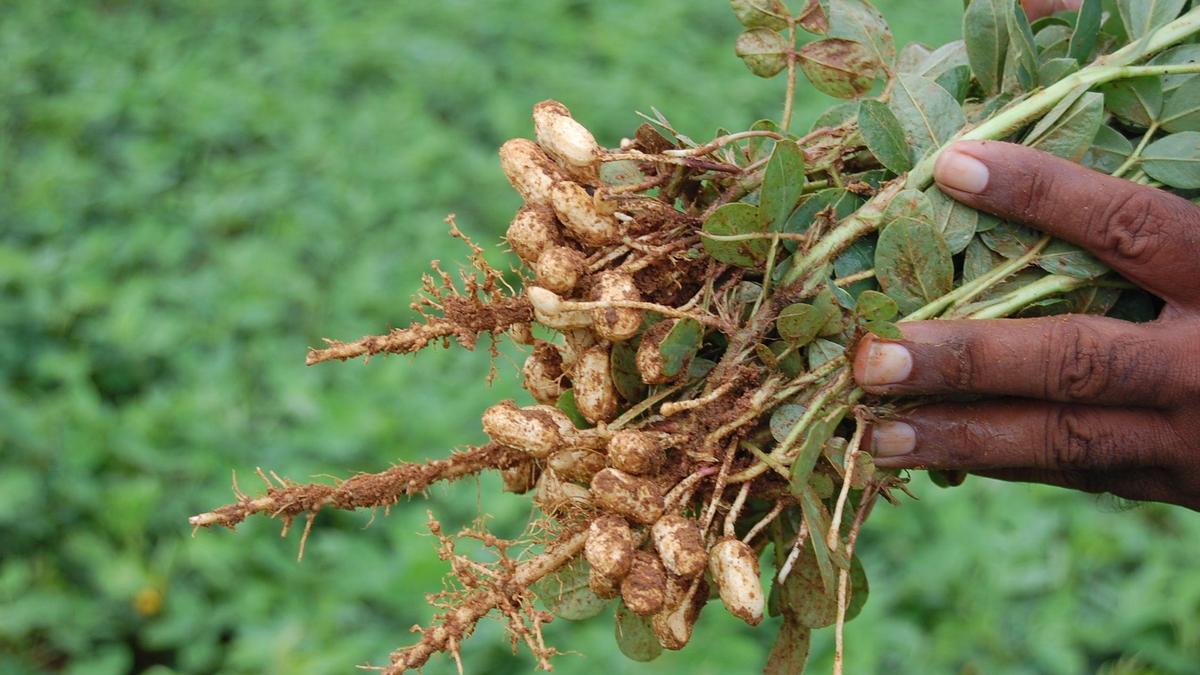
As Bengaluru gears up for the historic Kadlekai Parishe, celebrated in Basavanagudi and Malleshwaram, the arrival of groundnuts in Karnataka’s markets has been delayed this year due to drought conditions, with farmers reporting reduced sowing and poor yields across major groundnut-growing districts.Groundnut farmers in Kolar, Chitradurga, Dharwad, Haveri, Mandya, Mysuru and Tumakuru districts said sowing had declined this year due to inadequate rainfall and drying borewells. Groundnut is predominantly cultivated during the kharif season in these districts, while Vijayapura, Yadgir, Kalaburagi and Raichur districts also cultivate the crop during the summer season.According to data from the Department of Agriculture, groundnut sowing this year stood at 1.59 lakh hectares against the target of 2.54 lakh hectares. Of the area sown, crop failure has been recorded across 1.49 lakh hectares, accounting for 93.71% of the total sown area.Agriculture Department officials attributed the extensive crop failure primarily to deficient rainfall, pointing out that groundnut cultivation in Karnataka is largely rain-dependent. Of the 2.54 lakh hectares targeted for cultivation, around 2.38 lakh hectares are rainfed, while only approximately 0.17 lakh hectares are under irrigation.Although groundnut is not widely cultivated during the rabi season, the department’s data showed that sowing had been completed across 0.58 lakh hectares as of November 13, against a target of 1.33 lakh hectares.Speaking to The Hindu, a senior Agriculture Department official said that the farmers who cultivate groundnut during the rabi season generally have access to better irrigation facilities. “Farmers who cultivate during the rabi season have good water facilities through borewells, or their fields are usually located in command areas,” the official said. Pointing to the delayed market arrivals, K.P. Bhoothaiah, senior vice-president of the Karnataka Rajya Raitha Sangha, Chitradurga, said even farmers who had managed to cultivate groundnut were reporting poor yields.“Even where farmers have cultivated groundnut, the yield is low and the seeds are smaller in size,” he said.Abhilash Reddy, a farmer from Kolar district, said that he had not cultivated groundnut this year due to drought, drying borewells and a shortage of agricultural labourers.“Groundnut cultivation is labour-intensive. The crop has to be harvested, dried under the sun and shelled. With the borewells drying up and labour becoming difficult to find, I decided not to cultivate it this year,” he said.He added that during drought conditions, farmers cannot expect the usual yield of 10 to 11 quintals per acre, with even five to six quintals becoming difficult to achieve. Farmers in parts of Kolar have therefore stayed away from groundnut cultivation altogether this season.“The yield is poor in terms of both quality and quantity, and farmers are unable to recover the money invested in cultivation,” he said.Prices rise amid reduced arrivalsWith supply falling and demand increasing ahead of the Kadlekai Parishe, groundnut prices have witnessed a significant rise in several agricultural markets.The gejje variety, which was earlier selling between ₹5,000 and ₹7,000 per quintal at the Hubballi Agricultural Produce Market Committee (APMC), reached ₹8,875 per quintal on November 24. In Chitradurga, the price of the naati variety increased from ₹3,000-5,000 to ₹7,933 per quintal, while the hybrid variety rose from around ₹4,619 to ₹10,809 per quintal.A senior APMC official said prices had touched ₹9,500 per quintal during the festival period before easing slightly. “Prices may increase again during Sankranti. Arrivals at the mandis have also been delayed due to crop failure and lower yields,” the official said.Drought-tolerant varieties also affectedThe University of Agricultural Sciences (UAS), Dharwad, has developed several groundnut varieties, including GPBD-4, GPBD-5, DH-256 and DH-257, which are known for their high yields and shorter cultivation periods.However, Ashok Sajjan, Director of Research, UAS-Dharwad, said these varieties were drought-tolerant but not drought-resistant.“These are high-yielding, short-duration varieties, particularly DH-256 and DH-257. However, they are only drought-tolerant and not drought-resistant. Under extreme drought conditions, the yields can also decline significantly or the crop may fail,” he said.
Drought affects groundnut cultivation in Karnataka; prices rise amid supply shortage
Full Article
Original Source
Read the full article at Thehindu →KhanList aggregates and links to publicly available news content. We do not host full articles from third-party sources. Always verify important information with original sources.