
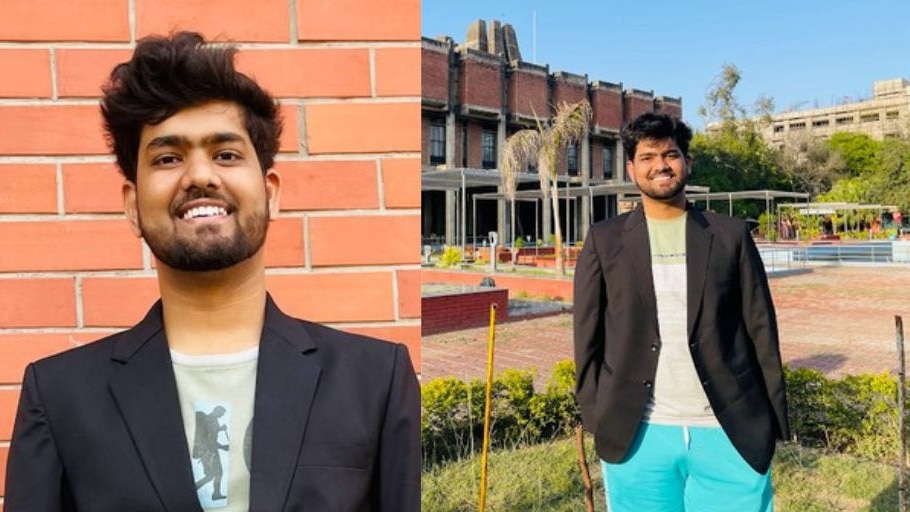
“An early result does not have to define you. Start with the next thing you can improve: one subject, one skill or one project,” says Tejesh Vaish, a 26-year-old AI engineer from Lucknow. For someone who once scored just 48 percent in Class 5, these words carry deeply personal meaning. Growing up in a modest household, Tejesh watched his father run a small sweet shop, unaware of how far his own journey would eventually take him.Today, he is leading AI engineering at Dubai-based Lumian.ai, where he earns Rs 2.5 crore annually. His role involves building AI tools that help Amazon brands improve decision-making, analyse information and simplify everyday operations.His success story, however, began with academic setbacks. Once an average student who took a drop year after Class 12, he went on to secure the ninth rank in the Uttar Pradesh State Entrance Examination (UPSEE) 2019 and earn admission to the Computer Science programme at IIT Kanpur.Tejesh credits education, family support and the right opportunities with changing the course of his life. THE TURNING POINTComing from a modest family, Tejesh had limited financial resources and an unremarkable academic start. At St Paul's College, he scored 48 per cent in Class 5, but his performance improved significantly over the years, reaching approximately 94 percent in Class 10 and 95 percent in Class 12.After Class 12, he took a drop year to prepare for the engineering entrance examinations. His routine involved six hours of coaching followed by nearly 12 hours of self-study, often extending until midnight. His efforts paid off when he secured ninth rank in UPSEE 2019, becoming Lucknow's top-ranked candidate and earning admission to the Computer Science programme at IIT Kanpur.HOW IIT KANPUR OPENED DOORS TO RESEARCH, INTERNSHIPS AND AIGetting into IIT Kanpur exposed Tejesh to opportunities beyond academics, including research, open-source projects and internships. Watching his peers explore these fields helped him recognise the possibilities available to undergraduate students."IIT Kanpur helped me realise how many paths were open to an undergraduate student. Being around people who were doing internships, contributing to open source and working on research made me realise that I could try those things too," he says.Financial assistance also played an important role. He received the PD Murti Scholarship, which eased the financial pressure on his parents. During college, he interned at Securonix, working on test automation and backend tooling, and Texas Instruments, where he gained experience in embedded software using C and assembly. He also earned approximately Rs 10 lakh through internships, freelance assignments and other paid work.Academically, he graduated in 2023 with a CPI of 9.14, built a compiler as part of his coursework and undertook undergraduate research with IIT Kanpur Director Professor Manindra Agrawal. His research involved developing a Python implementation of SUTRA, a COVID-19 epidemic model, using publicly available case data to fit the model to reported cases.Beyond academics, Tejesh served as a Senior Academic Mentor, mentoring and supporting more than 3,000 students. He also represented student academic concerns on his department's undergraduate committee and participated in discussions on the BTech curriculum.FROM BUILDING AI SYSTEMS TO LEADING ENGINEERING AT 26Today, Tejesh works at the intersection of artificial intelligence, software engineering and dependable technology. As a Lead Engineer at Lumian.ai in Dubai, he builds production AI agents for Amazon brands, helping businesses analyse information and automate workflows.His role goes beyond developing AI models. He builds the infrastructure that allows these agents to work reliably, including agent runtime, integrations, memory, scheduled tasks, permissions, approvals and evaluation."A user request only becomes useful when the system can reach the right tools and information, keep the right context and fail in a way people can understand," he explains.His earlier roles at Abacus.AI and Simbian helped him gain experience in enterprise AI infrastructure and security.Tejesh has also contributed to open-source projects, including TaskGen, AnythingMCP, Python's exceptiongroup library and Rust's erased-serde library. His work on TaskGen included improving AI agent state saving and restoration, as well as developing an investigation workflow that could pause for human input and resume afterwards.CAN STUDENTS BUILD AI CAREERS WITHOUT AN IIT DEGREE?Despite his own experience at IIT Kanpur, Tejesh does not believe that an IIT degree is essential to building a successful career in artificial intelligence.He believes students from other engineering colleges can also establish themselves in the field by developing strong fundamentals, building practical projects, gaining internship experience and contributing to open-source communities."IIT helped me because of the academic environment, the people around me and the opportunities that came with it. But students from other colleges can build strong careers in AI too," he adds.His recommended starting point is to develop a solid understanding of Python, SQL, data structures, probability, statistics and linear algebra. Students should then move towards practical software development skills, including APIs, databases, Git, debugging, testing and deployment.For those interested in AI, he recommends exploring frameworks and tools such as PyTorch and Hugging Face, alongside model APIs, retrieval systems and evaluation techniques.He also encourages students to use AI coding assistants such as Claude Code and OpenAI Codex, but not blindly accept their outputs."Ask the tool to explain something you do not understand, compare approaches or help investigate an error. Then read the change, run the code and make sure you can explain the reasoning yourself," he advises.HOW A PERSONAL FAMILY EXPERIENCE LED TO HOMEO AIAlongside his engineering career, Tejesh has been developing Homeo AI, an application that brings AI-assisted reference searches, case notes, follow-up information and document preparation together on one platform for homoeopathy practitioners.The idea took shape after his mother, Mamta Vaish, was diagnosed with cancer around 2024. She completed conventional treatment and went into complete remission, but the experience left Tejesh concerned about her recovery and the possibility of the illness returning.While exploring ways to support her, he began interacting with homoeopathic practitioners in Lucknow and other parts of India. Through approximately 10 sessions, he studied their working methods, reference requirements, patient-record management and administrative challenges to understand where technology could help.These conversations eventually led to Homeo AI. Tejesh now oversees its development, deployment and operations. The platform is designed as a professional support tool, with practitioners responsible for reviewing information and making clinical decisions.WILL AI REPLACE SOFTWARE ENGINEERS IN THE NEXT FIVE YEARS?As artificial intelligence becomes increasingly capable of writing code, generating tests and exploring possible implementations, Tejesh believes the role of software engineers will undergo a significant transformation over the next five years.However, he does not see engineering as simply a matter of generating code faster. Building reliable systems requires integrations, saved states, permissions, authentication, security controls and workflows that can involve human intervention.He expects engineers to spend more time addressing such reliability challenges as AI systems take on increasingly complex tasks."Problem definition, system design, debugging, evaluation, security and communication will matter even more. Engineers will have to decide whether the generated work is correct, whether it solves the user's actual problem and what happens when it goes wrong," he says.He also believes AI could allow smaller teams to develop more ambitious products, creating opportunities for independent developers and students who combine technical knowledge with sound judgement.WHAT LIES AHEAD? MORE AI INNOVATION AND GIVING BACKLooking ahead, Tejesh wants to deepen his work in AI and software engineering, continue leading engineering at Lumian and contribute more actively to open-source projects.He hopes to help build AI systems that can handle complex tasks, work safely with other software and recover when something goes wrong. Giving back is another important part of his long-term vision. Having benefited from scholarships, mentors and opportunities during his own academic journey, he wants to make similar support accessible to students from modest backgrounds.His advice to them is straightforward: do not allow an early academic result or financial circumstances to determine what you believe is possible.For him, the next milestone is not simply about building more advanced AI systems. It is also about making technology useful, sharing knowledge and ensuring that more young people get the opportunity to realise their potential.- Ends
Drop year changed my life: IIT-K grad earning Rs 2.5 crore recalls father's sweet shop
Full Article
Original Source
Read the full article at Indiatoday →KhanList aggregates and links to publicly available news content. We do not host full articles from third-party sources. Always verify important information with original sources.