
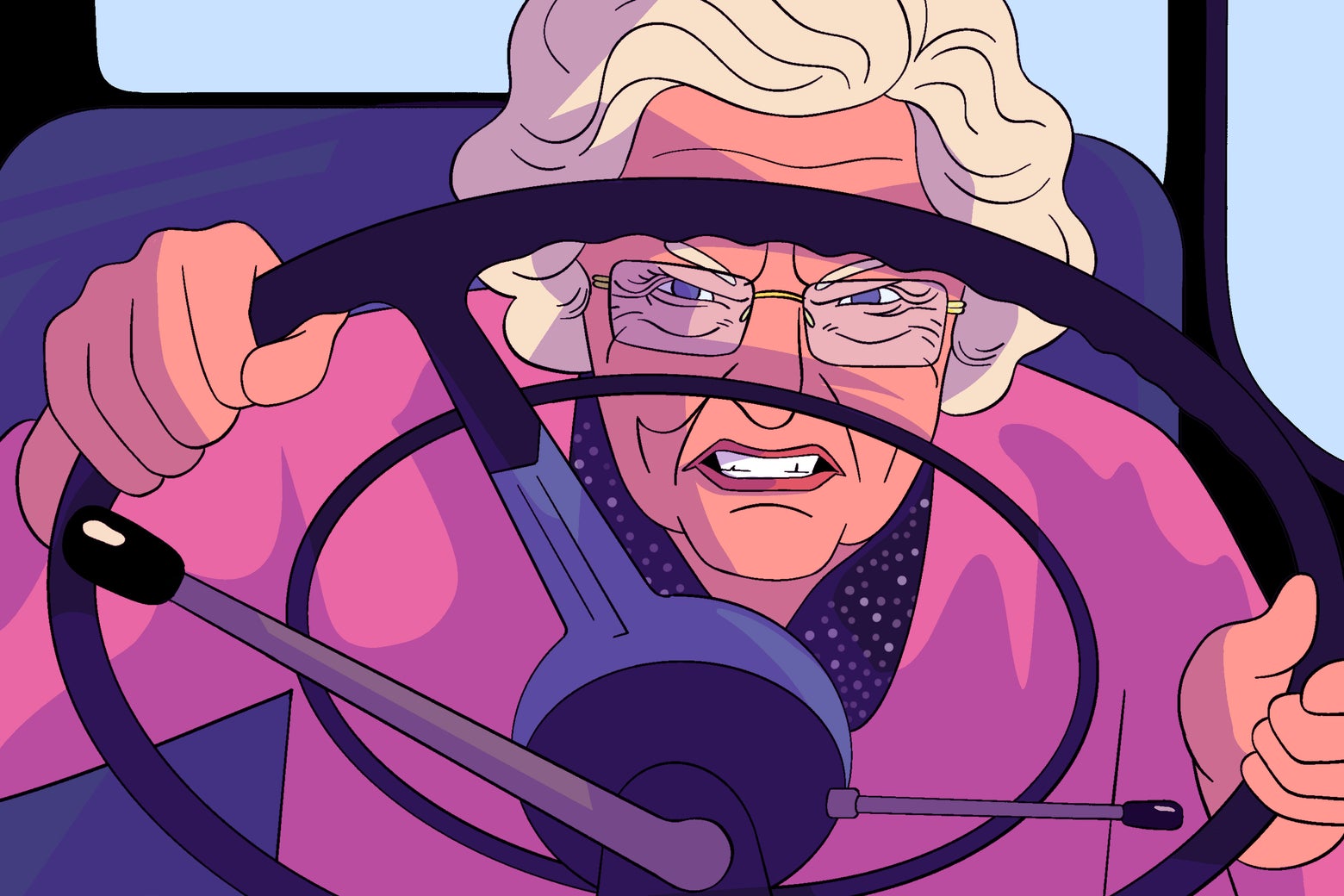
Family The Old and the Furious As Americans live longer than ever, car crashes involving elderly adults are on the rise. The question is what to do about it—and how many more deadly accidents it will take for us to act. For Daniel Adams, the matter was simple: His 83-year-old father, Richard, was no longer fit to drive. This conclusion didn’t come to him in a single thunderclap epiphany, but rather as a body of evidence that accrued over months: the growing number of dings adorning his father’s vehicle; stories that filtered back to him about Richard’s propensity to doze off behind the wheel. The kicker came when the elder Adams, of Andover, Connecticut, fell asleep and sideswiped a utility truck that held a worker hoisted in a bucket. “You’re going to kill somebody,” Daniel said in a conversation in which he demanded his father hand over his car keys. “If you want to kill yourself, that’s up to you, but you’re gonna hit somebody else.” Daniel, an auto mechanic, backed up his ultimatum: Surrender your license or I’ll disable your car. What ensued may be familiar to anyone who has had this difficult dialogue: There was some grumbling, some filibustering, some concern over the ramifications of losing his independence. Richard haggled and they struck a deal: He would only drive in the morning, when he was in his most wakeful state. Daniel relented—“foolishly,” he says now. Not long after that, his parents went to lunch in a nearby town. Heading home, about two miles from their house, Richard nodded off and the car careened off the road. The ensuing crash killed Richard and injured Adams’ mother, Geraldine, so badly that Daniel didn’t recognize her in the hospital. “My folks were totally stubborn and would always think that it couldn’t happen to them,” he says. Cold comfort though it is, Adams at least had broached the difficult topic; staying silent when he knew what he knew would’ve gnawed at his soul. It’s been a decade and a half since his father’s death, but Adams remains alive to the lessons of the tragedy: “It’s up to families to decide the difficult task of taking away vehicles,” he says. “If I had not had that conversation with my dad, I’d feel responsible for it to this day.” Richard was the only person who perished in the crash, but that’s not always the case. This February, in Los Angeles, a 92-year-old woman slammed into a cyclist, then careened into a 99 Ranch Market store, killing three people and injuring six others. A witness said the car appeared to accelerate after hitting the cyclist, and investigators were looking into the possibility of pedal error—confusing the gas for the brake. In Nashville, Tennessee, in August, an 87-year-old driver named Thomas Cahill ran a red light and struck a vehicle carrying Timothy Wedlock, 58, an Australian tourist who died in the crash. Witnesses said the vehicle showed no signs of braking. And in April, 76-year-old Zhuo Ming Lu was arrested on suspicion of vehicular manslaughter in San Francisco for his involvement in a crash that killed Cutberto Zamora-Martinez, 49. Police said Lu was trying to park when his vehicle jumped the sidewalk and crashed into a restaurant. And so on. The number of serious accidents involving elderly drivers has become so glaring that the Onion weighed in, running a satirical story in September headlined “Nation’s 93-Year-Olds Announce Plan to Crash Car Into Side of Bank.” Many experts believe the foreseeable if unintentional dangers associated with older motorists will only rise in the years ahead. A demographic tsunami is coming for America’s roads. To understand the scope of what lies around the metaphorical bend, consider the numbers. In 2022 there were about 58 million Americans 65 and older, comprising about 17.3 percent of the nation’s population, the U.S. Census Bureau reports. That number is projected to surge by 33 percent, to 77 million, by 2034. By 2050, the number of seniors will reach 82 million, at which point they’ll make up nearly a quarter of the American population. The Census Bureau projects that by 2029, older adults will outnumber children under 18 for the first time in U.S. history. Medical advances and improved lifestyle habits are allowing Americans to extend their lifespans to unprecedented lengths, but their longevity is making roads, and even sidewalks and parking lots, more perilous for everyone. As Adams’ situation vividly demonstrates, neutralizing that threat is not as simple as asking your parent to hand over their keys. For millions of older Americans who live in areas with limited or no public transportation, many elemental facets of life require the ability to drive, from shopping for groceries to socializing with friends and family to visiting a doctor’s office. At the same time, the demographic realities are such that public health officials and policymakers can’t just cover their eyes and hope for the best. While chronic disease management has improved dramatically, the cognitive and physical realities of aging have not changed, and a significant gap has opened between how old people feel and how well their reflexes and cognitive and sensory capabilities can perform. Many older adults buckle up behind the wheel despite an array of medical limitations, including diminished eyesight, slower reaction times, and a reliance on pharmaceuticals that can make them drowsy or otherwise compromised. But safety officials and policy advocates pondering how to make roads and parking lots safe must navigate a matrix of cultural and political complexities surrounding the trend. “It’s a critically important issue, and it will become more of an issue in the coming years, as folks live longer,” says Adam Snider, director of communications for the Governors Highway Safety Association. The question is what to do about it—and how many more crashes will occur before we can agree on an answer. The news is not all dire. In 2024, about 86 percent of Americans age 70 and older held valid driver’s licenses, according to the Insurance Institute for Highway Safety. Increased longevity, better general healthcare, and the desire to hang on to freedom and agency—not to mention a genuine need for transport—have combined to keep older Americans independent and able to look after their own needs longer than previous generations could manage. Aimee Cox, the IIHS’s lead researcher on older drivers, says that the number of accidents involving this group peaked in the 1990s but has since declined, even as the population ages and drives more miles than in the past. “At this point, I would say the historical fears that have been in place, that we have all these aging older adults and historically they crash more, just did not come to fruition,” she says. Much of this is attributable to improved crash-avoidance and driver-assist technology that has gradually transformed motor vehicles and their capabilities, she says. But crash rates don’t tell the full picture. In 2024, overall U.S. traffic fatalities declined by 3.8 percent, to about 39,345 deaths, according to National Highway Traffic Safety Administration data. That sounds like progress until you look at who’s dying. Among drivers and passengers age 65 and older, fatalities increased by 2 percent, to 8,019 deaths; in 2010, there were 5,524 deaths in that cohort. Mature motorists now account for more than 20 percent of all traffic deaths despite driving a smaller share of overall miles. The Centers for Disease Control and Prevention report that on an average day in 2022, 25 adults over age 65 were killed in traffic crashes. (An AARP spokesperson declined to comment for this story.) Bar graphs that show the rates of fatal crashes are U-shaped, with the highest numbers generated on one end by teenagers and on the other by drivers over 80. The bottom line is that even with today’s safer, more crash-avoidant cars, older people are dying at a higher rate on American roads. What’s more, the government data doesn’t account for crashes like the two fatal incidents in California. When accidents occur on private property, like parking lots, local police are not required to report their data to the federal government. This is a significant void in the overall picture of vehicle safety; the National Safety Council estimates that as many as a quarter of the nation’s car accidents takes place in parking lots. “Remember that older drivers self-retire when it gets dark, or long trips, but everyone goes to the grocery store,” says Rob Reiter, a safety and security specialist with expertise in retail and pedestrian safety. Reiter is co-founder of the Storefront Safety Council, a collaborative research and advocacy organization founded in 2012 to prevent vehicle-into-building crashes and protect pedestrians around commercial, public, and retail spaces. The SSC maintains the only comprehensive national database of such crashes; he estimates that these incidents occur at a rate of more than 100 per day nationwide. About 2,600 people are killed and 16,000 are injured annually in storefront crashes, according to his data. Nearly 40 percent of the drivers responsible for these accidents are over the age of 60, and many blame pedal errors. For drivers of that age, “our data is showing that pedal error and pedal misapplication are through the roof,” Reiter says. “The number of times when I get a police report where a 96-year-old man sitting inside a donut shop was killed when a 98-year-old man drove his car through the window—you would be shocked how many of those I see,” he adds. Regardless of how you parse the vast seas of data, this much seems clear: As car technology and safety improve, virtually every category involving road safety is improving. Deaths involving older drivers—as the casualty, the cause, or both—are going in the wrong direction. A New Jersey woman we’ll call Susan Hansen is all too familiar with the potential for elderly drivers to do damage. Her father-in-law, a Princeton resident we’ll refer to as Henry, is 92 and still driving. New Jersey has no testing requirement for license renewals, so when his license expired when he was 90, the state automatically issued a new one. Princeton is a demanding place to navigate—there are hordes of pedestrians and cyclists—and in June, he hit the back wheel of a teenager’s bicycle passing through an intersection. Henry stepped out of the car to assess the situation. Although the bike’s wheel was mangled, the youth was uninjured, so Henry drove off. The car was registered to Susan, so the police called later that day; Henry was ticketed and his license was suspended for 30 days. The motor vehicle bureau later required him to undergo a medical test to determine whether he was still fit to drive. Henry’s physician, finding no clear evidence that Henry’s capacity to drive had deteriorated, repeatedly looked to Hansen during the appointment. She intuited that he was trying to understand the family’s preferences. It was a challenging moment. “I looked at it as, boy, this could have been a tragedy, and it wasn’t,” she says. “So let’s not make it a tragedy—or cause a tragedy.” Henry is still sharp mentally, and Hansen and her husband trust him to navigate local roads and to limit himself to daytime driving—both of which he has promised to do. She told the doctor as much, and Henry kept the license. “If I didn’t trust him,” she says, “and I thought he was going to go out and drive [at night] and do all that stuff, then I would have had to been more like, ‘Nope.’ ” Henry says he needs the license as identification and worries he may need it for his senior housing, but Susan thinks the deeper reason is psychological: Surrendering it would symbolize aging, dependence, and becoming a burden to family. Losing the ability to drive can be mentally and logistically devastating. Loss of mobility means a loss of agency, and sometimes, community. A Columbia University study of the health and well-being of older adults after they gave up their licenses found that former drivers are 91 percent more likely to experience symptoms of depression than peers who continue driving. For some, it’s literally a matter of life and death: One study of the effects driving cessation has on the health and well‐being of the elderly found a 68 percent higher five-year mortality risk for non-drivers compared to those who continue driving. These mitigating factors make decisionmakers swallow hard before taking the keys away. Sean McGann was a lieutenant in the Eugene, Oregon, police department for 28 years. Before retiring, he oversaw the department’s Traffic Enforcement Unit and was a member of the city’s Vision Zero task force, which is part of a global effort to eliminate traffic fatalities while increasing the availability of transportation. He felt the push and pull of the elderly-driving issue: In rural areas with few public transportation options, people need a car to get around. As a result, he rarely ordered elderly drivers to take driving tests to hold on to their licenses. “It can be very isolating,” McGann says. “That’s why we took it very seriously when submitting drivers for mandatory retest.” But that kind of reluctance can be a problem. Urban planning and sustainability writer Lloyd Alter points out that our car-centric American culture treats driving as a permanent right rather than a time-limited capability. We all have a “drivespan”—the window of time in our lives in which we can safely operate a motor vehicle. Illustration by Tolga Akdoğan It’s the eyes that start to go first. Research from the National Research Council’s Committee on Vision shows that by age 65, the human eye takes in only about one-third of the light that a 20-year-old eye receives, making night driving substantially more hazardous. Contrast sensitivity (the ability to distinguish objects from similarly colored backgrounds) declines markedly. Peripheral vision narrows. Glare recovery slows. About 14 percent of adults over 65 have clinically significant distance or contrast vision problems that impair driving, according to University of Michigan research. It doesn’t help that the standard Department of Motor Vehicles eye test—reading the familiar, pyramidical chart that has remained unchanged in most states for decades—assesses only static central visual acuity, which is the ability to distinguish fine details and shapes when both the observer and the visual target are stationary and the observer is looking straight ahead. There’s no screening for contrast sensitivity (as in the ability to distinguish a gray or silver car up ahead of you on an overcast day), glare recovery (the ability to see clearly again quickly after being momentarily blinded by oncoming headlights), dynamic visual acuity (tracking moving objects), or peripheral vision. A study by the University of Michigan’s Institute for Social Research found that among adults 65 and older with known vision problems, like difficulty seeing at night or in poor weather, more than 25 percent stop driving within a year of diagnosis—but tens of millions with compromised visual capabilities continue driving without knowing they are impaired. There’s also the issue of reaction time. The “two-second rule,” a minimum safe-following-distance standard, states that a driver should not reach a fixed roadside object in less than two seconds before the vehicle in front of them passes it. For many drivers over 70, their actual physical and mental reaction time exceeds this window, meaning that if the car in front slams on the brakes, they may not have enough time to avoid a collision. For this reason, safety experts often recommend that older drivers increase the buffer to three or four seconds. But research shows that even drivers over 70 who allow for larger gaps on the road are 20 percent to 30 percent more likely to commit errors related to visual processing speed and spatial judgment at intersections. And as Reiter of the Storefront Safety Council’s research has suggested, pedal errors occur at a rate 13 times higher among drivers age 75 and older than among middle-aged drivers. Neuroimaging research has illuminated why this is the case. Results from fMRIs, which track brain activity in real time as a participant performs a task, have found that elderly drivers show significantly higher activation in the left dorsolateral prefrontal cortex when performing pedal-switching tasks than younger drivers do—meaning their brains are working much harder to do what should be automatic. The brain is compensating for declining automaticity, and that compensation has limits. Then there are the increased odds of mild cognitive impairments and the possibility a medication—including common drugs like antihistamines, muscle relaxants, and some blood pressure meds—is interfering with their ability to drive safely. From 2015 to 2017, the AAA Foundation for Traffic Safety sponsored a study of nearly 3,000 elderly drivers; the Longitudinal Research on Aging Drivers found that 69 percent “are taking large quantities of medications that may affect their driving safety.” Ten percent said they used five or more “driver-impairing medications.” All of these factors combined could become a force multiplier, turning someone who looks like they are basically OK on the exam table into a danger on the road. But it’s not just that we care about the well-being that driving can afford the elderly—the elderly are also a formidable voting bloc. Few lawmakers are lining up with torches and pitchforks to get them off the roads. Thirty-seven states and the District of Columbia have enacted some form of special requirements for older drivers. But it’s a Whitman’s sampler of legislation: California requires eye tests for license renewals beginning at 70, whereas Florida doesn’t mandate vision tests until residents reach the age of 80, then only requires renewals every four years. Six states—Alabama, Connecticut, Mississippi, Pennsylvania, Tennessee, and Vermont—have no such age-based requirements. This patchwork of regulations is inconsistently enforced, and in most states has not been updated in decades. In fact, in 2025, the Illinois state Legislature voted unanimously to raise the age at which drivers must pass a road test—from 79 to 87, essentially cordoning off the parts of the issue that don’t fit what lawmakers wanted to see. Bypassing concerns about the possibilities of diminished cognition and reflexes, the state will allow drivers ages 79 to 86 to skip a mandatory road test and pass only an in-person vision test when renewing their licenses; now, only drivers ages 87 and older must pass a road test. It’s telling that even with these changes, Illinois boasts of still having one of the nation’s strictest set of renewal requirements. Few others states are making noises about change. In Michigan in 2024, a 94-year-old driver rear-ended a woman in traffic; when the woman exited the car to inspect the damage, the driver struck and killed her. “It became kind of shocking to me that a then-94-year-old still had valid driving credentials and that that had never been tested,” the victim’s husband, Christopher Thexton, told CBS. He contacted state Sen. Rosemary Bayer, who in turn introduced legislation that would require driving tests every four years for drivers age 75 and older, and annually for drivers 85 and older. The bill has not passed, and Bayer did not return a message from Slate seeking comment. Already visible on the technological horizon, of course, are self-driving cars, which carry the potential to obviate many of the limitations older drivers face. Mark Needham (not his real name) lives on the fringes of Charlottesville, Virgina. He is 82 and still active: He practices yoga at a local health club, engages in a glassblowing hobby, and dabbles with technology. He and his wife, 80, have lived in the same subdivision for 40 years, and while she’s wrestling with several health issues and is ready to move into a retirement facility, he’s adamantly opposed to it. “My wife is more inclined to being taken care of,” Needham says.“I’m more inclined to be doing stuff.” Part of what allows him to maintain his independence: a Tesla that over his two-plus years of ownership has morphed, via a steady stream of software updates, into a largely autonomous vehicle. (Many reviewers and experts still cite the need for improvement with tasks like changing speeds and parking before use becomes widespread.) “It drives better than I drove 30 or 40 years ago,” he says. Needham, who has had surgery that limits his peripheral vision, says he would probably still be driving even without the Tesla, but would be apprehensive of numerous scenarios that 20 years ago wouldn’t have bothered him. As we spoke, the couple was on the verge of a 150-mile round trip to Richmond to view some gardens—a trip they wouldn’t embark on without the self-driving car. The same is true of going out to dinner at night. “Being able to get in a car and be chauffeured by a much more competent-than-average driver is the ultimate luxury now,” Needham says. But he concedes that if it was up to his wife, they wouldn’t have gone anywhere near a Tesla, and she’s been resistant to learning about operating it. “The things I find natural and exciting, she finds unnatural and threatening,” he says. Needham adds that adoption rates of this type of vehicle are low, even among people decades his junior. “Most of the people I deal with are a good deal younger than I am—in their 40s and 50s—and they don’t get it,” he says. That’s one reason experts worry about the nation’s demographic trends and what they’ll mean for our roads. Reiter estimates that it will take 15 years for self-driving technology to evolve on the necessary scale—autonomous cars are expensive; finding a charger can be a headache in some parts of the country—and for resistant older drivers like Needham’s wife to buy in. “The most dangerous time in that 15 years is somewhere between year three and year seven,” he predicts, “because all the big trucks will have changed over, but the resistant people won’t, and so now you have self-driving everything trying to interact with random chaotic people who are driving themselves.” But something has to give; the nation will in some way have to evolve. Because over the next 15 years, the nation will be graying at a rapid rate, and the roads otherwise will become that much more hazardous. Until self-driving cars become as ubiquitous and widely embraced as cellphones, the key for older Americans staying safe on the road may come down to something simple: self-awareness. Think of it as recognizing your own drivespan. David Kravet, who turns 87 in November, is a former elementary school principal and executive recruiter who lives alongside 300 other seniors in a retirement community in Bloomfield, Connecticut. He is social enough to know what his neighbors are up to, and hearing about their driving habits bothers him. “You see people who have given up their licenses, and people who are not going to give up their licenses,” he says, “and it’s disturbing to see people who shouldn’t be driving out there driving.” One friend recently plowed through the front of a Dunkin’ when she mistook the gas pedal for the brake. Another was recently ticketed for driving too slow on a local interstate. He doesn’t need his kids to sit him down for The Talk. Kravet is self-aware enough that he’s already made difficult choices. He recently stopped driving to the Goodspeed Opera House, which requires an hourlong drive in darkness in the colder seasons. His reasoning: “Being blinded by a car coming toward me, and not feeling comfortable, and then saying to myself, ‘Do I really want to drive an hour with my hands on the wheel so tight [because] I’m afraid of what’s going to happen?’ ” Similarly, he no longer ventures to the Mohegan Sun casino—another favorite spot about an hour away—unless he stays overnight. How will he know when to completely surrender his license? He has an unusual metric. He says he swapped a treadmill for walks outside because he had become too distracted by birds and the overall surroundings to proceed safely with less reliable balance. He will make the same accommodation for operating his car. “When I’m driving, if I find myself as distracted as I am walking, I’m going to stop,” Kravet says. “Certainly, I don’t want to do harm to myself, but I definitely don’t want to do harm to other people.” He believes states should require batteries of tests for people his age—vision, driving skills, and whatever else is deemed necessary—even if it meant losing his own freedom. “It’s not a happy thing,” he says. “And if it happened, I’d be complaining just like everybody else. But it’s probably the right thing.” But when Kravet’s license expires in 2027, he expects to go into the local AAA office and obtain a new one, no questions asked. Kravet knows he’s fortunate: His senior center will drive him anywhere within 20 miles. For the countless numbers of seniors who live alone in this moment in time, with no transportation options and no family to shuttle them to their necessary stops, getting behind a wheel and hoping for the best will be their only option. Additional reporting by Lloyd Alter. Family Health Health Care Self-Driving Cars Transportation Cars
Driving Hell Is About to Break Loose on American Roads. Each and Every One of Us Needs to Understand What’s Coming.
Full Article
Original Source
Read the full article at Slate →KhanList aggregates and links to publicly available news content. We do not host full articles from third-party sources. Always verify important information with original sources.