
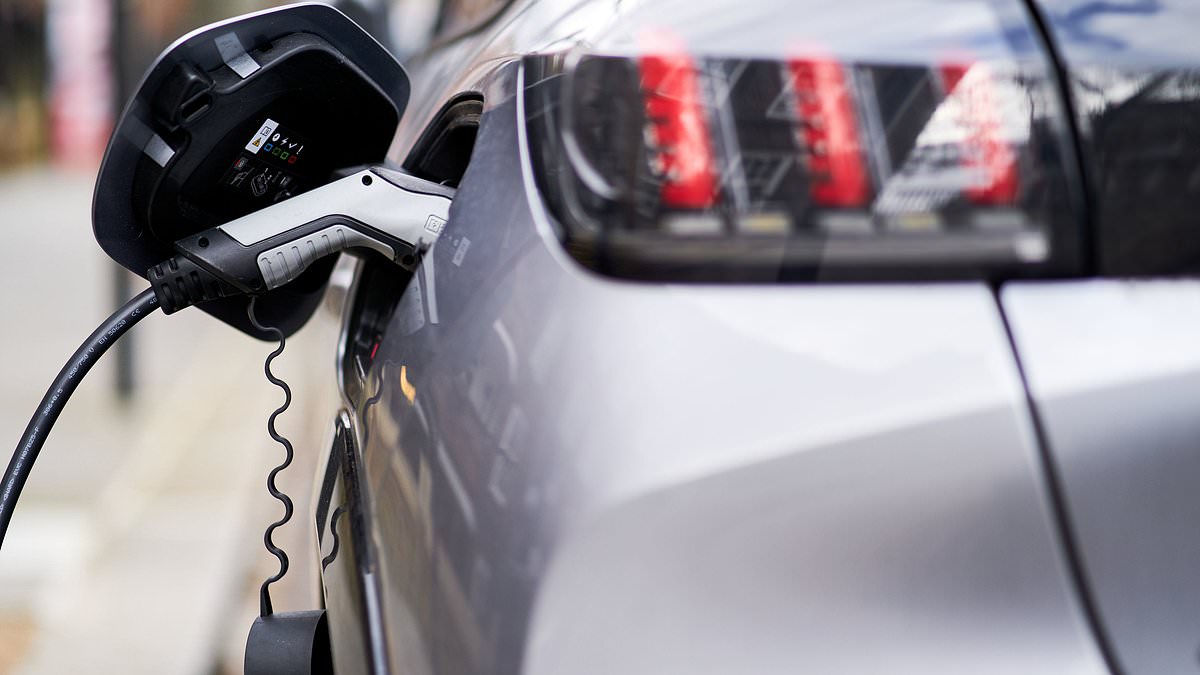
Drivers in Scotland are facing an ‘EV rip-off’ as rising prices mean electric cars can now be more expensive to run than petrol models.Many motorists switched to electric vehicles (EVs) on the promise that, as well as improving the environment, they would also be more economical.However, a new report has highlighted that drivers who rely on the public network of Rapid and Ultra-Rapid chargers can find themselves paying up to 24p per mile.By comparison, many petrol cars can be run for as little as 15p per mile.Now motoring groups have warned that Scots in particular are being hit with the highest tariffs because many live in flats and can’t charge their EVs at home.Experts agree the best way for drivers to reduce costs is to charge their cars overnight on a private driveway, using a slow but cheap domestic charger.In Scotland, though, a higher proportion of households, more than half, do not have access to their own driveway so can’t take advantage of low-priced overnight charging.Last night, campaign group the Alliance of British Drivers said many Scots EV owners felt lied to about the cost of going electric.A spokesman said: ‘We were promised that EVs would deliver cheaper motoring. But that hasn’t turned out to be entirely true. The cost of charging an EV can be greater than running a petrol model‘Many drivers are facing an EV rip-off and for Scots it’s even worse than for people in other parts of Britain.’The UK Department for Transport recently published a review into the ‘Cost of Public Electric Vehicle Charging’, which pointed out that, although costs for home charging are relatively cheap, tariffs for high-power public chargers have almost doubled since 2021.It noted: ‘Drivers who cannot charge at home are reliant on the public network, where prices have increased significantly.‘And while EV drivers with access to home charging will save considerably versus refuelling an equivalent petrol vehicle, cheaper running costs are no longer a foregone conclusion for those charging on the public network.’According to the Scottish government’s House Condition Survey, approximately 1.3million households (around 52 per cent of all dwellings) don’t have a private driveway or dedicated parking space on their own plot.As a result, thousands of Scots EV drivers depend on public chargers, so must choose between ‘cheap but slow’, or else ‘quick but very expensive’.Data provided for the Scottish Mail on Sunday by Zapmap, the UK’s leading charge point platform, shows the scale of the problem.In Scotland, almost all charge points are now operated by private firms after the Scottish Government phased out its state-run and heavily-subsidised ChargePlace Scotland charger network.Overall, there are 13,064 EV chargers currently available to the public.Of these, 9,623 are AC chargers rated as Standard or Standard Plus. Typically found on-street or in residential car parks, these cost 12-16p per mile but take between six and ten hours to provide a full charge.The remaining 3,441, more than a quarter, are Rapid or Ultra-Rapid DC chargers, which are typically found on A-roads, motorways, petrol stations and at forecourt-style hubs. These can provide a full charge in 10-60 minutes. But at a cost of around 24p per mile, they are far more expensive than refuelling the most popular petrol vehicles.Even after recent increases pushed the price of petrol to 170.5p per litre, a Ford Puma can run at 15p a mile, while a Nissan Qashqai or Kia Sportage can run at 17.6p a mile.The Department for Transport report explained that the soaring cost of charging was now discouraging people from buying EVs.It said: ‘The cost of charging away from home has risen sharply and is likely to keep rising. That matters for every driver, but especially for people who cannot charge at home and are already facing wider cost-of-living pressures.’It added: ‘At today’s prices, those charging in public pay on average at least twice the total costs of those who can charge at home... Public charging prices are now regularly cited as a barrier to EV ownership, in particular for those who cannot access cheaper overnight domestic charging tariffs.’To make EV ownership cheaper and fairer for people without access to a private driveway, the report recommended the widespread introduction of local on-street charging hubs where people could charge their vehicles near their homes overnight, with a capped tariff equivalent to a cheap domestic rate, allowing them to run an EV for around 8p a mile.In last month’s Budget, the UK government acknowledged that ‘higher public charging costs risk slamming the brakes’ on EV uptake. Ministers pledged to set up a taskforce to explore ways of implementing the recommendation for lower local tariffs, and also committed to spending £100m from next year on reducing charging costs.Last night Transport Scotland said grants were available to help people without driveways install EV chargers.A spokesperson said: ‘For households without access to a driveway, the Scottish Government funds the Cross-Pavement Charging Grant, which provides grants of up to £3,500 towards eligible cross-pavement charging solutions, such as cable gullies, helping residents access convenient and affordable home charging using domestic electricity supplies.’The Cross Pavement Charging Grant is available where the relevant local roads authority permits such installations, with decisions on individual applications remaining a matter for local authorities, which are responsible for approving cross-pavement charging arrangements in their area.
Drivers facing 'EV rip-off' as rising prices mean electric cars can now be more expensive to run than petrol models
Full Article
Original Source
Read the full article at Dailymail →KhanList aggregates and links to publicly available news content. We do not host full articles from third-party sources. Always verify important information with original sources.