
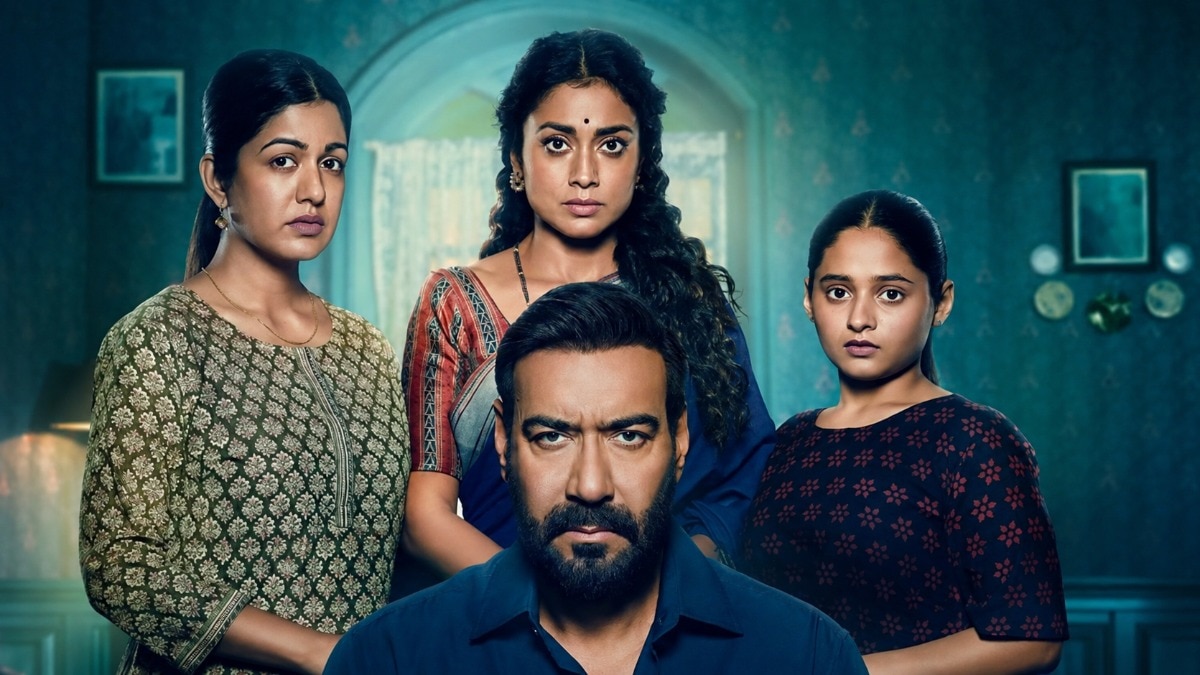
One thing is clear in Drishyam: The Conclusion: no matter how things pan out or how strong the adversary is, Vijay Salgaonkar is always miles ahead of it all. A fourth-dropout family man will do anything to protect his family from the law, even if it means making the trickiest and most unbelievable tropes look plausible to the audience. At least, that's what appears to be happening in Drishyam 3, the last instalment of the popular thriller franchise.You see, Drishyam 3 is not a perfectly made thriller. It has its problems. What works for it is also what works for Ajay Devgn's Vijay: the fact that, at the end of it all, the man who committed the crime will be celebrated as the hero. In the third instalment, though, that victory doesn't come as smoothly as it did in the first film, or even the second.The longer you sit with the story of the third film, the more questions emerge - some pointing to glaring investigative errors in the plot, and others simply looking like attempts to rush the story towards a convenient conclusion.It all starts with the very evidence that Jaideep Ahlawat's Rajveer Singh Tomar uses to reopen the case. A seemingly solid piece of forensic evidence proves that Sameer Deshmukh's DNA was found in the very soil of the then under-construction police station. Yet, it is barely investigated. If Sameer's body was never buried at the police station and the skeleton recovered from the location belonged to someone else, then what was Sameer's DNA doing in the soil?Such a crucial piece of evidence could have changed the course of the trial, or at the very least, given the prosecution more reasons and more time to investigate Vijay Salgaonkar and his family. Instead, it is used to reopen the case and then almost forgotten. Something similar happens with the other DNA evidence.In Drishyam: The Conclusion, Rajveer and his team run from pillar to post trying to match the DNA of the skeleton found buried at the police station. The skeleton has been lying in the evidence room for years. Now that Rajveer takes over, he wants to establish one thing: if the body discovered at the police station wasn't Sameer's, then whose was it?He sets up an entire team, which spends days collecting DNA samples from suspected families across Goa. Eventually, they find a match. The skeleton belongs to Christopher Pinto, a young man who died after suffering a head injury. But then what?The police use that evidence to obtain the court's permission to dig up Pinto's grave at St Andrew's Cemetery. And that's where things start getting strange.Because the fact remains that the skeleton in the evidence room is Pinto's skeleton. It doesn't really matter, at that point, who is lying inside Pinto's actual coffin. There cannot be two skeletons with the same DNA.If investigators have already established that the body recovered from the police station belonged to Pinto, then even if they find another skeleton inside his grave, the forensic evidence identifying the police-station skeleton as Pinto's still stands.Yet nobody seems to make that argument in court.How did Pinto's body end up at an under-construction police station? Why did the investigation not pursue that question more aggressively? Why didn't the prosecution use the forensic evidence to establish that Pinto's skeleton had no business being at the police station? And when they eventually found another skeleton inside Pinto's coffin, why wasn't that skeleton immediately subjected to a DNA test?And while we're at it, let's talk about how many ways there were to conduct that DNA test.Because, if you've come this far, you clearly don't care about spoilers. So here's the biggest one, and you need it to understand the problem.We know that Savio, the cemetery caretaker, and Vijay know that the skeleton found inside Pinto's coffin is fake. It is a prosthetic structure created by one of Vijay's contacts in the film industry. To the naked eye, it looks real. Fine.But is it really so difficult to believe that Rajveer - a man portrayed as being almost as sharp and future-sensing as Vijay himself - wouldn't find one quick way to take a sample from the skeleton and have it tested for Pinto's DNA?It's almost the Titanic moment all over again. There were several ways Jack could have survived alongside Rose on that piece of wood. The audience could see the possibility, but the characters didn't. Something similar happens in Drishyam 3.The entire first half of the film gives you an extreme build-up of Rajveer. We are repeatedly told just how formidable he is. He calls himself 'Shani' for a reason - because once he enters someone's life, he stays there for years and doesn't leave without wreaking havoc. He is fearless, determined and unlike any cop Vijay has faced so far.Which makes it difficult to accept that a man of his magnitude couldn't find a single way to sneak a sample from the skeleton while the chaos was unfolding at the cemetery.This is the same man who thought of testing the soil at the police station for Sameer's DNA. A man who thinks that deeply should be able to think quickly when it matters most.Then there are the many acts of convenience. The story, especially in the second half once the trial begins, seems increasingly dependent on chance rather than facts.Rajveer is stuck in a high-level meeting at police headquarters just when the case begins. He misses the entire court proceeding - the very trial he worked so hard to make happen. Then, suddenly, he leaves the meeting midway and rushes to the cemetery.If it was that easy for him to walk out of the meeting, why couldn't he have done it earlier and attended the trial? Vijay, after all, is sitting in court and dismantling one prosecution argument after another without even having to do much.And then comes the post-trial sequence, where Rajveer begins piecing together how Vijay fooled everyone, including the court.It takes him just a few seconds to realise that Vijay's voice on the tapes submitted and played in court was pre-recorded. Within minutes, he figures out how Vijay managed to create the illusion that he was home on the night of July 23.Rajveer listens to the recording and immediately understands that Vijay's family staged his homecoming that night. Which makes the earlier question even more interesting.If Rajveer is smart enough to identify that loophole within minutes, why wasn't he in the courtroom when the recording was played in the first place?And then there's Indrajeet Shetty, the big-shot lawyer who hasn't lost a case so far. He simply goes ahead and presents the recordings in court. Just like that?No pre-checking? No verification? No expert who could have assessed the recording before the prosecution decided to use it as a crucial piece of evidence?It is fair to assume that a lawyer of Shetty's stature would have an entire team researching his case, building arguments and scrutinising every piece of evidence. Yet somehow, nobody thinks to authenticate the recording or question whether Vijay's voice was actually recorded on July 23.Too many chances, you see.This is not to say that Drishyam 3 isn't a complex thriller. The film delivers genuine moments of surprise and suspense, particularly in the courtroom sequence involving Vijay's wife, Nandini Salgaonkar.She sets up a trap for the prosecution by hinting at the surveillance tapes, making Shetty believe that there is a chance to win it all by simply presenting the recordings and proving that Vijay wasn't home on July 23 - that he was actually away exchanging the bodies. It's a masterstroke. You don't see it coming.But all of the above stands too: there are too many moments of convenience and too many chances for the characters to have figured things out, when the story demands that they don't.Drishyam: The Conclusion ends the franchise on a high, leaving behind several iconic characters for Hindi cinema audiences to cherish, including Laxmikant Gaitonde, played by Kamlesh Sawant. The film keeps you guessing and throws one twist after another at you - which is exactly what a good thriller is supposed to do.It just asks you to overlook quite a few questions along the way.The film also features Tabu, Rajat Kapoor, Ishita Dutta and Mrunal Jadhav in important roles. It has already crossed the Rs 300 crore mark worldwide in four days, with weekday business also looking promising.Drishyam: The Conclusion, directed by Abhishek Pathak, is currently running in theatres.- Ends
Drishyam 3 loopholes: Glaring errors in Vijay Salgaonkar's story you can't overlook
Full Article
Original Source
Read the full article at Indiatoday →KhanList aggregates and links to publicly available news content. We do not host full articles from third-party sources. Always verify important information with original sources.