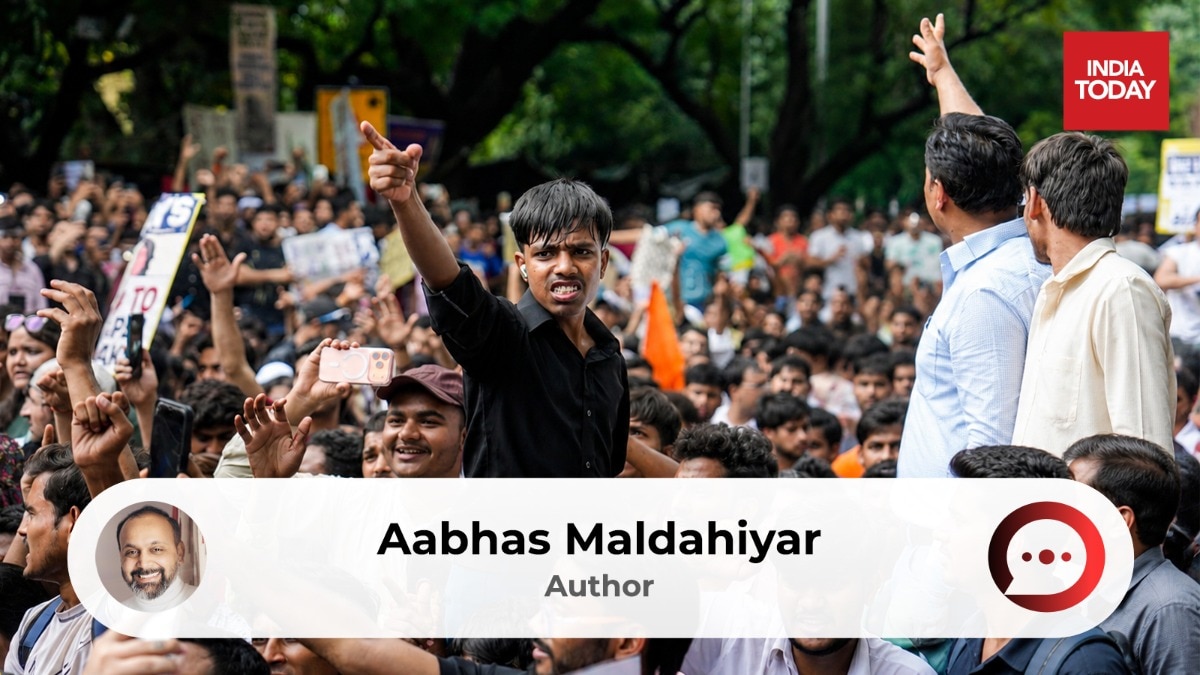
Dreams are perhaps the oldest inheritance of every living creature. They compel a bird to weave its nest, a lion to hunt, and a seed to split through rock in search of sunlight. Human beings are no different. We merely dream on a grander scale. For hundreds of thousands of young Indians, examinations like NEET embody that dream.A few hours inside an examination hall are preceded by years of relentless discipline. Behind every candidate lies a story of sacrifice. Parents overtime mortgage farmland, sell jewellery, take loans, and quietly deny themselves comfort, so their children might secure a medical seat. In countless homes, becoming a doctor is no longer one child's ambition, it is an entire family's hope for dignity, stability, and social mobility.A compromised examination tells every honest student that years of perseverance may count for less than a criminal network. It suggests that while some spend sleepless nights mastering biology, chemistry, and physics, others may purchase opportunities through corruption or organised fraud. Few things corrode a nation more deeply than the suspicion that merit has become negotiable.The outrage that followed was therefore inevitable. In a healthy democracy, governments should not fear such anger. Students were justified in demanding answers, parents in seeking accountability, and the Ministry of Education owed the nation an urgent, credible response. For many aspirants, the deeper wound was not merely that the examination had been compromised, but that reassurance arrived only after uncertainty had taken root. Yet the crisis extended beyond a paper leak. It exposed deeper weaknesses that have accumulated across India’s educational landscape. Policies have too often appeared reactive rather than visionary, while reforms have frequently generated controversy because they seemed inadequately explained or insufficiently prepared, allowing uncertainty to erode confidence in institutions meant to inspire it.Nothing illustrates this crisis better than the continuing debate over how India teaches its own history. Having spent years studying Timurid (wrongly called Mughal) history through primary Persian manuscripts, I have often disagreed with how medieval India has been presented in textbooks. In my view, episodes of conquest, persecution, temple destruction, and religious violence have frequently been softened, denying students a fuller understanding of the past. Read the third of Muldahiyar's three-part series here: Babur's sultanate: Parasite on a prosperous civilisation?But recognising that failure should never push us towards the opposite extreme. Nations do not mature by deleting uncomfortable chapters from collective memory; they mature by confronting them honestly. Every civilisation is shaped not only by those who built it, but also by those who threatened it. The courage of Maharana Pratap, Guru Gobind Singh, and Chhatrapati Shivaji Maharaj acquires greater meaning only when we understand the forces they resisted. Remove either side of that story and history ceases to educate — it merely flatters.My own experience reinforced this conviction. Earlier this year, my book 'Babur: The Quest for Hindustan' was effectively prevented from being discussed at the Bhopal Literature Festival. More troubling than the cancellation was the question that was repeatedly offered in its defence: Why should we even discuss an invader?The sentiment was voiced most forcefully by the Vice-Chancellor of Makhanlal Chaturvedi National University of Journalism and Communication. That question by him exposed a deeper problem. Universities exist to examine civilisation in its entirety, not curate comfortable memories. Their duty is to encourage intellectual honesty, not decide which historical figures deserve discussion. Concerned by what this reflected about higher education, I wrote to the Union Education Minister. My letter was never about personal grievance, but about a larger question: if the heads of universities themselves fear difficult history, what intellectual confidence are they preparing future generations to inherit?Sadly, these questions found few willing listeners. Challenging romanticised accounts of Timurid rule have rarely been fashionable, even when grounded in primary sources.Yet the NEET controversy demanded the nation's full attention — and rightly so. It was not merely an examination that had been compromised, but the dreams of hundreds of thousands of young Indians. They deserved justice, transparency, and an examination system worthy of their faith.For a brief moment, the country stood united behind them before things began to change. And, to be clear, I never trusted the intentions behind the movement, given the background of its leaders.What began, at least in the words of the movement's leaders, as a demand for fairness in examinations gradually evolved into something very sinister. Calls for merit, transparency, and institutional accountability slowly gave way to slogans that bore little connection to educational reform. Political grievances of every kind seemed to gather beneath the same banner, and the clarity that had once united students, parents, and citizens gradually dissolved into ideological contestation.Every protest carries an unwritten moral contract. Society supports a movement because it recognises the legitimacy of its grievance, and that support endures only while the movement remains faithful to the cause that first earned public trust. Once a protest begins pursuing objectives unrelated to its original purpose, its moral authority inevitably weakens.The greater tragedy was that a movement born in defence of merit gradually drifted away from merit itself. Not every NEET aspirant, however, responded in the same way. Most of them believed that the compromised examination had denied them a fair opportunity, but they quietly returned to their books. They revised forgotten chapters, corrected old mistakes, and prepared for the possibility of another examination. When the reexamination was conducted, many secured remarkable ranks. Their success neither erased the injustice of the paper leak nor excused the institutional failure that had made it possible. It simply demonstrated that the student community was never a single political bloc. While some chose to take to the streets, countless others chose the study table. Both choices were legitimate.What became difficult to defend was the gradual transformation of a movement for educational justice into a vehicle for abusive anti-Hindutva and anti-Modi rhetoric. As the agitation evolved, the language of reform steadily gave way to ideological confrontation and demands for transparency increasingly competed with slogans bearing little relation to medical entrance examination. The Prime Minister became the principal object of abuse, crude gestures were celebrated as resistance, and partisan narratives slowly eclipsed the issue that had first united students across ideological lines.A democracy has room for fierce criticism, uncompromising political disagreement, and electoral opposition. Those freedoms define the Republic. But democracy is strengthened when disagreement remains anchored in civility and purpose. There is a profound difference between dissent and degradation. Anger might be justified, but indecency never becomes a constitutional virtue simply because one is angry.This distinction matters because protest occupies a sacred place in a constitutional democracy. Independent India itself was shaped by public movements that challenged authority, and the Constitution protects free speech and peaceful assembly because its framers understood that governments must remain answerable to the people.Yet the Constitution recognises an equally important truth: no liberty can survive without order. On 25 November 1949, while presenting the Constitution to the Constituent Assembly, Dr BR Ambedkar warned that once constitutional methods become available, extra-constitutional methods lose their moral legitimacy. His enduring phrase — the "grammar of anarchy" — was not a rejection of dissent, but a warning against replacing constitutional institutions with permanent street mobilisation.That warning remains remarkably relevant as the Parliament is not merely another government building. It is the constitutional forum where the Republic resolves its disagreements while sitting together. Every law, budget, and constitutional amendment passes through its chambers, making it a space that belongs equally to those who voted for the government and those who voted against it.The terrorist attack on Parliament in December 2001 permanently transformed India's understanding of legislative security. It was not like any other assault on elected representatives, but on the constitutional continuity of the Republic itself. The security architecture that followed was shaped by bitter experience, and against that backdrop, prohibiting an unauthorised march towards Parliament on the opening day of the Monsoon Session cannot automatically be described as anti-democratic.Citizens are free to criticise governments, question police action, and challenge administrative decisions through courts and public debate. What no constitutional democracy can reasonably permit is an unrestricted attempt to converge upon one of its most sensitive institutions simply because those organising the march believe their cause is just. Every movement believes itself to be just; that is precisely why constitutional rules exist.Reports, videos, and police accounts suggest repeated attempts to breach barricades, followed by violent clashes that left hundreds of police personnel — including women officers — and several journalists injured. If protesters assaulted police officers or members of the media, those acts deserve unequivocal condemnation and the full force of the law.It was found that stones had been stockpiled for the confrontation, while reports pointed to an organised logistical network supplying the protest site. Some social media influencers publicly acknowledged receiving payments to amplify the agitation online, raising questions about whether parts of the mobilisation had become carefully orchestrated rather than entirely spontaneous.Among those reportedly attacked was ACP Vivek Prabhat, known for dismantling a Lashkar-e-Taiba conspiracy targeting Delhi's Chandni Chowk. According to police accounts, he narrowly escaped with his life after being surrounded by the mob. Journalists covering the protests were assaulted, while several women journalists alleged molestation and intimidation. Even in Mumbai, reporters faced humiliation simply for doing their job.One is compelled to ask: were these really the young men and women whose dreams had been shattered by the NEET paper leak? Were these the students seeking justice for a compromised examination? Or had the movement, by then, been overtaken by those whose principal objective was no longer educational reform but political confrontation? The conduct on display increasingly suggested the latter. In many places, the struggle for merit gave way to a campaign driven less by the future of students than by anger against Narendra Modi, the BJP, and Hindutva.The larger lesson extends beyond the events of a single day. The moment persuasion gives way to physical confrontation with constitutional institutions, a movement begins surrendering the moral authority that first earned public sympathy.Many of the organisations and voices that became the loudest champions of the NEET agitation had remained conspicuously silent when far more consequential questions concerning higher education demanded national attention. The University Grants Commission (UGC) Regulations had the potential to reshape the future of generations of students, yet they never inspired anything close to the nationwide mobilisation later claimed in the name of student welfare.The contrast is difficult to ignore. If the concern was truly the future of students, why was the outrage so selective? Was it because many believed the Regulations would disproportionately affect General Category students? Educational justice cannot become an instrument of political convenience. The moment principles are invoked only when they serve a preferred political narrative, they cease to be principles at all.Those who opposed the UGC Regulations understood this distinction. They did not demand the Education Minister's resignation or seek confrontation with the State. They challenged the Regulations through constitutional means. Their concerns were largely ignored, extraordinary justifications were offered in defence of the policy, and the matter ultimately reached the Supreme Court, where it faced its constitutional test.None of this diminishes the legitimacy of the students' outrage over the NEET paper leak. Their anger was justified, and they deserved justice. Yet one cannot help wondering how many of those who transformed the movement into a wider political spectacle had even heard of the UGC Regulations, let alone understood their implications. The irony is striking. Those who fought one of the most significant battles over higher education did so quietly, constitutionally, and effectively, without reducing the nation to perpetual agitation. Many were also among the first to demand accountability when the NEET paper leak came to light.The leak shattered the faith of lakhs of deserving students. No examination determining the future of an entire generation should ever again be compromised by criminal networks or administrative failure. That responsibility is beyond dispute.The Prime Minister's recent self-recorded message promising strict action against those responsible will reassure many. The resignation of the Education Minister may likewise be seen as an acknowledgement that public institutions must answer for their failures. The government's decision to withdraw cases against protesters, however, is of an altogether different character. I welcome the first two (with bags of salt), but the third should concern every Indian.Some uncomfortable questions remain. Why did reassurance and resignation arrive only after the issue became a national political flashpoint? When citizens challenged the UGC Regulations entirely through constitutional means, no comparable assurance came from the Prime Minister's Office. Even after my session at the Bhopal Literature Festival was cancelled following pressure from the Madhya Pradesh government, my letter to the Prime Minister received no response. Does a government hear the clamour of the streets more readily than the quiet conviction of constitutional dissent?An even greater irony persists: many who opposed the UGC Regulations were committed BJP supporters, while many who came to dominate the NEET agitation were among its fiercest critics. What message does a government send when constitutional engagement is met with silence, yet sustained street mobilisation secures political concessions and legal relief?A democracy must remain responsive to public opinion, but it must never become hostage to a street veto. India has faced this dilemma before. The farm laws were eventually withdrawn after prolonged protests despite many economists and agricultural experts believing the reforms were necessary for the nation. One may support or oppose those laws, but the constitutional question remains unchanged: should governments alter policy through Parliament or under sustained violent pressure from the streets?The decision to withdraw cases raises an even deeper concern. If those accused of assaulting police personnel, attacking journalists, or molesting women reporters are ultimately shielded from legal scrutiny merely because they participated in a larger agitation, what message does that send to every police officer who stood his ground, every journalist who risked reporting the truth, and every citizen who still believes the law applies equally to all? Accountability cannot become selective, nor should justice be negotiated under political pressure.Equally troubling is that some protest leaders, like terrorists, have reportedly continued to demand that all criminal cases be quashed, including those arising from allegations of violence, and have criticised judicial decisions refusing blanket relief. If a movement begins insisting that every participant, irrespective of individual conduct, must be immune from prosecution, it ceases to seek justice and instead begins questioning the very principle that the law must apply equally to all.Every generation inherits two responsibilities: to question authority whenever it betrays public trust, and to defend the constitutional framework that makes such questioning possible. The first gives birth to protest; the second preserves the Republic. India cannot afford to lose either.Before I conclude, a few questions must also be directed to the Leader of the Opposition in the Lok Sabha, Rahul Gandhi. Where was this constitutional indignation when peaceful protesters led by Baba Ramdev were dispersed in the dead of night? Where was it when citizens demanding justice for Nirbhaya faced lathi charges? Where was it when citizens opposed the UGC Regulations through constitutional means? If public memory is expected to forget these episodes, it underestimates the intelligence of the Indian people.And to Arvind Kejriwal, a humble reminder: not every public tragedy should become an opportunity for political harvest. Many still remember the promised dossier on the alleged corruption of the late Sheila Dikshit that never materialised. Many ordinary citizens, myself included, contributed hard-earned money believing a genuine political transformation was underway, only to discover that hope itself can be exploited.The saddest irony is that students who believed in books watched those who believed in barricades shape the outcome. A government that should have drawn strength from constitutional dissent instead appeared to bend before the theatre of the streets. That is not the lesson a Republic should teach its young. When merit must compete not only with corruption but also with anarchy, dreams cease to inspire, and nations quietly begin to decline.(Aabhas Maldahiyar is the author of Babur: The Quest for Hindustan)- Ends(Views expressed in the piece are those of the author)Published By: Avinash KateelPublished On: Jul 31, 2026 13:08 IST
Dreams were stolen and the Republic blinked
Full Article
Original Source
Read the full article at Indiatoday →KhanList aggregates and links to publicly available news content. We do not host full articles from third-party sources. Always verify important information with original sources.