
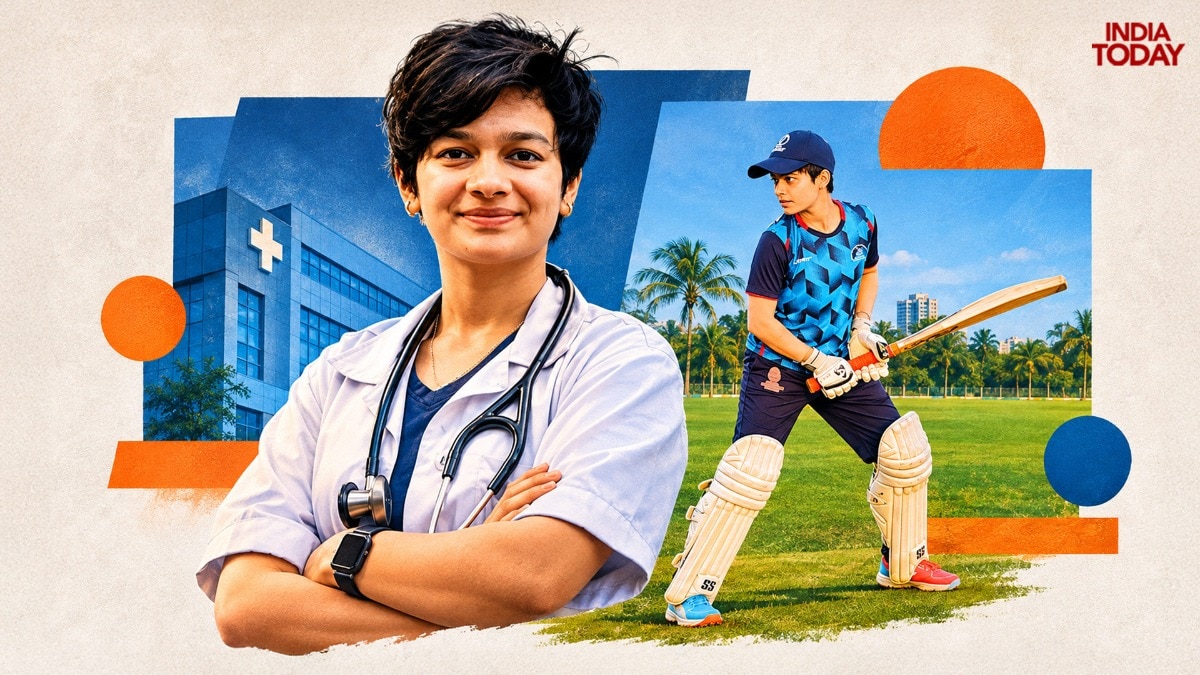
If you are a Bollywood fan, you might remember the 2024 Rajkummar Rao-starrer Mr. & Mrs. Mahi. In the film, Janhvi Kapoor's character, Mahima, gives up her medical profession, which she had pursued to fulfil her father's wishes, to follow her dream of playing cricket for India. It is the kind of transformation that makes for a compelling movie. But sometimes, real life comes up with stories just as extraordinary.From Pandharpur, a town in Maharashtra where opportunities for women in cricket were limited, comes the story of Dr Vedika Magar. Like many Indian children, she grew up with the expectation of becoming a doctor. She studied medicine, secured a government job and appeared to be on a conventional career path. But somewhere along the way, cricket became a dream she could no longer keep aside.Last year, Vedika took the courageous decision to leave her government job and pursue cricket professionally. It meant walking away from the security of a career she had worked hard to build and stepping into an uncertain future.The journey was not straightforward. She was named in Mumbai's domestic probables on three occasions but had to wait for her opportunity to come from elsewhere. In October 2026, that leap of faith brought her a special moment when she made her professional debut for Sikkim against Kerala in the Senior Women's T20 Trophy. Vedika's journey has been anything but conventional. Unlike many cricketers who come through the age-group system, she began playing professional cricket only at a relatively late stage. Her years were spent pursuing medicine, but the desire to play never really went away.THE DREAM SHE COULD NO LONGER PUT ON HOLD Vedika Magar began her cricket career at the age of 23. (Courtesy: Vedika Magar) After securing admission to Grant Medical College and Sir JJ Group of Hospitals in Mumbai, Vedika moved to the city to pursue MBBS. But even as she immersed herself in medical studies, she made sure cricket remained part of her life. "After securing admission to a government medical college, Mumbai, I moved there to pursue MBBS. I never lost touch with cricket, continued attending practice sessions and joined a coaching academy," Vedika told India Today in an exclusive interview.It was during her time in college that Professor Dr Hemant Gupta from the Department of Medicine noticed her playing leather-ball cricket with boys. He began guiding her and eventually asked her a question that would change the course of her life: did she want to pursue postgraduate studies or professional cricket?"He started guiding me and once asked whether I wanted to pursue postgraduate studies or cricket professionally," Vedika recalled."Playing professional cricket had always been my childhood dream, but I had never imagined it would be possible. My internship was underway, I had a government job through my bond, and I had several other responsibilities. However, his guidance made me realise that I had to take a chance."I did not want to spend the rest of my life regretting that I had never tested my potential or given myself an opportunity. I then joined coaching, started dedicating more time to cricket and began pursuing the game professionally."FOUR HOURS OF SLEEP AND AN UNSHAKEN DREAM Vedika Magar had to go through a demanding schedule to pursue her passion. (Courtesy: Vedika Magar) Pursuing cricket while working in the medical profession was far from easy. Hospital duties, long working hours and the demands of training left Vedika with very little time for rest and recovery."As you know, the medical field is not easy. You have to make sacrifices when it comes to sleep, recovery and everything else. It is not like having a six- or eight-hour shift. Sometimes, you have to work 12-hour shifts or even 24 hours. So, managing everything was quite difficult," she said."I used to practise for two to three hours and then go for duty, where I would have to work 12-hour shifts. Naturally, I wasn't getting enough time to recover. In fact, during my first year, I suffered a serious injury — a femur fracture — largely because I wasn't recovering properly."There were days when she had to squeeze practice into an already exhausting schedule. Night shifts became a way to make that possible."I used to take night shifts so that I could find time to practise during the day. I would work from 9 pm to 9 am, come back in the morning, sleep for four to five hours and then head out for practice in the afternoon. That was my routine for almost a year," she said."Balancing everything was the most difficult part because recovery and sleep, along with nutrition, are extremely important in cricket. These aspects were getting compromised."The initial phase was particularly challenging, but she gradually found ways to manage her responsibilities and devote more time to the game."The first couple of years were a little difficult, but eventually, I got used to the routine. I also managed to reduce my working hours and started focusing more on cricket."WHEN BELIEF MATTERED MOST Vedika Magar thanked her parents for immensely supporting her. (Courtesy: Vedika Magar) While Vedika was beginning to take her cricketing ambitions seriously, not everyone around her understood the decision. Having completed her MBBS and secured a government job, she was expected to follow the conventional route of pursuing postgraduate studies and building a career in medicine."Honestly, very few people believed in me or thought I was serious about pursuing cricket professionally. I was 23, had completed my MBBS and was working in a Class II gazetted officer-level position at a government hospital. So, when I decided to take up cricket professionally, people found it difficult to understand," she said."After MBBS, the conventional path is to complete your internship and compulsory bond service before pursuing postgraduate studies. My decision to choose cricket over postgraduation was unconventional, and there was considerable criticism. People kept questioning why I wasn't pursuing higher studies and doubted whether I could make it as a professional cricketer. Some even thought it was just a hobby or a phase, and that I was being delusional."At a time when doubts were coming from several quarters, her parents stood firmly behind her. Their support gave her the confidence to take a chance on a future that was far from certain."My parents, especially my mother and father, stood firmly by me. They told me, 'If this is your passion and playing cricket makes you happy, go for it. Even if you don't reach the highest level, at least you won't regret never having tried.'"Vedika believes that their faith in her helped her through one of the most difficult phases of her journey."I am where I am today because of their support and that of a few other people who kept encouraging me. Their belief helped me through a difficult phase. I want people to understand that it is possible to achieve what you dream of if you are genuinely passionate, willing to put in the effort and prepared to work hard for it."BALANCING TWO WORLDS, CHASING ONE DREAM Vedika Magar works as a team doctor for the Delhi Capitals women's team. (Courtesy: Vedika Magar) Eventually, Vedika realised that managing a full-time government job and pursuing professional cricket was becoming increasingly difficult. Despite having worked hard to establish herself in medicine, she decided to step away from the security of her position."I resigned from my government job about a year ago. It was a good position, but I decided to leave it for cricket because I just couldn't manage both. When you are working 24-hour duties, when do you get time to recover? When do you practise and when do you play cricket? It was becoming increasingly difficult," she said.She has, however, not completely moved away from medicine. Since 2024, she has been associated with the Delhi Capitals set-up in the Women's Premier League as a team doctor. The role has also given her an opportunity to remain connected to the sport while continuing her medical work."So, right now, I am completely focused on my game. Simultaneously, I am associated with the Delhi Capitals team in the WPL as a team doctor," she said.Back in Mumbai, she also works under a senior doctor at a private clinic, where the relatively flexible schedule allows her to balance both professions."I am also practising under my senior at a private clinic, where the work is not as demanding. I can manage around four to five hours there, which allows me to dedicate enough time to cricket."For now, cricket remains her priority. She is keen to make the most of the opportunity she has given herself before deciding what comes next in her medical career."For the next couple of years, I want to focus only on this phase of my career. After that, I will decide how things progress, particularly with regard to pursuing postgraduate studies."A DOCTOR'S ADVANTAGE Vedika Magar said she would look to use her experience in the medical field while playing cricket. (Courtesy: Vedika Magar) While juggling medicine and cricket has been demanding, Vedika's medical background has also proved to be an advantage. It has helped her understand the importance of recovery, nutrition and strength training — areas she believes often do not receive enough attention at the grassroots level."From what I have observed, there is still a lack of awareness among female athletes, and athletes in general, at the grassroots level. I feel that awareness is something that needs to improve, particularly in club cricket," she said."At the higher levels, things are relatively well taken care of. Once you start playing domestic cricket or represent India, players are educated about these aspects. They have strength and conditioning coaches, physiotherapists and other support staff to guide them."But at the grassroots and club levels, nobody really teaches you these things. I think that is one of the reasons why some players take longer to develop. Their progress gets delayed, and it takes them a lot of time to understand what they need to do differently."Her understanding of the human body helped her approach training with greater clarity, particularly as a bowler."That was one advantage I already had. I knew how important recovery was, what I needed to eat and how much work I needed to put into strength training. I also understood specific requirements for my role as a bowler. For example, rotational power is extremely important for me."So, having that knowledge helped me immensely and allowed me to develop faster. I have also worked very hard over the last three to four years, but I feel I have learnt a lot more and made significant progress in a relatively short period."She believes her medical education gave her a useful head start in understanding the demands of athletic performance and applying that knowledge to her own game."My medical background was another factor that helped me tremendously. It gave me an understanding of these aspects of athletic performance and helped me apply that knowledge to my cricket."LEARNING FROM THE BEST Vedika Magar worked alongside Shafali Verma and others at the Delhi Capitals. (Courtesy: Vedika Magar) During her association with Delhi Capitals, Vedika has had the opportunity to work alongside some of the biggest names in women's cricket. The set-up featured Australian stars Meg Lanning, Jess Jonassen and Annabel Sutherland, South African all-rounder Marizanne Kapp, England's Alice Capsey, and Indian internationals Jemimah Rodrigues and Shafali Verma.Being around these established players gave her a chance to observe elite cricketers from close quarters and understand what it takes to compete at the highest level."Some of my competitors have been playing cricket for 10-12 years. They have that much experience and have spent years developing their game. I had to cover that gap in a much shorter period, particularly over the last two to three years," she said."One of the biggest factors that helped me was observing international athletes very closely. I have watched foreign athletes, studied their training patterns and tried to incorporate those practices into my own routine."What stood out to her was that elite players worked on much more than just their cricketing skills. Their preparation involved several aspects of athletic performance, all of which contributed to their development."I noticed how much importance they give to different aspects of their game, beyond just skill development. They focus on strength, power, recovery, nutrition and mental strength. I feel that when all these aspects come together with your skills, your growth becomes much faster."So, over the last three to four years, I tried to quickly absorb and implement everything I had observed and learnt. It really helped me a lot."Her association with Delhi Capitals also allowed her to study the game from the dugout, offering a perspective that went beyond her responsibilities as a team doctor."Another advantage was that I got to be around those players and observe high-level cricket from very close quarters. Even when I was sitting in the dugout as part of the support staff, I was constantly watching and studying the game. I had the opportunity to observe top-level cricket very closely and learn from those experiences."I think being able to grasp and apply those lessons is one of the reasons I am here today. Otherwise, I don't know how much longer it would have taken me to reach this level."VEDIKA NOT ALONE IN HER JOURNEY Vedika is not the only female cricketer to juggle between medicals and cricket. (Courtesy: Vedika Magar) Vedika's decision to pursue professional cricket after completing her medical education may seem unusual, but she is not the only woman in the game to have navigated both worlds. Across women's cricket, there are examples of players who pursued medicine while keeping their sporting ambitions alive, showing that the two professions need not always be mutually exclusive.One of the most prominent examples is Australia's Georgia Redmayne. The wicketkeeper-batter completed a Bachelor of Medical Studies and Doctor of Medicine at the University of New South Wales, graduating in 2018.Remarkably, she continued playing competitive cricket while pursuing her medical education and went on to establish herself in Australian domestic cricket and the Women's Big Bash League. She also continued working as a doctor, including at Tweed Hospital, even as her cricketing career progressed.Another example is Netherlands cricketer Caroline de Lange, who completed her medical graduation before taking up an internship at a hospital in The Hague. When the Netherlands qualified for their maiden Women's T20 World Cup in 2026, she made the decision to step away from her job temporarily to represent her country. She planned to return to medicine after the tournament, demonstrating her commitment to both professions.There is also Anuradha Doddaballapur, the Bengaluru-born cricketer who combined her academic pursuits in medical genetics and cardiovascular biology with international cricket. She went on to captain Germany and made history in August 2020 by becoming the first woman to take four wickets in four consecutive balls in an international match.Their journeys have taken different routes, but they share a common thread: the determination to pursue cricket without allowing their academic or professional backgrounds to define their limits.DREAMING OF INDIA COLOURS Vedika Magar was in the Mumbai probables for three years before the Sikkim call-up came up. (Courtesy: Vedika Magar Instagram) For Vedika, making her senior cricket debut is only the beginning. Having taken the unconventional route to professional cricket and spent the last few years trying to make up for lost time, the doctor-turned-cricketer now has her sights set on bigger milestones. Like every aspiring cricketer, representing India remains her ultimate dream. She also hopes to feature in the WPL, a tournament she has experienced from close quarters in her role as a team doctor with Delhi Capitals."Every player playing cricket in India, including me, dreams of representing the country. My end goal is definitely to play for India. I want to wear that jersey. I also want to play in the WPL," she said.However, Vedika is conscious that there is still a long way to go. Having made her professional debut only in October, she wants to use her maiden domestic season as an opportunity to understand the demands and standards of senior-level cricket before setting her next targets."When I look at where I started and how far I have come, I feel I have already travelled a long way. There is still a lot further I want to go, but for now, I am taking things one day at a time. My immediate focus is on this season. Once it is over, I will start thinking about the next season and what more I need to do to prepare for it," she said.The 26-year-old has also been impressed by the remarkable growth of women's cricket, particularly the standard of batting and power-hitting in the domestic circuit. Having observed international players during her time with Delhi Capitals, she is now getting an opportunity to experience that level of competition as a cricketer herself."Since this is my debut season, I am also observing how domestic cricket is played at the higher level and understanding the standard of competition. Honestly, women's cricket has improved tremendously. It is almost at par with men's cricket in terms of the power-hitting we are seeing. Women are hitting the ball really well, clearing boundaries and scoring 200-250 runs in domestic matches," she said.For someone who once struggled to find enough hours in the day to balance hospital duties and cricket practice, simply reaching this stage is a significant achievement. But Vedika is not ready to stop here. The dream of wearing India colours remains alive, as does the ambition of playing in the WPL. This time, however, she is determined to enjoy the journey rather than rush towards the destination."My ultimate goal is to play for India and feature in the WPL. But at the moment, I am concentrating on the process. Let's see where my destiny takes me," she said.DON'T FIT INTO BOXES Vedika asked youngsters to follow their dreams and not get carried away by societal expectations. (Courtesy: Vedika Magar) Having taken an unconventional path herself, Vedika wants young girls to challenge societal expectations and not feel compelled to choose between education, a profession and their sporting ambitions. She believes that pursuing a career in medicine or engineering need not mean giving up on a passion. More importantly, she wants them to have the confidence to explore possibilities beyond conventional career choices."You don't have to fit yourself into a box. You can be a doctor and an athlete, an engineer and an artist. There is a taboo in our society where people question how a doctor can play professional sport or how someone holding a job can pursue another passion. But that doesn't have to be the case," she said.Vedika also believes that recognition often comes only after success, and that those pursuing an unconventional dream must learn to believe in themselves even when others are sceptical."People will appreciate you after you achieve success, not before. They will praise you and look up to you as an inspiration once you make it, but they might not believe in you when you are still trying. You have to think outside the box and be willing to choose an unconventional path. Most importantly, you have to believe in yourself because nobody from the outside is going to constantly tell you that you can do it. You have to tell yourself, 'Yes, I can do this'," she said.For Vedika, her own journey is proof that education and sport can go hand in hand. Her message to young girls is to stay focused, trust their abilities and not allow societal expectations to determine what they can achieve."Education and sports can go hand in hand. You simply have to stay focused, trust the process, work hard and believe in yourself. Yes, you can make it happen," she said.HER OWN SECOND INNINGS Vedika Magar has the dreams of playing in the WPL and for India. (Courtesy: Vedika Magar) One of the most moving aspects of Mr. & Mrs. Mahi is how Mahima gets a second chance to pursue a dream she had put aside for years. Her journey is shaped by the encouragement of her husband, Mahendar, who recognises her talent and pushes her to believe in herself.Vedika's story has its own version of that turning point. For her, it came through a professor who urged her to think beyond postgraduate studies, parents who stood by an unconventional decision and a handful of people who believed she deserved a chance.But the difference between a film and real life is that there are no guarantees waiting at the end of the journey. Vedika does not know whether her decision will take her to the WPL or earn her the India cap she dreams of. What she does know is that she has given herself a chance - something she might have spent the rest of her life wondering about had she stayed on the conventional path.Her journey has not required her to leave behind the years she spent studying medicine. Instead, that education has become part of the cricketer she is trying to become. The doctor understands the demands of recovery, the importance of nutrition and the science behind training; the cricketer is learning to turn that knowledge into performances on the field.There is still a long way to go, and she is only at the beginning of her senior domestic career. After years of squeezing practice between hospital shifts, coping with injuries and trying to convince others that her ambition was more than a passing phase, Vedika has finally reached the starting line she once thought might remain out of reach.Perhaps that is what makes her story special. She has not waited for the perfect time, nor allowed a degree, a job title or society's expectations to define the limits of her ambition. Her India dream is still a work in progress, but she is no longer wondering what might have been. For now, she is a doctor, a cricketer and a woman determined to give both her identities the space they deserve.- Ends
Dr. Vedika Magar quit government job for cricket, now she dreams of an India jersey
Full Article
Original Source
Read the full article at Indiatoday →KhanList aggregates and links to publicly available news content. We do not host full articles from third-party sources. Always verify important information with original sources.