
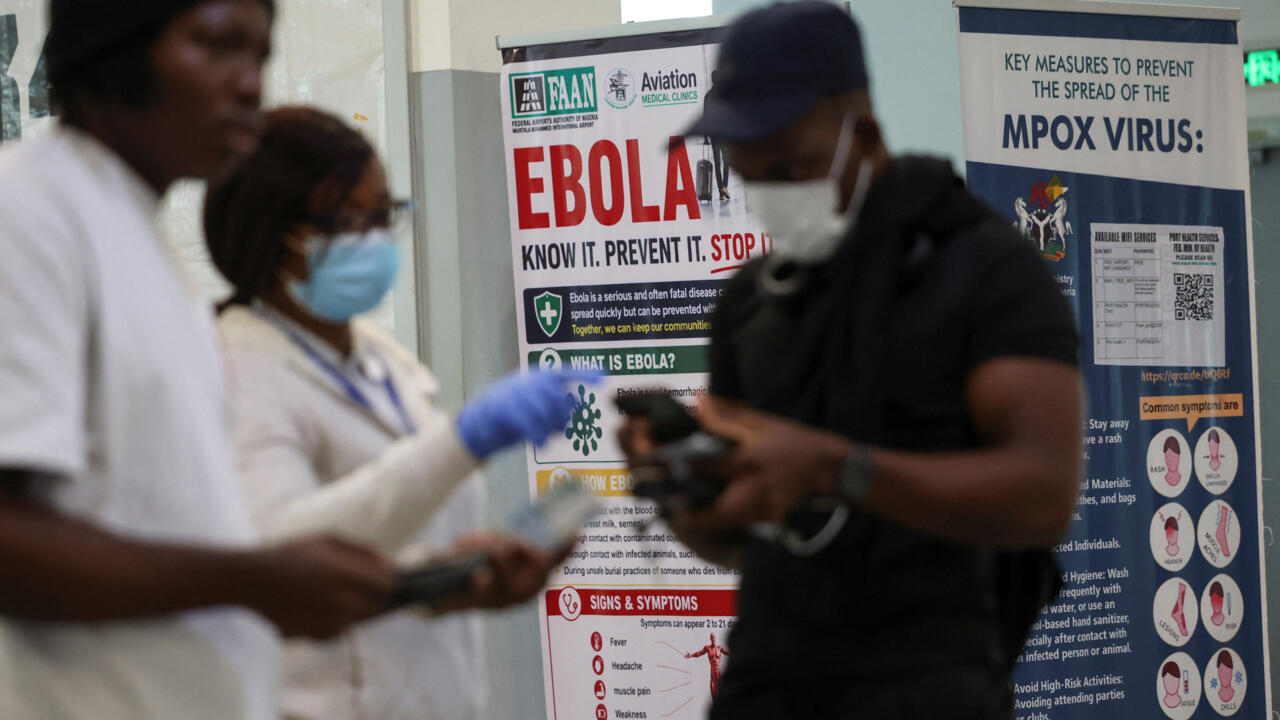
Africa's top public health agency has warned that the Ebola outbreak in DR Congo remains out of control six months after it was declared, citing deadly attacks on health workers, unpaid staff and a shortage of resources. Officially declared on 15 May, the Ebola epidemic affecting the eastern Democratic Republic of Congo (DRC) has continued to spread, reaching eight provinces across the country six months after it first emerged in Ituri. "We are all in agreement today to say that this outbreak is still serious, and is still not under control," Jean Kaseya, director-general of the Africa Centres for Disease Control and Prevention (Africa CDC), said on Sunday. In an interview with RFI, he described the outbreak as "extremely serious". More than 11,200 infections and 5,500 deaths have been reported, according to government data. More than 80 percent of new cases are being detected among people who were not on contact-tracing lists, while over 65 percent of deaths occur in communities rather than healthcare facilities, Kaseya said. Ebola is most contagious during the late stages of the disease. "If we don't stop this outbreak now, it will be the worst Ebola outbreak that the world will have," he warned. A health worker wears full gear at a Ebola treatment camp in Butembo, Congo, Wednesday, on 30 September, 2026. © AP Photo/Sebastien Kitsa Musayi While research into treatments and vaccines is progressing, efforts to contain the outbreak on the ground continue to face major obstacles. Driven by the rare Bundibugyo species of the virus, the epidemic is already the second-largest Ebola outbreak on record, after the 2014–2016 outbreak in West Africa, which infected more than 28,600 people and killed over 11,000. Inside Bunia’s fight to protect families from DRC’s deadliest Ebola outbreak Regional concerns The outbreak has also spread beyond the DRC over the past six months, reaching Uganda, Kenya and Nigeria. "Uganda has managed to bring the epidemic under control," Kaseya explained. "We had declared its end there – even though two cases, one from Kenya and one from Nigeria, had passed through Uganda." The situation in Kenya has also improved. Last week, the country announced that the final patient had been discharged from facilities used to monitor people who had come into contact with infected individuals. "We have also seen very good results in Nigeria," Kaseya added. "Not all the identified cases tested positive; at present, the situation appears to be under control." However, the Africa CDC chief remains concerned about the continuing spread of the epidemic within the DRC and the risk of further cross-border transmission. "First, there is the Central African Republic, which is a major source of concern for me. Second, there is South Sudan, which also remains a major source of concern." He also highlighted the potential risk to Rwanda and Burundi if the outbreak spreads from the Beni-Butembo area towards Goma and Bukavu. "And, of course, there are all the other countries that could be affected indirectly," he added. Medical charity warns funding for DRC Ebola fight not reaching front lines Hope for a vaccine Kaseya told RFI that the lack of an effective vaccine against the Bundibugyo strain remains one of the biggest challenges. A vaccine "should have been available for the past 19 years, given that the Bundibugyo strain has been known for that long," he said. He added that the absence of treatments and diagnostic tests specifically designed for the strain had contributed to the scale of the epidemic. Research into treatments and vaccines is progressing, however, with several clinical trials already underway, according to RFI's correspondent in Kinshasa, Paulina Zidi. The "Tumaini" clinical trial – named after the Swahili word for "hope" – is focusing on vaccine development. A group of experts from the World Health Organization (WHO) has recommended adding two new vaccine candidates specifically developed to target the Bundibugyo virus. Meanwhile, the Ebo-Pep trial is examining whether the oral antiviral drug obeldesivir can prevent the disease from developing in people exposed to the virus. The trial is being conducted at several locations, including treatment centres in Ituri managed by the medical NGO Alima. Africa CDC chief warns ‘no country is safe’ as Ebola reaches Nigeria Challenges on the ground Insecurity in eastern DRC, large-scale population movements and weaknesses in healthcare and disease surveillance have all contributed to the scale of the outbreak. Around $2.9 billion has been pledged internationally to help fight the epidemic. However, despite these commitments, much-needed assistance is still failing to reach some of the worst-affected areas, medical charity Médecins Sans Frontières warned last week. The organisation highlighted shortages of trained staff, ambulances without fuel and a lack of surveillance teams. Kaseya acknowledged that coordination between the Congolese government and international donors remains a problem. "We are not pointing fingers," he said. "We are saying it's a collective failure." He called on donors to release around $1.6 billion in pledged aid and work more closely with Kinshasa to ensure funds are used effectively and resources are not wasted through duplication. Kaseya also acknowledged that some healthcare workers had not been paid for months, adding that the Congolese government was working to digitise its payroll system to address the problem. (with newswires)
DR Congo Ebola outbreak still out of control six months on, Africa CDC warns
Full Article
Original Source
Read the full article at Rfi →KhanList aggregates and links to publicly available news content. We do not host full articles from third-party sources. Always verify important information with original sources.