
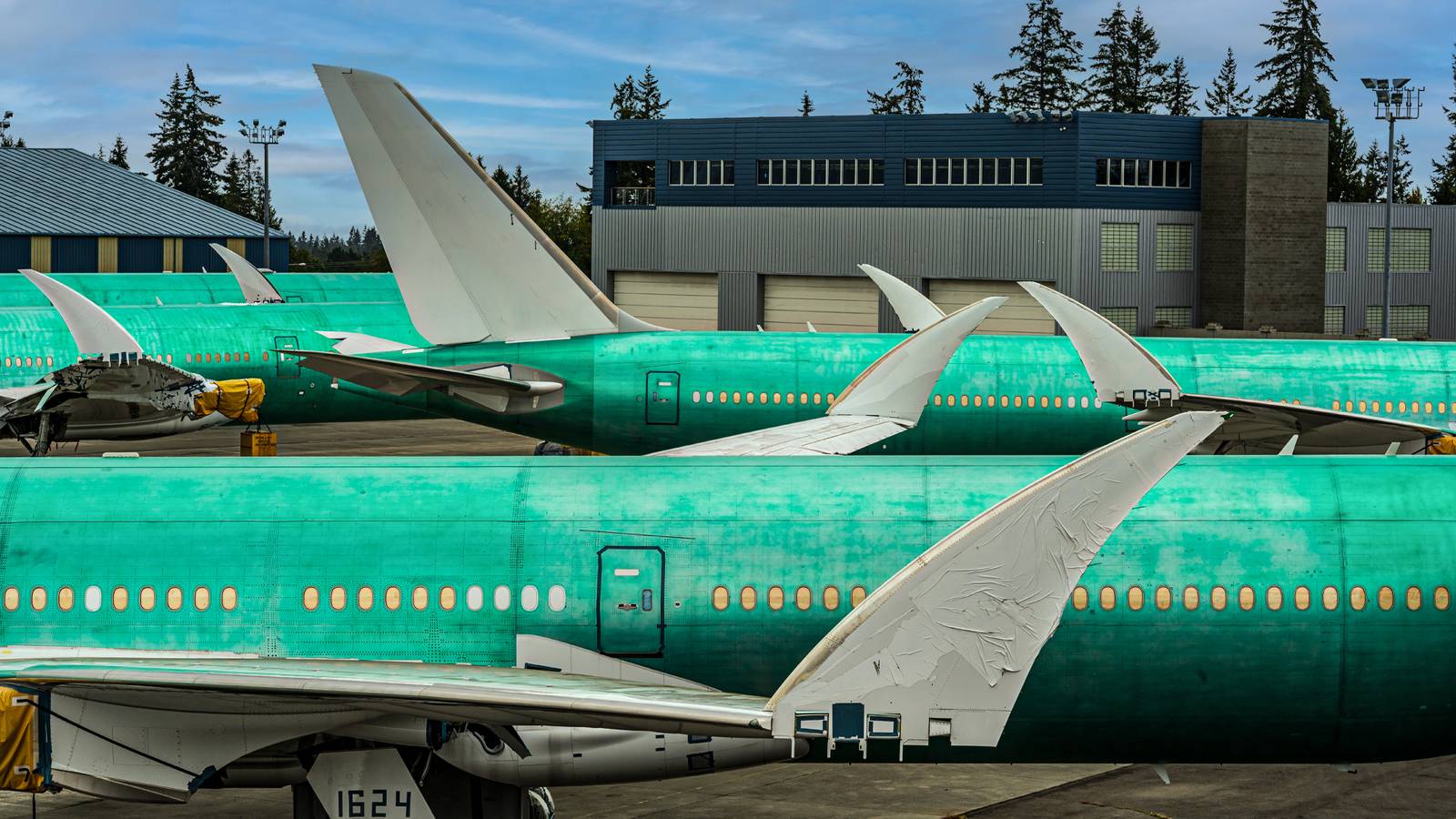
Published Oct 6, 2026, 2:00 PM EDT Daniel comes to Simple Flying with a business focused approach to the aviation world. Daniel enjoys analyzing strategy and how companies move against each other to gain a step ahead in the skies. Besides strategy, Daniel also has a passion for aircraft design and the history of aviation. Based in New York After years of delays and missed certification targets, the Boeing 777-9 may soon be ready for service at last. Boeing is expected to certify the aircraft in early 2027, and it will enter service shortly afterward with Lufthansa, representing a roughly seven-year delay. However, because Boeing couldn't simply shut down the 777 production line during these delays, it has already built multiple 777-9s intended for passenger service, but that doesn't mean customers will get their 777Xs quickly. The 777-9 is the first variant of the 777X family, which also includes the shorter 777-8F model. Boeing is also marketing a passenger 777-8, but development has been put on hold due to a lack of demand. Customers have been waiting years for their 777-9s and are eagerly awaiting their deliveries, but it will take time for airlines to build substantial fleets of the type. This is even more pronounced because some carriers won't take early-production examples, as those planes require significant rework. The Early Production 777-9s Credit: EQRoy I Shutterstock Boeing has already produced roughly 40 777-9s since the type's first flight in 2020. A handful were built for development and testing purposes, while over 30 are customer examples meant to be delivered after the aircraft's certification. However, during the aircraft's testing and development, multiple design changes were made to ensure compliance with FAA regulations, and these were implemented on later production models. These changes now have to be implemented on all 777-9s already produced. This process, known as 'change incorporation', requires modifying aircraft to match a current design specification. The extent of the required modifications varies by aircraft, with recent examples needing light changes while older planes require much more thorough work. This is common across a wide variety of aircraft types, and the process is also used after a type enters service, allowing older examples of a particular type to remain up to date with the manufacturer's standards. The problem with change incorporation is that it can add weight, resulting in slight performance penalties. The extent of these penalties varies by aircraft, and the exact number is usually known only to the manufacturer and the customer. However, it's known that Emirates and Lufthansa have outright rejected early production 777-9s that would have needed to be reworked. This means Boeing needs to find new customers for these airframes, and it's already had to scrap a 777-9. Taking Apart Line Number 1611 Credit: Gunnar E Eide I Shutterstock Line Number 1611 was a 777-9 intended for Emirates, with a planned registration of A6-EZT. However, it was also one of the oldest customer 777-9s, and bringing it up to Boeing's current design standards would have required substantial modifications. As such, this was one of several 777-9s that Emirates rejected, leaving the aircraft without a customer. Normally, you'd expect Boeing to sell this aircraft, as it's believed to be doing with other rejected 777-9s, but instead, it opted to scrap LN 1611. This aircraft is admittedly unique because it was used for significant structural testing. It never actually flew, and Boeing had already partially torn it apart in 2025 before officially writing it off as part of a larger $15 billion in charges. Reportedly, the aircraft would have been so expensive to rebuild to current standards that it was more economical for Boeing to tear it apart than to try to sell it, especially since it would have had to be sold at a much lower price. 1611 was unique in that it was essentially used to test the limits of the airframe's structure and never flew, so its fate doesn't necessarily predict the fates of the initial 777-9s. However, it also shows that Boeing doesn't have a significant number of hand-raisers for early 777-9s beyond those that have already committed to these planes. When those customers pull out, it becomes significantly harder to find buyers for early production 777-9s that are less capable and burn more fuel. Trying To Sell The Early 777-9s Credit: Ian Dewar Photography I Shutterstock It's publicly known that Emirates and Lufthansa have outright rejected what were supposed to be their initial deliveries. These are now essentially white-tails: already-assembled aircraft without buyers, so Boeing has to sell suboptimal aircraft that need to be modified to the specification the aircraft will ultimately be certified to. Demand for large widebodies like the 777-9 is already limited, which makes the early-production 777-9s even less desirable in the wider twin-aisle market. There were rumors earlier in 2026 that United Airlines was interested in the 777-9, and that the white-tails were potentially under consideration. It's unknown how deep United's interest in the planes was, if there was any at all, but the carrier later confirmed it was not pursuing the 777-9. Whether this was due to the performance of the aircraft batch in question (if Boeing offered the early white-tails) or whether the type didn't fit within United's fleet at Boeing's prices is unclear, but what is clear is that these lower-priced white-tails didn't result in a United order. The main appeal of the white-tails to a potential new customer is price and availability. These planes will generally have shorter lead times than a new-build 777-9, and Boeing is presumably discounting these aircraft significantly more than standard, given the performance hit. At the same time, the planes would not only have slightly worse fuel burn than other 777-9s, but they'd also be oddballs within a carrier's fleet. As such, the price becomes extremely important when negotiating a potential order for these aircraft. Looking Back At The Terrible Teens Credit: Vidit Luthra I Shutterstock The situation with the 777-9 is not ideal, but it's not unusual for early examples of a new aircraft type to be less desirable. With Boeing's most recent clean-sheet aircraft, the 787, Line Numbers 10-22 were several tons heavier than initially promised, resulting in a significant drop in range. Nicknamed the 'Terrible Teens', Boeing had difficulty selling these 787s, but it was eventually able to find customers for all examples in question, and there's no reason to think that the same won't hold for the early 777-9s. The full impact of the change in incorporations on the 777-9 isn't fully known, but the 787 Terrible Teens were particularly noteworthy because of how much added weight these planes were built with compared to later models. The term has returned for the 777-9, however, because of the aircraft rejections and the fact that these planes have diverged significantly in design from how the 777-9 will be certified. However, considering that the aircraft isn't in service yet, it's still too early to judge how quickly or slowly Boeing will sell these planes. 787 Terrible Teens Line Numbers Original Customer Receiving Customer 10 LAN Airlines Ethiopian Airlines 17 Royal Air Maroc Crystal Cruises 11 All Nippon Airways Boeing Business Jets 18 All Nippon Airways Ethiopian Airlines 12 All Nippon Airways Ethiopian Airlines 19 Royal Air Maroc Residence II 13 All Nippon Airways Ethiopian Airlines 20 Japan Airlines Japan Airlines 14 All Nippon Airways Ethiopian Airlines 21 Japan Airlines Japan Airlines 15 All Nippon Airways Air Austral 22 All Nippon Airways Air Austral 16 LAN Airlines Ethiopian Airlines What is more unusual about the current situation is that the 777X is an improved derivative of a decades-old type, rather than a clean-sheet widebody. Much of the aircraft is theoretically proven, and it's also more striking considering that the 777-9 has been in development for over 13 years. However, while the 777-9 will be certified as a 777 model and looks somewhat similar to the untrained eye, the 777X is one of the most thorough overhauls of an existing aircraft type in modern aviation history. The Changes Made For The 777X Credit: Ian Dewar Photography I Shutterstock The 777X still features the metal cross-section, nose, and rear fuselage from the prior 777 models. However, the 777X features new fuselage lengths: the 777-8F is closer in size to the 777-300ER than the 777F, while the 777-9 is longer than a 747-8. Inside, the 777-9 features larger, dimmable passenger windows and an updated interior, while the 777X's flight deck closely resembles the 787. In addition, the cabin altitude and humidity will be lower than on prior 777 models and closer to the carbon-composite 787. The most striking visual difference on the outside is the new wing. Made of carbon composites, it's brand new for the 777X, and it's estimated to have cost roughly as much as the full Airbus A330neo program on its own. The wings are so wide that Boeing designed new folding wingtips that let the 777X fit into standard widebody gates, and the plane also features a new vertical stabilizer design and two General Electric GE9Xs, the largest turbofan engine ever put into production. Although the plane is still certified as a 777, it's by far the most radical update to the type, and the type's longer development timeline, along with the extensive re-engineering required, makes more sense when you consider how much of the plane is new. Boeing has sunk billions into updating its iconic 777 to stay competitive today, and it's betting that such a thorough refresh would help it maintain its advantage over Airbus as the market leader for widebodies.
Dozens Of Early-Build 777Xs Need Rework & Boeing Already Quietly Scrapped 1 Of Them
Full Article
Original Source
Read the full article at Simpleflying →KhanList aggregates and links to publicly available news content. We do not host full articles from third-party sources. Always verify important information with original sources.