
Newly elected mayor Retief Odendaal has warned that Nelson Mandela Bay could struggle to pay salaries and its Eskom bill from March unless its finances are turned around. To avoid this, he has promised a 100-day reset. But fixing years of administrative “paralysis” and crumbling infrastructure will take longer, he says.Now the question is whether he has enough time, money and political support to deliver. Odendaal says the municipality has lost almost R3-billion in cash reserves over the past three financial years. His own projections warn that without a turnaround plan, the City could struggle to pay monthly salaries and its bulk Eskom electricity bill by the end of the first quarter of 2027.It is a sobering inheritance for a mayor who has barely had time to settle into the job. Perhaps that is why Odendaal was already in his office on Sunday, getting to grips with the scale of the task ahead.But he is at pains to make one distinction: the municipality is not bankrupt, he says, and it does not owe Eskom money. The problem is the speed at which its financial position has deteriorated.Odendaal puts the annual loss in the electricity department at about R1.8-billion – roughly half the income the metro receives through rates. He says the municipality has about 110,000 residential ratepayers and 13,000 commercial ratepayers, leaving little room to simply increase rates and tariffs to plug the gap.“We can’t just kick the can to them [ratepayers] and say, ‘Oh well, we have to balance the books, so you need to give us more.’ There is no more to give,” he says.Businesses are closing or struggling to pay their municipal accounts, he adds. The answer, in his view, is to stop wasteful expenditure, improve revenue collection and make sure every rand spent delivers value.No Big BrotherThe political support he needs to put his plans into action rests on a six-party coalition, should it hold. The coalition holds 63 of the council’s 120 seats, two more than the 61 needed for a majority.Odendaal was elected on Friday, with 63 votes to 55 for the Patriotic Alliance’s Bradley Murray, with one spoilt ballot. The DA, with 53 of the council’s 120 seats, governs with the United Democratic Movement (UDM) and Freedom Front Plus (FF+), which have three seats each, ActionSA (two seats), and the African Christian Democratic Party (ACDP) and Pan Africanist Congress (PAC), which each have one seat.The DA’s press briefing on 24 November to announce its coalition partners. (Photo: Deon Ferreira) Partners have already been handed portfolios:Public Health: Sipho Chris Fayindlala (UDM);Constituency Services: Xoliswa Bobani (UDM);Roads and Stormwater: Bill Harrington (FF+);Economic Development, Tourism and Agriculture: Bassie Kamana (PAC); andSport, Recreation, Arts and Culture: Nonkqubela Jonas (ActionSA).ACDP councillor Lance Grootboom is deputy mayor. The rest of the mayoral committee has yet to be announced.Nelson Mandela Bay Deputy Mayor Lance Grootboom. (Photo: Deon Ferreira) Odendaal says he will not be flying the DA flag at every opportunity. “I won’t be talking about a DA-led government, and I certainly won’t be reminding people that I’m a DA mayor every single day,” he says.“I think it’s counterproductive. There will be a time to campaign for 2029, but right now the focus must be fixing the city.” Decisions, he says, will be taken by consensus and concession: “There’s no Big Brother in our coalition.”He describes it as a matter of trust. “I’m a firm believer in building a trust relationship,” he says, with frank discussions and a joint caucus planned for this week. He says he was surprised to discover that the previous coalition had not held joint caucuses, something he intends to change. A first braai is already behind them. “I always say there’s no problem that I can’t resolve over a braai.”The new coalition, he says, started with the work, not the posts available. Partners agreed what they wanted to do before discussing positions, and produced a 15-page turnaround plan that will form the basis of the 100-day programme.He contrasts that with the opposition’s coalition attempts, which he claims were talking about posts from the get-go. In his opinion, if one municipal department falters, “we all suffer”, whether it is “a UDM department or a PAC department or a DA department”.The opposition, however, isn’t convinced about the strength of this coalition. Speaking on the sidelines of Friday’s council meeting, ANC regional chair and former mayor Babalwa Lobishe said the coalition would not last a year because of the DA’s “bullying”. She also said Odendaal wants to take the Budget and Treasury Directorate, which meant there was no power-sharing taking place.Former Nelson Mandela Bay mayor Babalwa Lobishe. (Photo: Lulama Zenzile) ‘The engine room has stalled’Odendaal points out what many residents in the metro already know – the municipality has no permanent executive directors, with acting officials carrying responsibilities that, he says, many of them are not even qualified to handle. He told the council on Friday that he has serious concerns about the legality of the existing acting arrangements.He says paralysis grew from there: whoever was acting didn’t want to take a decision, and “nobody wanted to put something in writing”.Within 100 days, he says, the new government will head-hunt people to fill those posts. “We can’t continue stumbling from one crisis to the other, where you have the one acting director after the other.”Then there is supply chain management, one of the biggest problems he identified when speaking to Daily Maverick on Sunday.“The engine room of this municipality has stalled, and I believe it’s by design,” he says.It is a serious allegation but one the new mayor is happy to expand on. Odendaal argues that when new contracts stall, the city falls back on deviations from the process, which he says is “how you steal from government”, with the same contractors getting the work “year after year after year”.He says he is now preparing a letter to Finance Minister Enoch Godongwana asking the National Treasury to assist with the municipality’s supply chain processes. He would also like the acting city manager to reconstitute bid committees, but is careful to say he cannot interfere directly in procurement.Finance Minister Enoch Godongwana. (Photo: Phando Jikelo / Parliament of RSA) In essence, he says, he wants closer scrutiny of who gets contracts, who does the work and who signs it off.Odendaal says he wants small, medium and micro enterprises to succeed, but argues that contractors must have the skills to do the work they are awarded.“If you are not a plumber, you can’t get a plumbing job. If you’re not a carpenter, you can’t get a carpentry job.”As an example of what he believes is wrong, he points to the entrance to City Hall. The shatterproof glass on one side of the door has shattered. On the other side, it has already been replaced – with ordinary glass.If a child pushed against it and a hand went through, he says, the child could be seriously injured. “That is not okay,” he says. “Our officials need to understand that they are the ones that sign off on the work. And if they’re going to sign off on substandard work, they are not doing their jobs.”It is a small example, but it gets to the heart of his argument: the municipality is not simply failing to maintain its assets. It is failing to check whether the work it pays for is any good, he says.Odendaal has also promised a more open approach to municipal government. He says mayoral committee meetings will be open to the press, except when discussions involve staff matters or legally sensitive issues. “The decisions we take have to be up to scrutiny, and they have to be done publicly,” he says.For residents, the test is simple: do the lights come on and do the taps run?And that, Odendaal says, is why the metro needs to get back to basics: fixing streetlights, water leaks and outages, potholes and electricity failures. Some residents, he says, have been without electricity for months because of cable problems.Streetlights along William Moffett Expressway in Gqeberha were not working on 25 June 2026, with similar outages reported across Nelson Mandela Bay. (Photo: Deon Ferreira) He also wants the municipality to stop treating symptoms and start dealing with the underlying causes. A road that develops potholes every month needs to be resealed, he says, rather than patched repeatedly. The metro also needs proper plans to replace ageing pipes and refurbish infrastructure.He gives the example of the Emerald Hill reservoir, which now serves the same geographical area despite the decommissioning of a second reservoir that previously shared the load. The result, he says, is that some communities experience repeated water interruptions. The solution is not simply to respond to each outage, but to understand the infrastructure problem and plan accordingly.That will take time, he warns. The government, he says, is like an oil tanker: decisions made today may only produce results in six months or a year.A long road back to the mayor’s seatOdendaal’s interest in local government began at school, when he was elected to the junior city council. He served as a junior councillor for two years before studying law and becoming an attorney.He was elected to the municipal council in 2009, aged 27, and at 31 he became leader of the opposition in council, before serving as MMC for finance.After the DA lost control of the metro in 2018, he moved to the Eastern Cape legislature. In 2022, he was asked to stand as mayor, and was elected by a single vote at the head of what he says was a 10-party coalition. It lasted eight months. He was voted out in May 2023, when National Alliance councillor Gary van Niekerk took over the mayor’s chair after joining forces with the ANC and EFF.He says the experience taught him that consensus and compromise are essential to coalition government.His return to the mayor’s office was not inevitable. He says his wife, Anna-Marie, had suggested he consider leaving politics altogether, but they eventually decided that he would run again for mayor.Newly elected mayor Retief Odendaal and his wife, Anna-Marie, at the Seaview Community Hall, where they voted on 4 November. (Photo: Deon Ferreira) The man behind the mayorOdendaal lives in Beachview in Gqeberha and talks enthusiastically about the Bay’s lifestyle, climate and affordability. He wants to make the metro a place that attracts people and investment, particularly from Gauteng. But he is clear that unemployment remains its biggest problem.Away from municipal business, he enjoys long walks on the beach and, he admits, hair gel.His friends tease him about the hair gel, but he is sticking with it.“When you’ve got so little hair, like I do, you have to make sure that every one is in its place.”Odendaal says he prefers being treated as the guy next door rather than being addressed formally.But the job he has taken on is anything but ordinary. He has inherited a municipality with a shrinking financial cushion, an unstable administration and residents who have heard plenty of promises before. DM
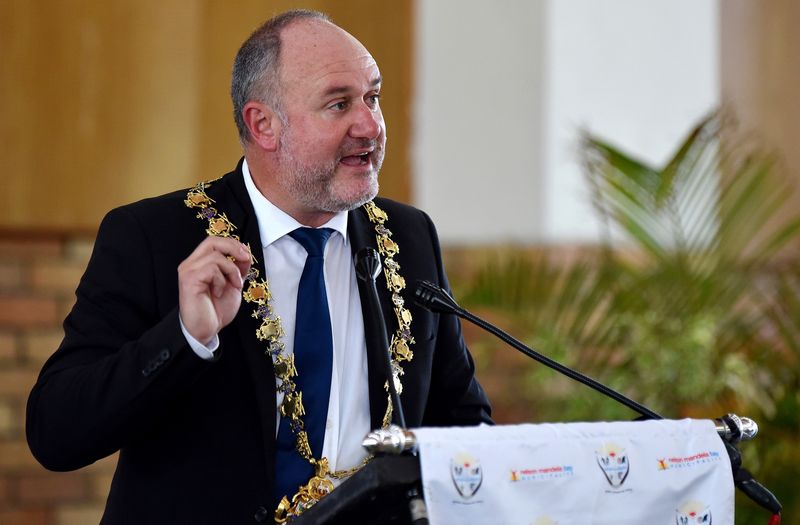
DOWN TO BUSINESS: Back in the hot seat, Mayor Retief Odendaal launches 100-day rescue plan for NMB
Full Article
Original Source
Read the full article at Dailymaverick →KhanList aggregates and links to publicly available news content. We do not host full articles from third-party sources. Always verify important information with original sources.