
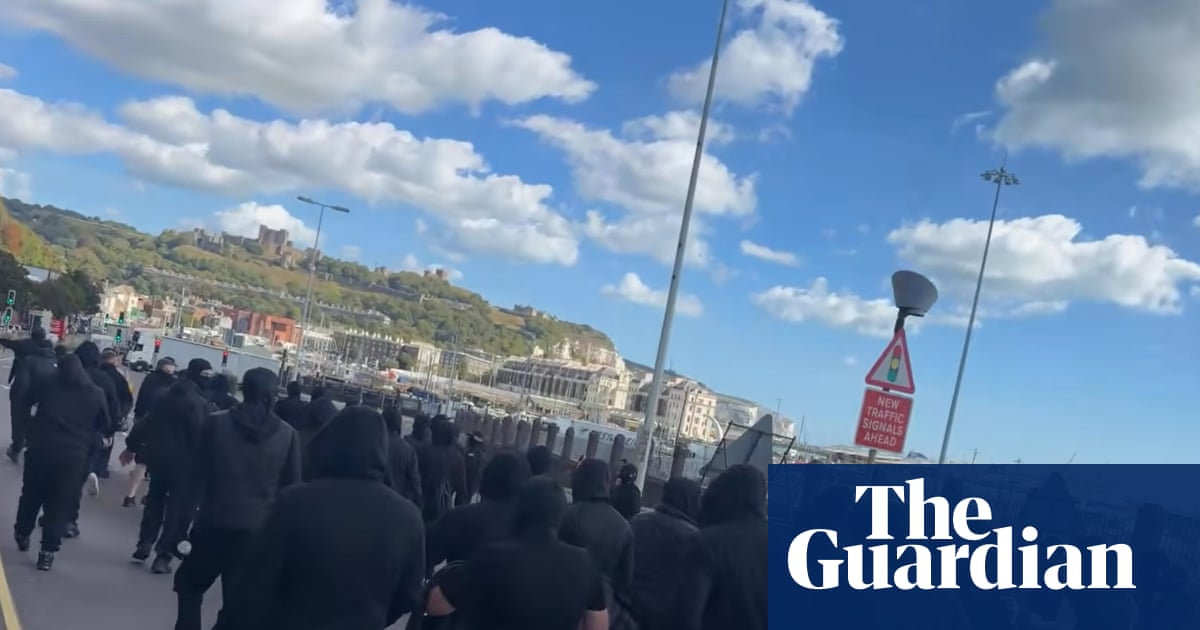
To anybody watching the videos of a group of masked men, all wearing black, descending on the port of Dover last weekend, it was immediately obvious that something novel and disturbing was happening: a mass intimidation in uniform not seen in Britain since the 1930s.Yet to the police and the rest of the UK’s intelligence apparatus, the arrival of the men chanting “stop the boats” was a surprise, despite the fact that residents of a village 18 miles away tried to report that dozens of men were congregating there on the Friday, threatening to go to Dover and “attack Muslims”.Intelligence specialists describe the events in Dover and the day after in Portsmouth as protests, as if they are on a par with cardboard-carrying campaigners marching on an approved route. The same definition was used by Kent police and Sarah Jones, the policing minister, on Monday. “Protest activity,” she told MPs.Such semantics are important to the state, though they appear to misunderstand the recent events. In a democracy, it is argued it is not the job of MI5 and police to spy on campaign groups, as undercover police did so zealously on leftwing groups from the 1960s to the 1990s, sending reports to the Security Service.Masked men chant ‘stop the boats’ in Dover on September 5Nigel Brookes, an assistant chief constable at Kent police, said this week: “The right to peaceful protest is an important part of our democracy and applies irrespective of the political views being expressed.” No arrests were made in Dover, though traffic was halted for several hours before the masked men dispersed.The contrast with Palestine Action is sharp. The group was designated and banned as a terror organisation after some members broke into RAF Brize Norton and sprayed two military planes with red paint.Terror arrests in Great Britain were at record levels for the year to March as thousands of mostly elderly supporters were arrested, many holding placards reading: “I oppose genocide, I support Palestine Action.”Monitoring every protest group would be too intrusive, it is argued. Yet Patriot Platform, created in June by the far-right agitator Daniel Thomas, known as Danny Tommo, is clearly somewhat different, with its emphasis on recruitment of “English men”, vetting, uniforms and hostility to migrants arriving in the UK by small boats.skip past newsletter promotionafter newsletter promotion“In the next three or four weeks, we are going to ask you to be part of one of the biggest pushbacks this country has seen from its men since world war two. Are you up for it or what?” Thomas was reported by Searchlight as having said at a “national recruitment day” event at Burton Dassett, south of Coventry, last month.The language is calibrated, not explicitly racially charged or inciteful. Those dressed in balaclavas and black were careful to avoid violence in Dover, though there were clashes the night after in Portsmouth. Police used batons and synthetic pepper spray to control people blocking the road away from the port, down which 120 disembarked migrants were expected to be taken for processing.It appears that the aspiration is to agitate or provoke at a level just below the criminal threshold: grey zone tactics. In Dover, protesters were handing out a “legal reference sheet” justifying their right to obstruct the highway outside the port where migrants on boats are taken to and processed, citing the rights to freedom of expression and freedom of assembly under the Human Rights Act.Police officers stand on Eastney Point, near Eastney beach, Portsmouth, after the unrest the previous night. Photograph: PA/Joe Sene/PAThe question is, where is this heading? That is difficult to predict, but it is the job of intelligence to discover and assess genuine risks to the public and the country. Perhaps it is reasonable for masked gangs to block roads and turn up outside newspaper offices, but there is the possibility that intimidatory actions could escalate. The situation at Portsmouth, a day after Dover, was notably more tense, and the RNLI, the lifeboat charity, has stepped up security at south coast sites.Nick Lowles, from the campaign group Hope Not Hate, said: “One of the ways in which the police were able to swiftly shut down far-right activity during the riots in 2024 [after the Southport attack] was making arrests.“This time, the police response exposes serious failings in the authorities’ approach” to intimidatory far-right activity, he added. Being caught by surprise in Dover was flat-footed at best.
Dover unrest exposes serious flaws in Britain’s handling of far-right extremism
Full Article
Original Source
Read the full article at Theguardian →KhanList aggregates and links to publicly available news content. We do not host full articles from third-party sources. Always verify important information with original sources.