
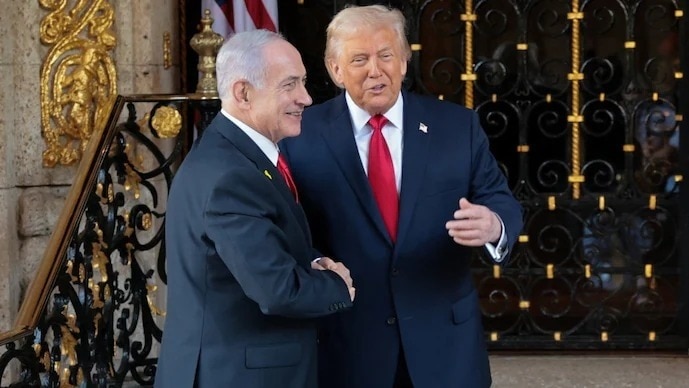
Diplomacy or another round of airstrikes? That is the question facing US President Donald Trump as pressure mounts for Washington to resume military operations against Iran after the November 3 midterm elections.Israeli Prime Minister Benjamin Netanyahu is reportedly pushing for fresh strikes against Tehran, with his own political position weakened after his coalition failed to secure a parliamentary majority in Israel's recent elections.His bloc won 53 seats in the 120-member Knesset, falling short of the 61 needed to form a government. Reports in US media and commentary by political watchers close to the Trump administration suggest that Netanyahu is building pressure on the US President for a shattering strike on Iran in the hope that a renewed military campaign could push rival Israeli political factions towards a unity arrangement and help him stay in power. The two leaders discussed the possibility of renewed military action during a phone conversation on Saturday, October 31. (Reuters) Meanwhile, Trump, while seemingly inclined to give negotiations more time, has also renewed threats of "the big one", comments that have widely been interpreted as a potential strike on a nuclear-linked facility at Iran's Pickaxe Mountain. Pickaxe Mountain is believed to host Iran's nuclear enrichment facilities in a heavily fortified underground complex that military watchers believe may require a nuclear strike to destroy.STRIKE LOADING?According to a report by Axios, Turmp and Netaynahu discussed the possibility of renewed military action during a phone conversation on Saturday. Israeli and US sources told the publication that Netanyahu wants Washington to strike Iran immediately after the midterm elections, while Trump currently prefers to give diplomacy more time. The Israeli source described the conversation as "tough", while the US source called it "direct."Trump is pursuing parallel diplomatic and military options, according to Axios. While his administration is attempting to restart negotiations with Tehran, preparations are also being made for a possible resumption of major combat operations after the elections.The President has also repeatedly referred to Pickaxe mountain, a heavily fortified underground site near Iran's Natanz nuclear complex. Pickaxe mountain is located around 220 km south of Tehran. (AP) Speaking to reporters on Saturday, Trump said negotiations with Iran were "going fine" and that he was "not in much of a hurry". However, he added that Washington still needed to "take care" of one or two Iranian nuclear sites."We can do that in 10 minutes. We have that planned. You can look at Pickaxe mountain. We need to take care of that. We can do that very quickly," Trump said.US Secretary of State Marco Rubio has maintained that Trump has not made a decision on further military action and prefers a diplomatic solution, Fox News reported.WHAT IS PICKAXE MOUNTAIN, THE IRANIAN NUCLEAR-LINKED SITE?Pickaxe mountain, also known as Kuh-e Kolang Gaz La, is located around 220 km south of Tehran and close to the Natanz nuclear complex.The site is believed to contain a network of deeply buried tunnels inside a mountain and has been linked to Iran's nuclear programme.According to the Institute for Science and International Security (ISIS), construction of the facility began in 2020.The main tunnel complex is estimated to be at least 100 metres beneath the mountain. It has four entrances, with some sections reinforced using layers of concrete and earth.The site is also surrounded by a large security perimeter, including fencing, walls and patrol routes.The facility's exact operational status and the nature of the equipment inside remain uncertain.In an assessment published on October 16, ISIS said satellite images from October 7 showed that the eastern tunnel entrances remained blocked by earth, while roadblocks were still in place near the western entrances.The organisation said the restricted access indicated that the facility was not operational, and that major construction had not continued during the period observed.However, it noted that valuable equipment or materials, including centrifuges and components, may have been moved into the tunnels after earlier attacks.TRUMP HAS THREATENED TO STRIKE PICKAXE MOUNTAIN BEFORETrump has repeatedly warned that the United States could target the underground facility.On July 13, during an interview with conservative radio host Hugh Hewitt, he said Washington was monitoring the site and suggested it could be hit."We have eyes on it and Pickaxe mountain is a possible target for a nice big fat shot right in the front door," Trump said.He later issued a more direct warning, saying: "We're going to take out Pickaxe mountain. Tell the Iranians to be ready." Pickaxe mountain has always been a place of interest for Donal Trump. (Reuters) On July 21, Trump again threatened to strike the area, saying the US would hit it "pretty soon and very heavily". He also suggested that Iran might have moved nuclear centrifuges to the site but said Washington was primarily tracking nuclear material.The threats have drawn attention to the difficulty of targeting a facility buried deep inside a mountain.The 14-tonne GBU-57 Massive Ordnance Penetrator, the largest non-nuclear bunker-busting bomb in the US arsenal, is designed to penetrate fortified underground structures.However, the depth and construction of Pickaxe mountain could make a direct attack challenging.WHAT COULD A US ATTACK ON IRAN'S PICKAXE MOUNTAIN LOOK LIKE?A July 14 assessment by the Institute for Science and International Security outlined possible vulnerabilities at the facility and discussed how an attack could be carried out. The report examined both aerial strikes and a potential ground operation.1. Air attackAn aerial assault is one of the options discussed in the assessment. Rather than relying solely on a direct strike against the mountain, an attack could target infrastructure connected to the underground complex.These vulnerabilities include power supply lines, ventilation systems and tunnel entrances. The report noted that two western tunnel entrances remained open in satellite imagery from July 9, 2026, making them potential targets.The assessment also drew comparisons with earlier attacks on Iran's Fordow and Shahid Boroujerdi underground facilities. In those operations, ventilation shafts were among the vulnerabilities targeted by US strikes.However, destroying tunnel entrances alone may not completely disable the facility.According to the report, strikes that do not generate sufficient impact inside the tunnels could temporarily restrict access without permanently destroying the underground complex.A more recent ISIS assessment, published on October 16, discussed the possibility of combining bunker-busting weapons with attacks on tunnel entrances and external infrastructure.It also referred to the potential use of the Massive Ordnance Air Blast (MOAB), a conventional weapon that produces a powerful shockwave, to damage the underground site.The organisation said such an attack could force the facility into a monitored closure, although the extent of the damage inside the mountain might remain unclear.2. Ground operationA ground operation would present a different set of challenges for US forces. The July assessment noted that the facility's existing layout and security arrangements could make it a potential target for ground forces seeking to disable or sabotage the underground complex.However, such an operation would expose American personnel to significant risks. Iranian military forces could respond to an incursion, while the absence of publicly available internal tunnel schematics would complicate any attempt to navigate the facility.The report also highlighted the possibility of defensive measures around the tunnel entrances.A ground operation would therefore involve considerable uncertainty, particularly given the difficulty of assessing the underground structure from satellite imagery alone.The assessment did not establish that Washington had approved a ground assault. Nor did it suggest that a nuclear weapon would be necessary to attack the facility.NUCLEAR STRIKE ON IRAN?The possibility of renewed military action has also drawn criticism from conservative commentator Tucker Carlson, who warned that Netanyahu could be pushing the Trump administration towards a nuclear strike on Pickaxe mountain. Carlson, despite his opposition to the US's current policy on Iran, is believed to be close to the Trump administration.In a post on X, Carlson claimed that conventional weapons might not be sufficient to destroy the underground facility and suggested that a nuclear weapon could be considered.However, he did not provide independently verifiable evidence that the US administration was preparing such an attack.Under pressure from Israeli prime minister Benjamin Netanyahu, the Trump administration may be within days of launching a nuclear strike on Iran. The target would be Pickax Mountain in central Iran, where Israeli intelligence claims the Iranian government has restarted its nuclear enrichment program. No conventional weapon in the American arsenal can penetrate 300 feet of solid granite to destroy the tunnels where enrichment is supposedly taking place. The only military option is a nuclear strike. Netanyahu has been pushing hard for one. “Bibi calls Trump about it every day,” says an informed observer. Netanyahu is cornered and desperate. After last week’s election results, he can’t form a government unless Trump intervenes directly in Israeli politics and brokers a deal with other parties that gives Netanyahu 61 seats in the Knesset. Otherwise, he is out as prime minister and on his way to ignominy, investigations and possibly jail. Netanyahu must stay close to Trump. He needs this war. To that end, he’s applied maximum pressure to his closest allies in the administration, including Secretary of Defense Pete Hegseth and CENTCOM commander Brad Cooper. Both oppose a negotiated settlement to the war they’ve so grievously mismanaged; both are pushing to restart major combat operations. Secretary of State Marco Rubio and CIA director John Ratcliffe are also following Netanyahu’s lead, as are leaders of the Democratic Party. In a recent meeting on the subject, former president Barack Obama said he opposes the current Iran peace deal being drafted in Doha. The rest of America’s longtime allies in the Middle East are terrified by the prospect of more war. On September 27th, Netanyahu flew secretly to Abu Dhabi to enlist the UAE in his lobbying effort for a final attack on Iran. The Emiratis refused. After eight months of conflict, Gulf economies are teetering. So are global energy and fertilizer markets. They won’t recover soon. Globally, there are a total of about 850 supertankers used to transport oil from producers to the rest of the world. In October alone, 11 of them were badly damaged in Hormuz. At this pace, a global depression is imminent. A nuclear strike would radically accelerate the destruction. Fallout from a ground explosion at Pickax Mountain would contaminate the Persian Gulf, poisoning the water supply for 100 million people. And those are just some of the immediate consequences for the region. The rest of the world is every bit as exposed. No country other than the United States has ever used a nuclear weapon in war. Some would like to. An American nuclear attack on Iran would set a new precedent. The Russians have already told at least two other governments that an American nuclear strike on Iran would free them to use nuclear weapons against Ukraine. Pakistan and India would be tempted to do the same against each other, as would North Korea against Seoul. After the first nuclear strike, World War Three is inevitable. That war would be short and final. We’ve been sleepwalking toward this moment for months. Since February, the administration has quietly rewritten America’s nuclear doctrine to make first use of so-called “battlefield nukes” easier and therefore more likely. No one in Washington in either party seems bothered by this. Now we’re on the brink of it. Close observers say Trump is likely to decide by next weekend whether or not to use nuclear weapons. That would be November 7, six days from now. To his credit, he’s hesitating. At the moment, Trump is listening to his vice president, JD Vance, and to his envoy and friend Steve Witkoff, both of whom argue a deal with Iran can be made. They’re right, though it won’t be simple. The Iranians are famously frustrating to negotiate with under any circumstances, and elements of that government have become more radical since Ayatollah Ali Khamenei and his family were killed in February. After decades of isolation, even relatively moderate Iranian leaders seem confused by how decisions are made in the West. (There is a widespread belief in Tehran, for example, that the United States government controls Israel.) But overall, people who have spoken to decision-makers in Iran say there is consensus there that more war is bad for everyone and a deal is worth making. One group that hasn’t been consulted so far is the global population — the hundreds of millions of people who will be killed along with their children if Trump is pushed by Netanyahu into launching a nuclear strike next week. Now would be the time for them to speak up.— Tucker Carlson (@TuckerCarlson) November 2, 2026Carlson was previously a prominent supporter of Trump and an influential voice within the MAGA movement.He backed Trump's presidential campaign in 2024, described him as a "wonderful person" at the Republican National Convention and campaigned alongside him.Their relationship has since deteriorated over Trump's decision to pursue military action against Iran.Carlson has criticised the President's approach, accusing him of abandoning his "America First" position and opposing further US involvement in the conflict.In April 2026, Carlson also apologised to his audience for having misled them about Trump, saying: "I want to say I'm sorry for misleading people. It was not intentional."QATAR-MEDIATED TALKS CONTINUE AS IRAN CONSIDERS US OUTREACHWhile the possibility of fresh strikes remains under discussion, diplomatic efforts to end the conflict are continuing.US Vice President JD Vance recently sent a letter to Mohsen Rezaei, secretary of Iran's Supreme National Security Council, regarding the possibility of restarting negotiations.Rezaei confirmed that he had received and read the letter but had not yet responded.Qatari mediators also met Iranian officials for a third consecutive day on Sunday, November 1, in an effort to facilitate the resumption of direct talks between Washington and Tehran.Iranian Foreign Minister Abbas Araghchi said discussions were continuing but had not produced a final agreement. Iran President Masoud Pezeshkian has been in constant touch with his Qatari allies. (Reuters) He indicated that a proposal under consideration could allow the Strait of Hormuz to reopen within two days if Washington met Tehran's conditions."We are making every effort in this regard and hope that the other side will demonstrate enough rationality to choose diplomacy over other paths," Araghchi said.With Netanyahu pushing for fresh military action and Trump keeping both diplomatic and military options open, the days following the November 3 US midterm elections could prove significant for the future of the conflict.- Ends
Doomsday Iran strike loading? Israel polls, US mid-terms and Trump's big dilemma
Full Article
Original Source
Read the full article at Indiatoday →KhanList aggregates and links to publicly available news content. We do not host full articles from third-party sources. Always verify important information with original sources.