
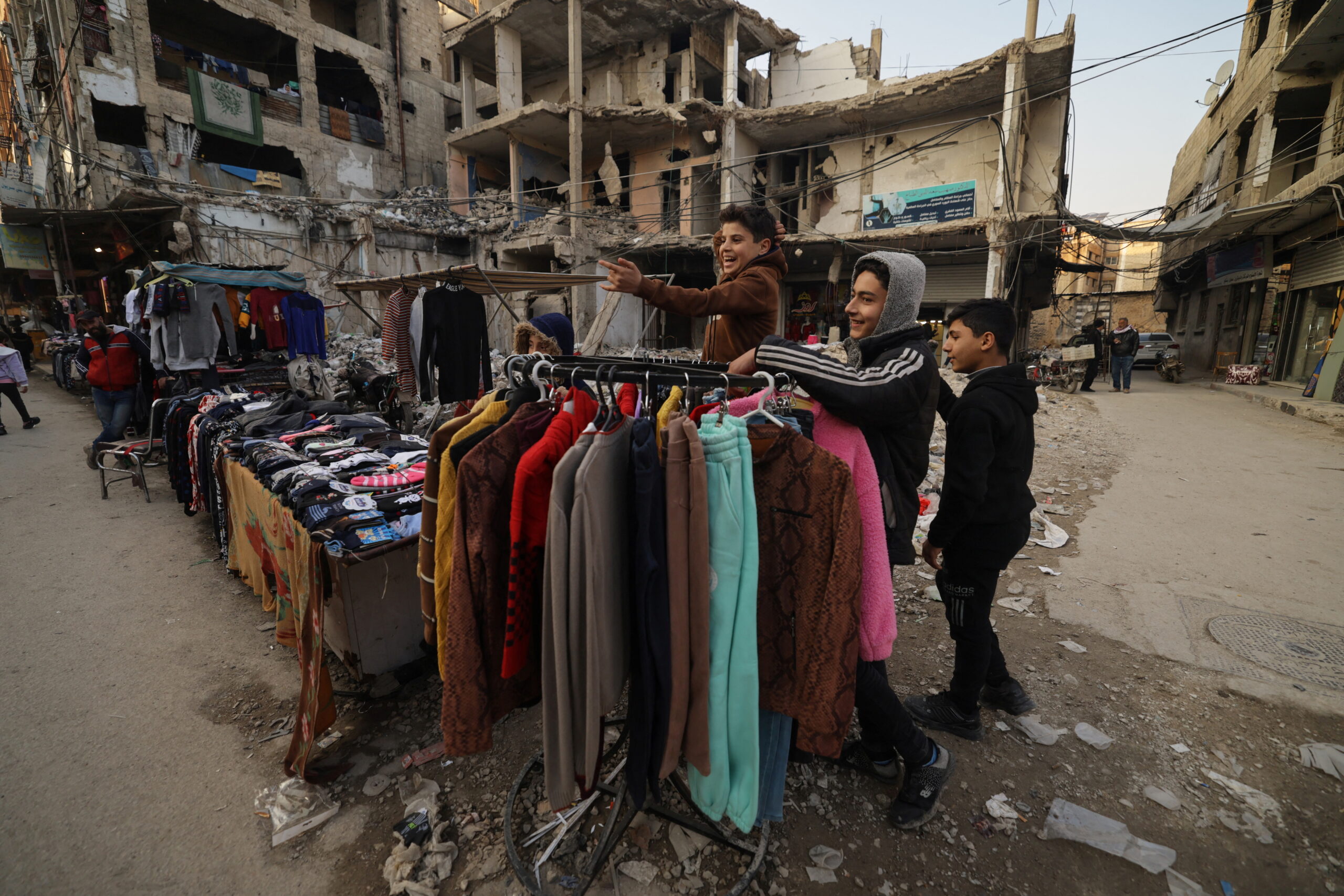
Like many others, I have a “deny entry” next to my name in the Syrian customs database. In my case, it’s a leftover from the Assad era, when I was effectively declared persona non grata due to my sneaking into the country to report for CNN. But the last time I visited in mid-August this year, an official at the Ministry of Interior handed me a piece of paper roughly half the size of a credit card and warned me not to lose it. Handwritten on it is my case file number. “Show this next time you go through customs, you won’t have any problems,” he said. I’m often asked if I’m optimistic about Syria. It’s a rational question, but the wrong one. It demands a clean yes or no, whereas Syria is more like a pendulum that rarely stops swinging violently from one side to the other. Optimism is less important than stability. And stability requires foreign investment, economic growth, justice and accountability, and proper governance. That tiny piece of paper I was handed can be viewed as progress; the government is starting the process of investigating and then, in theory, removing names from the deny entry list. But realistically, it’s an indication of just how excruciatingly slow progress has been and of how much support Syria needs. “We’re still trying to run a country on Windows 98,” one government source darkly joked, referring to the three-decade-old Microsoft operating system, before commenting more seriously on how government institutions do not even have the foundation needed to handle massive investments, nor is there a comprehensive reconstruction plan or strategy. On a more positive note, the US recently removed Syria from the list of State Sponsors of Terrorism, lifting a major barrier to international investment. But regardless of the legal barriers, donor nations have been reluctant to invest in Syria given the instability within the country and now, with the war in Iran, the region. Very few of the billions of dollars promised in memoranda of understanding have actually materialized. And those promises still fall far short of the $216 billion the World Bank estimates Syria needs. The government has turned to private investments and murky deals, which have come under criticism not only for their lack of transparency but also for not addressing what the people of the country really need. For example, the United Arab Emirates’ Arada Group just signed a seven-billion-dollar deal with the Syrian Sovereign Fund to build a sprawling residential and commercial compound in Damascus. It does not take a lot of imagination to see the anger that will generate among the population if they are still living in squalor. The Syria Humanitarian Fund is severely underfunded. My own charity, the International Network for Aid, Relief, and Assistance (INARA), is also struggling, along with everyone else trying to stretch the little money we have. The vast majority of the Syrian population (some sources say 90 percent) lives below the poverty line, and 5.5 million people remain internally displaced. According to the UN, since Bashar al-Assad’s fall in December 2024, 2 million internally displaced Syrians and 1.8 million refugees have returned home. But most of them found their homes in ruins. Progress and unease on the street Driving through Yarmouk, an area that started as a camp in the 1950s for forcibly displaced Palestinians but then mushroomed over the decades into a sprawling district, one does see change. Like all of the neighborhoods surrounding Damascus, much of it is decimated. But at the base of otherwise bombed-out buildings, there is a smattering of reconstructed storefronts, fresh fruit and vegetable stands, and electronics and sporting goods shops. “It’s all individual efforts,” one resident explained. “We don’t know where the government is or what they are doing.” I replied, “I feel like the people are doing what they can at the street level, but then when you look at the metaphorical levels above it, I wonder how long the street can keep holding them up.” Said the resident: “We don’t know. We are still patient, but we don’t know.” The government has made enormous strides in bringing Syria out of global isolation, with effective external messaging, reassurances, and rhetoric. But where it has failed is in its internal messaging, in connecting to its own people, in openly and transparently explaining the challenges it is facing. As a result, I’m hearing growing comments of frustration and disappointment from people who feel that the al-Sharaa government is reverting to the Assad dictatorship playbook. “This is not about just changing the system; it’s about having to do a whole change management exercise,” one businessman lamented. External and internal threats to stability I had just left Yarmouk when the news came through: Israel bombed an air base in Syria. The August 18 strikes on the Abu al-Duhur base near Aleppo reportedly targeted the runway and storage warehouses and caused no casualties. Israel claimed that the strikes were to prevent a Turkish military build-up. Both Syria and Turkey denied Israel’s allegations over the Turkish military presence in Syria. Tom Barrack, the US ambassador to Turkey and special envoy for Iraq and Syria, had rare choice words for Israel, calling the strikes “an unnecessary escalation.” That night over dinner, an individual sarcastically remarked that “the former al-Qaeda guy is the rational player showing restraint,” referencing President Ahmed al-Sharaa’s previous ties to the terrorist group. But for all the dark humor, the fear of Syria turning into a proxy battlefield between Israel and Turkey, or Israel launching a massive widespread bombing campaign and swallowing up even more Syrian land, is very real. So too is the internal threat. In July, at a crowded café often frequented by journalists and professionals from the nearby Palace of Justice, a bomb hidden under a table killed nine people and wounded another twenty-two. I had texted a Syrian journalist friend of mine that day asking if she was ok. “I was just there yesterday. I think it’s the beginning,” she wrote back to me. “I honestly can’t imagine Syria heading anywhere but towards a very difficult period.” The Syrian government blamed the Islamic State of Iraq and al-Sham (ISIS) for the attack, although another obscure group, Saraya Ansar al-Sunnah (SAS), claimed responsibility. It is the same group that took responsibility for an attack on the Mar Elias Greek Orthodox church last summer that killed at least twenty-three people and left another sixty-six injured, although back then the government also blamed ISIS. Little is known about SAS, and while still small in size and capacity, the group is believed to include former Hayat Tahrir al-Sham members, people who once looked to al-Sharaa as their leader but were angered by his accommodating positions as Syria’s president. There are concerns among analysts that SAS could form an alliance with ISIS or join forces with it. While ISIS attacks are currently at a historic low, such nonstate actors are patient, calculating, and exploitative. Assad’s cronies could also throw their lot in with the extremists, as former Saddam Hussein regime elements did with al-Qaeda in Iraq. And violent elements could capitalize on or manipulate growing frustrations and discontent. Earlier this year, al-Sharaa did undertake a government overhaul, but the government has yet to turn the growing tide of discontent. Even so, Syrians are not giving up on Syria. During my visit, I ran into an old friend who was starting up a venture capital firm, visited a creative hub established by two Syrian women who were living in Germany, and met with women’s rights activists, lawyers, and professionals committed to reshaping the country. Charting a new path On the final day of my visit, I made my way through the old souk, skirting piles of trash and chatting with shop owners. Just about everyone was complaining about the rising rents, cost of living, and economic misery. Many told me that “the people are tired,” but used an Arabic word for “tired” that has a deeper meaning. It’s an exhaustion of the soul, of the essence of life. Just a few weeks after I left, widespread protests broke out over an overnight 40 percent price hike on diesel and a 28 percent increase on gasoline prices. Chatting with some Syrian friends, we could not help but remark that at least, unlike during Assad’s time, protesters were not gunned down en masse. And just days later, the Syrian energy minister said that Syria will offer cheaper diesel for heating, agriculture, and industry—not exactly everything that the protesters were demanding, but at least it’s something. There is a fierce determination among the vast majority to chart a different, new, and potentially exciting future. But it’s been twenty months since Assad’s fall. People expect more, patience is wearing thin, and Syria is being attacked by internal and external forces. Of course, conditions in Syria aren’t ideal. But Syrians are not waiting for the ideal to somehow materialize. They are dealing with reality. Arwa Damon is a nonresident senior fellow at the Atlantic Council’s Rafik Hariri Center for the Middle East and president and founder of INARA. Image: Firas, a street vendor, jokes with his friends as he stands beside his stall at the street market in Douma, Syria on January 2, 2025. Photo by REUTERS/Zohra Bensemra
Don’t talk about optimisim in Syria, talk about action
Full Article
Original Source
Read the full article at Atlanticcouncil →KhanList aggregates and links to publicly available news content. We do not host full articles from third-party sources. Always verify important information with original sources.