
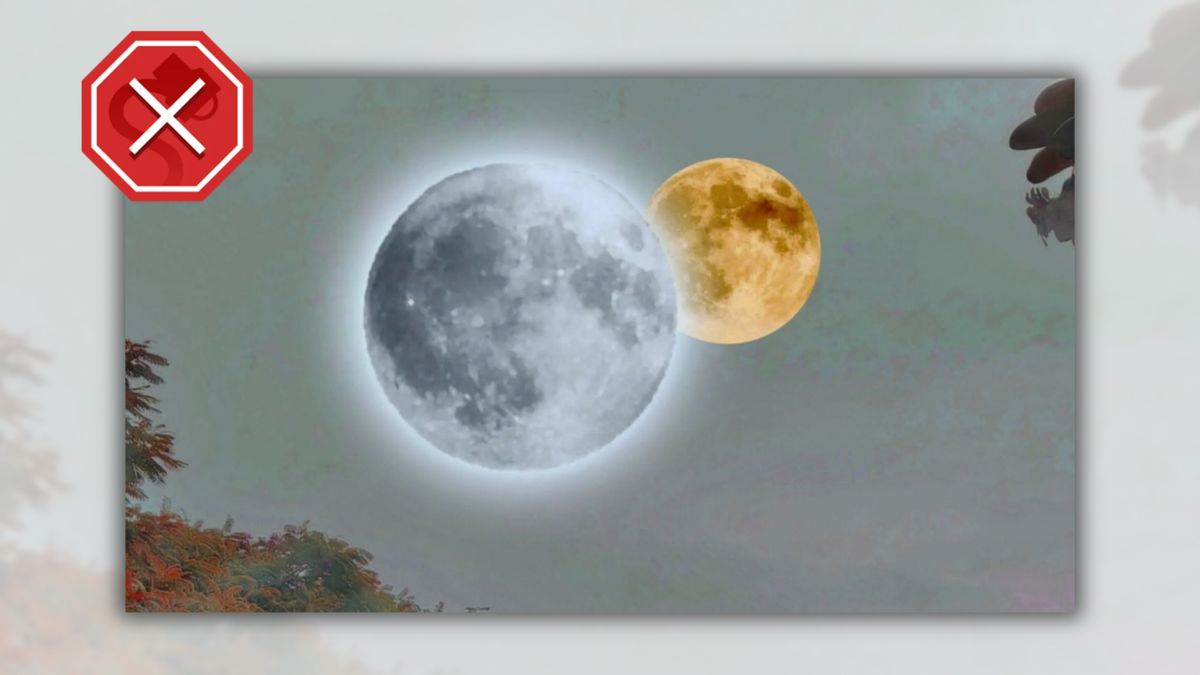
Posts about the alleged phenomenon referred to an asteroid that is not visible with an amateur telescope, let alone the naked eye. Published Sept. 29, 2026 Claim: There will be a "two-moon night" on Sept. 29, 2026. Rating: ContextThe celestial object referenced in the posts making the claim, asteroid 2025 PN7, is not visible to the naked eye, binoculars or even amateur telescopes. Because its orbit around the sun is very similar to Earth's own orbit, 2025 PN7 is considered a "quasi-moon." In late September 2026, some Facebook pages spread a rumor that Sept. 29 would be a "two-moon night." For example, text on an image in one Facebook post (archived) claimed that "Earth may seem to have two moons in the sky." The text of the post read: 😯👉🌙✨ A RARE "TWO-MOON" NIGHT IS COMING! ✨🌙 On September 29, 2026, skywatchers may notice an unusual celestial event. Earth's natural Moon will share the night sky with asteroid 2025 PN7, a small object described as a temporary quasi-moon. 🌌🔭 Although 2025 PN7 is not a true second moon, its unusual relationship with Earth makes it an interesting object to learn about. It's a beautiful reminder that our cosmic neighborhood is constantly changing. Look up, find a clear and dark location, and enjoy the night sky! 🌠✨ Other Facebook pages (archived) posted videos (archived) sharing claim, which largely depicted the moon alongside a smaller, brown-hued version of itself. Snopes readers searched the site and sent emails asking whether the claim was true. However, the asteroid referenced in the posts, 2025 PN7, is not visible to the naked eye, binoculars or even amateur telescopes. Therefore, we've rated this claim false. On NASA's September 2026 skywatching tips page, a "two-moon night" is not named among the listed "skywatching highlights" for the month. That's because there won't be a visible "second moon" in the sky. The reason why is that asteroid 2025 PN7 is too small, too far away and not nearly bright enough to be visible, according to NASA's small-body database. Let's break down the specifics: The asteroid has a diameter of about 60 feet, according to the Las Cumbres Observatory, or approximately the length of a bowling lane. That's less than one-third the length of a Boeing 787 passenger airplane, which is between 186 and 224 feet long. The moon, on the other hand, has a diameter of 2,159 miles, about a quarter of Earth's diameter. Not only is this asteroid much, much smaller than the moon, it's also much farther away. The average distance of the moon from Earth is about 238,000 miles, according to NASA. The space agency's small-body database says that, at its closest approach in 2026 (visible on Page 12 of the closest approach table), 2025 PN7 was nearly 2.8 million miles from Earth — more than 11 times the distance from the moon to Earth. Astronomers quantify how visible stars, planets, asteroids and other celestial objects are in the sky through a measure called apparent magnitude. Brighter objects have lower values, while dimmer objects have higher values. The sun has an apparent magnitude of -26.5, while the full moon has an apparent magnitude of -12.5. Unsurprisingly, asteroid 2025 PN7, which is both much smaller and much farther away than the moon, is not nearly as bright as the moon. NASA's small-body database records the apparent magnitude of objects over time through a table called an Ephemeris. On Sept. 29, the apparent magnitude of the asteroid is 24.373. On its brightest night in 2026 — Aug. 4 — its apparent magnitude was just under 21. According to the Australia Telescope National Facility, people can usually see objects up to an apparent magnitude of approximately 6.5 with the naked eye when there is a clear, dark sky with no light pollution. With binoculars, a person might be able to see up to an apparent magnitude of 10. With an amateur telescope, a person may be able to see objects up to 14 or 16 apparent magnitude. As a "quasi-moon," asteroid 2025 PN7 actually orbits the sun. It appears to orbit the Earth like an actual moon only because its orbital path around the sun is very similar to Earth's own. For further reading, we previously fact-checked the claim that 2025 PN7 was temporarily a "second moon" orbiting Earth. Sources "2025 PN7 Details | LCO NEOx." Neo Exchange, Las Cumbres Observatory, 2025, https://neoexchange.lco.global/target/154945/. Accessed 29 Sept. 2026.Basey, David. "The Brightness of Stars – British Astronomical Association." British Astronomical Association, 24 Mar. 2018, https://britastro.org/2018/the-brightness-of-stars. Accessed 29 Sept. 2026."Boeing: 787 Dreamliner." Boeing.Com, 2024, https://www.boeing.com/commercial/787. Accessed 29 Sept. 2026."Bowling Lane Dimensions & Drawings | Dimensions.Com." Www.Dimensions.Com, https://www.dimensions.com/element/bowling-lane. Accessed 29 Sept. 2026.Fun Facts About the Moon. NASA Jet Propulsion Laboratory, https://nightsky.jpl.nasa.gov/media/documents/attachments/Fun_Facts_About_the_Moon.pdf. Accessed 29 Sept. 2026."Meet Earth's New 'Quasi-Moon!'" Liberty Science Center, 23 Oct. 2025, https://lsc.org/news-and-social/news/meet-earths-new-quasi-moon. Accessed 29 Sept. 2026."Small-Body Database Lookup (2025 PN7)." NASA Jet Propulsion Laboratory, https://ssd.jpl.nasa.gov/tools/sbdb_lookup.html#/?sstr=54542757&view=PC. Accessed 29 Sept. 2026."The Magnitude Scale - Australia Telescope National Facility." Australia Telescope National Facility, 18 Feb. 2026, https://www.atnf.csiro.au/resources/education/senior-astrophysics/photometry/magnitude/. Accessed 29 Sept. 2026.Villanueva, Raquel. "What's up: September 2026 Skywatching Tips From NASA." NASA Science, Sept. 2026, https://science.nasa.gov/solar-system/skywatching/whats-up-september-2026-skywatching-tips-from-nasa/. Accessed 29 Sept. 2026. By Emery Winter Emery Winter is based in Charlotte, North Carolina, and previously worked for TEGNA'S VERIFY national fact-checking team. They enjoy sports and video games. Article Tags
Don't expect to look up and see a '2-moon night' on Sept. 29, 2026
Full Article
Original Source
Read the full article at Snopes →KhanList aggregates and links to publicly available news content. We do not host full articles from third-party sources. Always verify important information with original sources.