
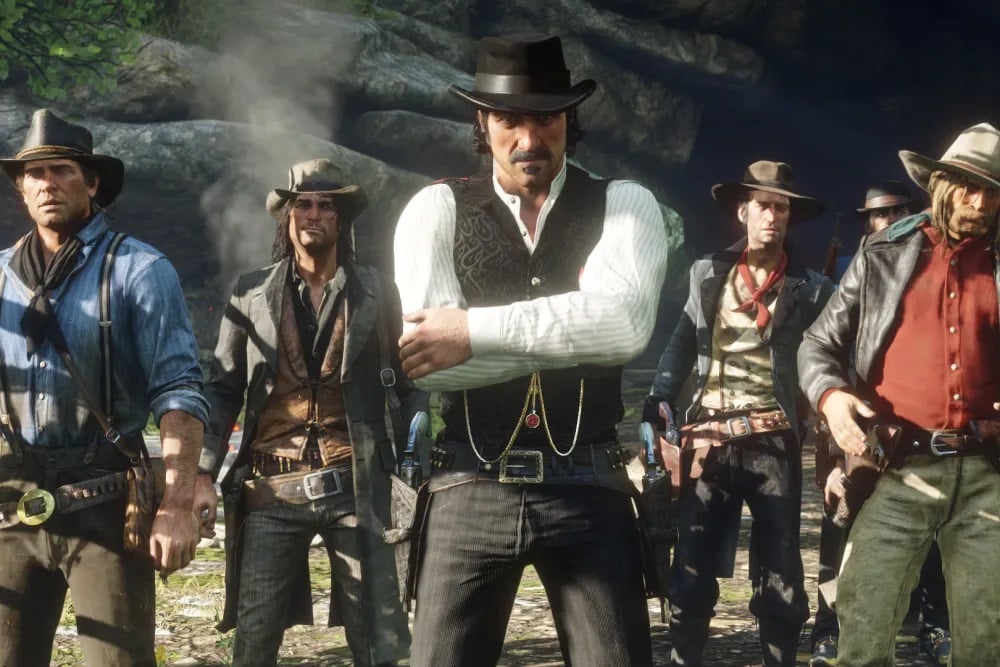
With many legacy franchises in decline and few new ones taking off, Hollywood has turned to video games for big box office blockbusters. There have been huge success stories like Minecraft and big bombs like Borderlands. But some of the biggest video game series have yet to make the jump to the silvers screen. Chief among them is Grand Theft Auto. Could that be about to change? According to a report in The Ankler this week, the answer is no. Multiple sources told the outlet that Rockstar Games isn’t interested in doing a movie adaptation of GTA. It makes sense, in a way, since GTA has increasingly become a series about bringing prestige, cinematic storytelling to the messy, systems-driven gameplay of open-world gaming. Putting that engine in reverse would be a bit like turning the video game version of Indiana Jones back into a movie. Who would ever do that? But it sounds like Rockstar, owned by Take-Two, is interested in shopping around the rights for a movie or TV adaptation of its Western open-world series, Red Dead Redemption. The Ankler adds that a number of $100 million was at one point thrown around for the price of licensing Red Dead. It points out that Amazon paid $250 million for the TV rights to Lord of the Rings. Red Dead is in a similar lane to The Last of Us, which HBO managed to thread the needle on making into a prestige television show that still hooked fans of the game. It’s easy to imagine a similarly placed streamer doing the same for Rockstar’s IP, with internal executives pointing to mood boards that include the critical success of things like Deadwood and the commercial appeal of things like Yellowstone. “We’re very careful about line extensions because this is a creative company and our goal is to make the best entertainment on earth. Entertainment we’re always proud of,” Take-Two CEO Strauss Zelnick, who used to be COO at 20th Century Fox, said in an interview on The David Rubenstein Show November 12. “We would make a movie or television show based on our intellectual property if our creative teams were passionate about it. If they thought that would somehow engage and delight our consumers. It’s a high bar to do that. And of course, there’s always a risk of failure. So we don’t rule it out, but we’re very, very selective.” He’d given shareholders a more detailed account of this reasoning back in 2023 during Hollywood’s Barbenheimer-craze” The hit ratios in the motion picture business are vastly lower than they are in the interactive entertainment business. Our hit ratios for console properties are in the 80 percent or 90 percent. The hit ratio for a well-run movie studio is around 30 percent, which is to say there’s a 70 percent chance that the movie that we license could fail. And so in success, the number, in terms of the benefit to our bottom line…it’s not zero, but it’s not really material to what we do around here. And in failure, we run the risk of compromising the underlying intellectual property. The race to adapt other popular game franchises is already well underway. According to The Ankler, Amazon, Netflix, and FX are paying between $15 million and $25 million per episode for adaptations of Tomb Raider, Assassin’s Creed, and Far Cry. Those are essentially mid-range Hollywood blockbuster budgets. But Take-Two hasn’t rushed to turn its IP into streaming adaptations, and following the disaster that was the Borderlands movie, which was in production prior to it acquiring series maker Gearbox Entertainment, it has good reason to be. It’s games are already breaking sales and revenue records that Hollywood can’t compete with (GTA 6‘s day-one revenue eclipsed Avengers: Endgame). Why jeopardize that for a small side deal? A good Red Dead show could help the game sell ten million more copies, but a bad one could severely hamper its growing popularity beyond traditional gaming audiences. “They thought we’d be blinded by the lights and that just wasn’t the case,” Rockstar cofounder Dan Houser, who left to form his own entertainment company, said last year when talking about past discussions. “We had what we considered to be multi billion dollar IP, and the economics never made sense. The risk never made sense. In those days, the perception was that games made poor-quality movies.” A 2008 adaptation of Max Payne, which Remedy Entertainment developed but Rockstar publishes, starred Mark Wahlberg and was moderately successful at the box office but critically panned with a 15 percent on Rotten Tomatoes. The misstep didn’t doom the series, which eventually got Max Payne 3 and is currently slated for remakes of the first two games, but it’s clearly not the sort of thing Rockstar or Take-Two are interested in repeating, especially when legacy movie studios are in the decline and they’re the entertainment industry’s new big shots.
Don’t Expect A Grand Theft Auto Movie Anytime Soon And Here’s Why
Full Article
Original Source
Read the full article at Kotaku →KhanList aggregates and links to publicly available news content. We do not host full articles from third-party sources. Always verify important information with original sources.