
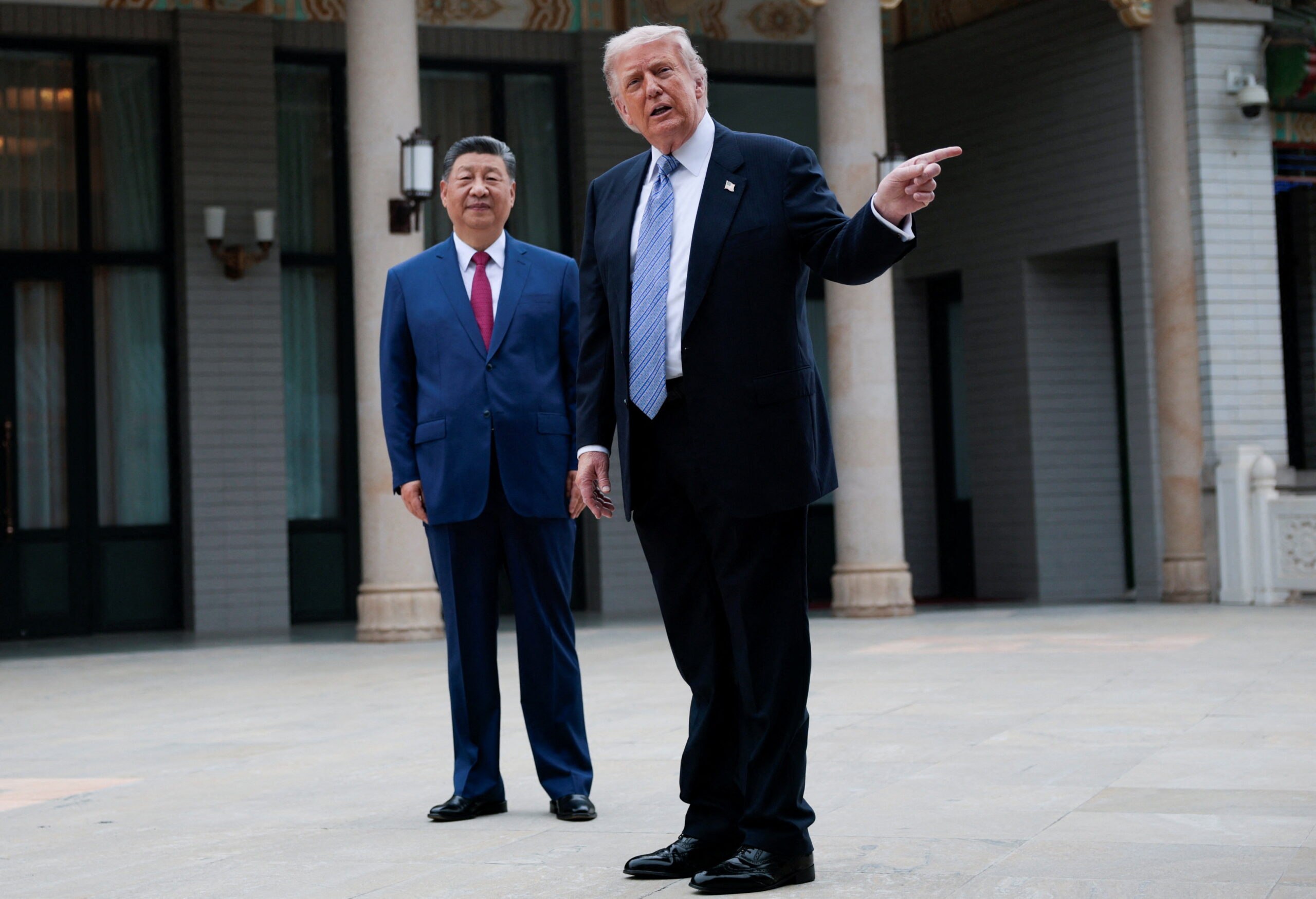
WASHINGTON—Discussions about artificial intelligence (AI) have exploded in recent days as several industry leaders and researchers have warned of the need to “pace the frontier” of AI development. Some have cited “loss of control”—the likelihood of catastrophic risks to humanity due to AI going rogue—as the motivating factor in their speaking out now. The stakes extend well beyond AI safety. Both Washington and Beijing frame AI as central to economic competitiveness and national power. US President Donald Trump, for example, has said that “there’s only going to be one winner here, and that’s probably going to be the U.S. or China. And right now we’re winning by a lot.” Meanwhile, Chinese President Xi Jinping has described accelerating next-generation AI development as “a key strategic lever for gaining the initiative in global technological competition.” As a general-purpose technology, AI strengthens economic and military capabilities across sectors and gives the country with the stronger ecosystem greater influence over the platforms, standards, and rules adopted globally. The balance of AI capabilities will certainly be a deciding factor in the broader systemic competition between the two countries. The series of warnings on AI comes as the United States and China prepare to hold AI safety talks between senior officials in advance of a planned Trump-Xi meeting in Washington later this month, raising questions about whether either side would accept constraints that could weaken its competitive position. Beyond the leaders’ statements on AI, there are several factors that make meaningful cooperation on a slowdown more or less likely. Factors in favor of a deal First, on the positive side, there are strong signals that the People’s Republic of China (PRC) and the United States share significant overlap in their conceptions of frontier misuse risks, which should motivate both sides to engage meaningfully on the issue. At a speech at the July 2026 World AI Conference held in Beijing, Xi made specific reference to the risks of loss of control. While the PRC has previously acknowledged these risks in various settings and fora, as well as in its latest AI safety standards guidance, the speech was significant in that Xi elevated shikong, or loss of control, in a major international speech and paired that concern with a proposal for how governments should address it. Xi underscored the need to monitor AI systems for dangerous behavior, detect emerging risks early, maintain procedures to ensure human control, and develop international rules for advanced AI. For the PRC, risks arising from AI that may affect social and economic stability, and thus party control—a main motivator for controlling AI in the first place—will surely take precedence in any broader PRC AI safety agenda. There are also technical reasons motivating China to come to the table on AI safety. Chinese developers lose visibility once users deploy their (overwhelmingly) open-weight models on infrastructure they do not control, including on US cloud platforms. Sharing evidence of abuse would help these developers identify vulnerabilities, strengthen safeguards, and improve subsequent model releases. Additionally, both the US and the PRC seem to want some kind of progress before the Trump-Xi meeting later this month, so there is also political motivation toward some kind of deliverable. Factors against a deal However, critical roadblocks make the prospect of both sides reaching some significant agreement on AI safety before the September 24 meeting unlikely. The most significant roadblock is a dual credibility problem: China doubts US motives for engaging in safety talks, while Washington has concrete reasons to question whether China would honor, report, or operationalize any safety arrangement. China appears suspicious that the US would use the guise of AI safety talks to seek to constrain China and promote its own tech dominance. For instance, in the same breath as citing loss of control as one of the five main security risks related to AI on September 1, a senior official at China’s main AI regulator called “risks of technological hegemony” one of the core challenges, specifically citing efforts to “maliciously smear” other countries’ “technological development.” Similar statements from official sources conclude that any efforts to engage in bilateral AI talks must take place on equal footing, and specifically call out that China will not let the United States “unilaterally define” frontier model risk thresholds. They also argue that the talks must distinguish between real safety threats and “technological competition” and, perhaps most tellingly, that if the United States is serious about discussing rules, then it must first prove that those rules also apply to American companies. That PRC official sources have repeatedly singled out Anthropic, a company viewed in China as both leading US safety advocacy and supporting restrictions on Chinese AI development, only reinforces this skepticism. Meanwhile, the United States also has its own reasons to question whether Beijing is a viable deconfliction partner. Some have suggested formal channels, such as a hotline, between the two countries in case of an AI related crisis. But such a channel would be useful only if it functions during a crisis, and past incidents have shown that Chinese counterparts have rejected or failed to answer senior-level requests for calls and meetings during times of high tension. One example occurred in February 2023, immediately after the United States shot down a PRC surveillance balloon. Beijing reportedly declined a US request for a call between then-Secretary of Defense Lloyd Austin and his Chinese counterpart to de-escalate the confrontation. The United States also has reason to doubt the PRC will honor any bilateral commitments on AI. Drawing lessons from the cybersecurity space, in 2015, Xi and then-US President Barack Obama agreed that neither government would knowingly support cyber-enabled theft of intellectual property for commercial advantage. Three years later, the US Trade Representative concluded that China had not fundamentally altered the technology-transfer, intellectual-property, and cyber practices under investigation. Recent AI-specific disputes deepen those concerns on the US side. In September, the National Security Agency, the Federal Bureau of Investigation, and the Cybersecurity and Infrastructure Security Agency accused several China-based AI companies of using unauthorized, industrial-scale distillation to extract proprietary capabilities from US frontier models. (China has rejected the allegation, noting that distillation is a widely used and legitimate technique.) Separately, a 2025 guilty plea confirmed at least one China-linked scheme involving completed and attempted exports of $160 million in controlled advanced graphics processing units. Meanwhile, OpenAI and the New York Times have also reported that PRC-linked actors are conducting information operations to undermine domestic support for data centers, the infrastructure underpinning US AI competitiveness. A narrow but realistic way forward While none of these examples prove that Beijing would without a doubt violate an AI agreement, they highlight why any agreement on pacing would be inseparable from disputes over technology security, compliance, and enforcement. Any major breakthrough on these issues is therefore unlikely in the short term. Anthropic co-founder Dario Amodei’s recent essay captures this tension between cooperation and competition with China—arguing that global pacing “requires” cooperation between the two sides, while insisting that any agreement would need “ironclad verifiability” while also “protecting the lead of the U.S. and its allies.” That is a tall order for two countries that share deep mutual distrust and mutually exclusive definitions of who should hold the competitive edge in global AI competition. Nonetheless, there exists a narrow but meaningful path for bilateral cooperation on deconfliction in the context of loss-of-control issues. In other words, deconfliction can be possible, even if a broad, trust-based slowdown is unlikely. The immediate objective would be to prevent a serious model failure, unauthorized cyber operation, or non-state misuse from being mistaken for deliberate state action. Before a hotline can count as a deliverable, Washington needs to know who would pick up the phone in Beijing, what authority that official would possess, and whether the channel would remain active when political tensions rise. On the technical side, Amodei himself suggested beginning with narrow prohibitions on plainly dangerous uses, including AI-enabled biological weapons, followed by common pre-release testing. Only later would the two sides address possible limits on recursive self-improvement. A track 1.5 dialogue in August laid some initial groundwork, with both sides agreeing on the need for dialogue on AI risks. Chinese scholars on AI have also written extensively on possible avenues for cooperation and deconfliction, including preventing abuse from non-state actors and jointly developing rules, technical monitoring, risk-warning, and emergency-response systems. And further indications of how the PRC is conceptualizing loss-of-control risks should come with the release of the next version of China’s AI safety governance standards, expected mid-September. Lastly, deconfliction does not have to be exclusively bilateral. The US and its allies should develop common definitions of serious incidents, testing protocols, and conditions for using Chinese models, which could establish a broader baseline and make those standards harder to dismiss by the Chinese side as unilateral US demands. Washington’s own policies also affect this leverage. A June 2026 order restricting foreign access to Anthropic’s most advanced models forced the company to disable them worldwide. This incident illustrated how uncertainty over US access can encourage foreign users—even allies and partners—to seek Chinese alternatives. Reliable allied access to guarded American systems could make those models more attractive than Chinese alternatives. Given the stakes of global AI competition and the importance both countries have placed on maintaining their competitive edge, a comprehensive pause is highly unlikely, because an undetected defection could shift the balance of power. However, the need for cooperation is urgent: Washington and Beijing must find a way to “pace the frontier” before AI development outpaces humanity’s ability to control it. Deconfliction and a focus on narrow provisions related to loss of control may offer a rare basis for cooperation, and a meaningful start.
Don’t count on Trump and Xi to slow down AI. Don’t count them out either.
Full Article
Original Source
Read the full article at Atlanticcouncil →KhanList aggregates and links to publicly available news content. We do not host full articles from third-party sources. Always verify important information with original sources.