
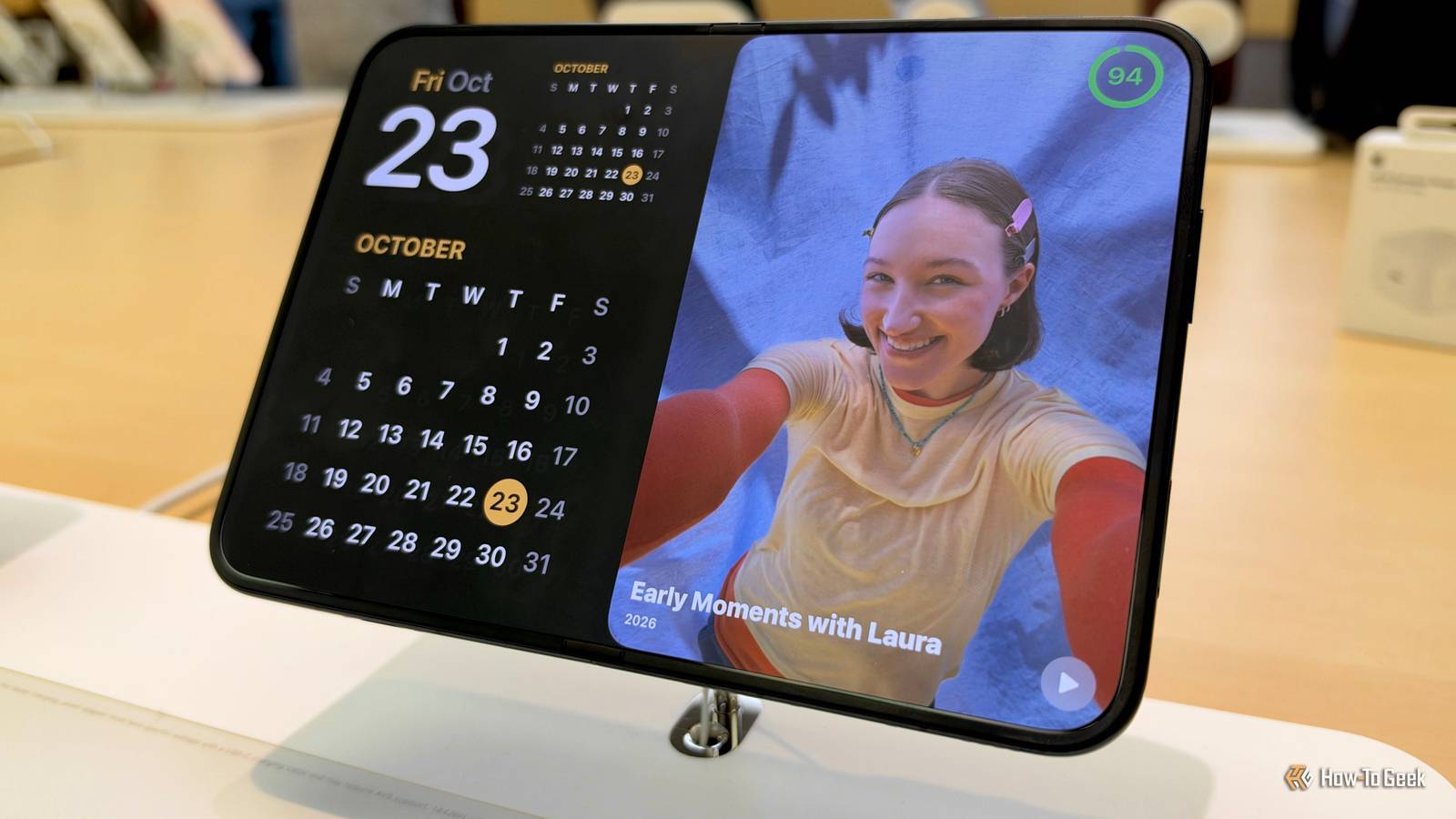
Published Nov 5, 2026, 7:00 PM EST Bertel is a lifelong tech enthusiast with over a decade of experience writing thousands of articles about Android devices, Linux, and more. Before joining the How-To Geek team, Bertel wrote for the likes of MakeUseOf, MakeTechEasier, and Android Police—at the latter he wrote over 3,500 articles. He delights in helping others decide which tech to bring into their lives... and which tech to do without. Bertel graduated from the College of William and Mary in 2012 with degrees in History and Government. He has spent his entire career as a tech journalist covering Android, Linux, wearables, smart home devices, and more. As someone who loves foldable phones, I’m happy the iPhone Duo exists. Apple’s first foldable phone has brought a lot of excitement and attention to a device category that, despite being around for nearly a decade, most people haven’t experienced. There are many now asking themselves if the iPhone Duo should be their first foldable phone — that answer, sadly, is no. Foldable phones aren’t new. Samsung and Motorola have been selling them here in the U.S. for eight years, while Chinese brands like Huawei and Oppo are now pushing the boundaries of what this type of device can do. These companies have all learned a lot in that time. The iPhone Duo, at its best, replicates the things these companies have done right. In other areas, Apple has simply walked headfirst into problems that other phone makers had the foresight to avoid. The iPhone Duo’s app situation is a mess No Android foldable has ever shipped with app compatibility quite this bad When you hold an iPhone Duo in your hands at the Apple Store or at Best Buy, the apps you can play with present an impressive picture. They all adapt quite well to both the inner and outer screens, filling each screen in compelling ways. Yet if you've been following the iPhone Duo, you’ve probably seen photos and video by now that shatter this illusion. The apps you see on display at the store are developed by Apple. When you go to install apps from other developers, or even some of Apple’s other apps, things quickly fall apart. Some iPhone apps float in the middle of the screen, immersed in a sea of black. Others are larger but still meet with black bars on one or both sides. Only those that have been explicitly updated with iPhone Duo support properly fill both screens. Even then, many developers haven't actually made the effort to adapt app interfaces in a way that actually makes sense. They may look the part, but important buttons remain off-screen, or some parts of the interface overlap others. Many expected the iPhone Duo to resemble two iPhone Airs glued together, like many existing book-style foldables. This would have allowed all existing iPhone apps to feel at home on the cover screen, and developers would only need to create new interfaces for the inner one. But Apple wanted its device to be different, and it’s the one phone company with both the history and hubris to believe app developers will put in extra work for this one specific device. It makes sense—the iPhone Duo will easily outsell any other foldable phone on the market by several orders of magnitude. Android phone makers, including Samsung, don't have Apple's luxury, so they have to design their phones to accommodate apps as they already exist. The upside is that even when an app hasn’t been explicitly updated to work with Android tablets and foldables, it still adequately stretches to fill the entire screen. An Android app that doesn’t have a foldable-specific interface is far more pleasant to use than an iPhone app that doesn’t support the Duo. Weight and thickness should be priority number one Once you've held a Galaxy Z Fold 8, the iPhone Duo feels like a brick I am writing these words on a Motorola Razr Fold. At 243 grams, it is hardly the lightest foldable out there. It is actually heavier than my previous foldable, the Samsung Galaxy Z Fold 6 — but the iPhone Duo, at 254 grams, is heavier than them both. That is only part of the story. My Razr Fold is thinner than the Galaxy Z Fold 6, and it has rounded corners and a gradual camera bump that makes that weight feel better distributed in my hand. By comparison, the iPhone Duo is a short and squat square. When you hold it, that weight is more concentrated. It looks like it should be lighter than the taller phone in my hand, but it isn’t. Quite the opposite, in fact. The iPhone Duo stands in stark contrast with the device it’s most similar in size to, the Galaxy Z Fold 8. At 201 grams, Samsung's passport-shaped foldable is 25% lighter. I don't know if that number looks striking to you, but I invite you to go to a Best Buy and feel the difference for yourself. I personally find the iPhone Duo to be the first iPhone I've considered attractive since the pre-iPhone X days, thanks to the lack of a giant camera notch, but comparing the two in person, the Galaxy Z Fold 8 still feels every bit like the more modern and desirable device. Foldables no longer need inferior cameras Other brands have learned how to put their best camera hardware in phones that fold For most of a decade now, buying a foldable has meant getting an inferior camera to that available in the standard slab version of the phone. Yet in the past year, that has changed. The Samsung Galaxy Z Fold 8 Ultra (think of it as the Z Fold 8’s taller sibling) comes the closest yet to closing the gap with Samsung’s flagship Galaxy S Ultra series. It has better camera hardware than every current Samsung phone except for the Galaxy S26 Ultra. Even in a head-to-head with that device, the megapixel counts are all the same, and the S26 Ultra pulls ahead primarily with a higher aperture and better zoom quality. Other brands have closed the gap further. The triple-camera setup on the back of my Motorola Razr Fold is identical to the camera hardware in the Motorola Signature; DxOMark scored higher than all other Android phones available at the time. Both fall short of the camera hardware available on some of the foldables being sold in China. Meanwhile, the iPhone Duo only has two cameras, much like the Galaxy Z Fold 8. Thanks to Apple’s processing, the iPhone Duo still has an edge over many Android foldables for video recording. But if you’re switching to the iPhone Duo from a modern iPhone Pro, it may feel like going back in time. Compared to Apple's current lineup, the Duo costs the most yet delivers some of the weakest photos. iPhone Duo owners must endure unnecessary growing pains This is Apple’s first swing at a foldable, and while the iPhone Duo does have its advantages, so much of it reeks of being a first-generation device — even though it’s far from being a first-generation foldable. This market is mature, and other brands have figured out how to give you top-notch camera hardware on a lightweight phone with apps that adapt to both screens. If you're wedded to the Apple ecosystem, you’ll have to wait for Apple to figure all of this out, but if you’re willing to comparison shop, there’s little reason to wait at all.
Don't buy the Duo—here's what Apple doesn't get about how to make a good foldable
Full Article
Original Source
Read the full article at Howtogeek →KhanList aggregates and links to publicly available news content. We do not host full articles from third-party sources. Always verify important information with original sources.