
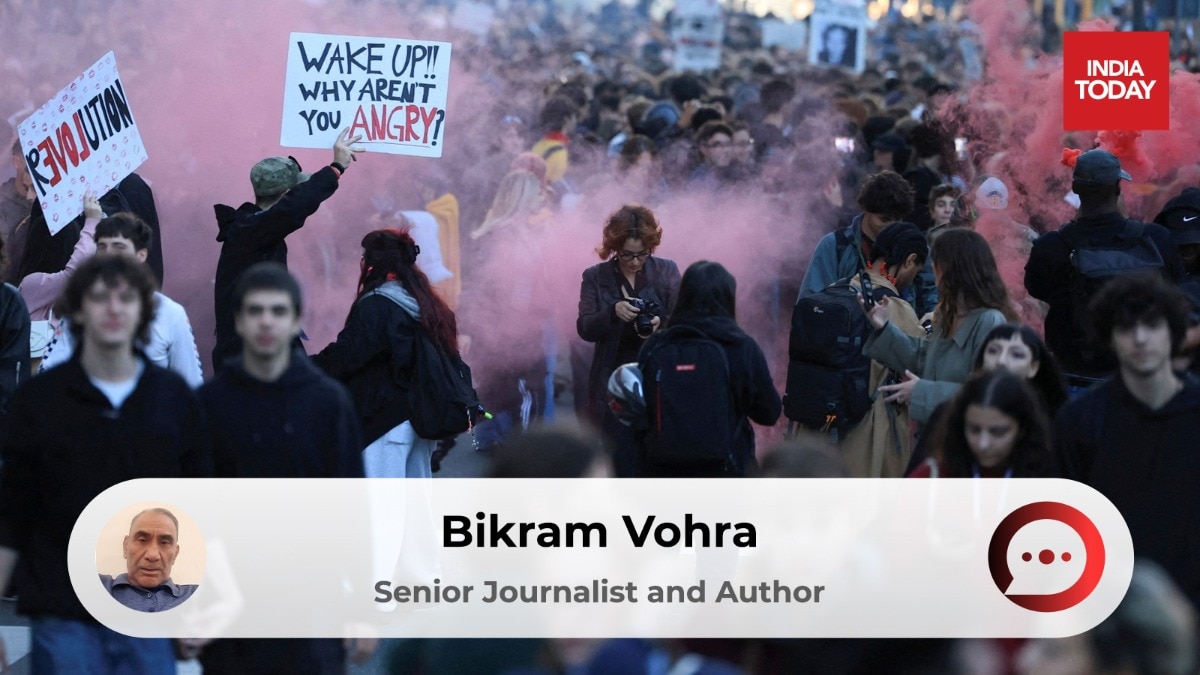
Go to the top of the class, Giorgia Meloni. Good for you. Let me tell you what happened in Milan. Not the sanitised version, but the one that matters. A bunch of people, mostly young, mostly angry about the cost of living, decided that the appropriate response to high fuel prices was to throw stones at police, loot a supermarket, and set fire to scooters near the Duomo.The Italian government, led by Prime Minister Giorgia Meloni, responded with the kind of speed that usually gets lost in committees or stays frozen in a pointless threat mode. Within days, a decree was approved: up to five years in prison and a €20,000 fine for "violent participation in a demonstration", with the added proviso of parents being held financially liable for their minor children's acts of vandalism.Meloni's line was simple: "Protesting is a right, devastating our cities is not" . Absolutely brilliant. About time.Now, I can already hear the chorus from the usual quarters in India. "Fascist!" "Authoritarian!" "How dare they criminalise dissent"? And I ask you: Since when did smashing a bus-stop become a constitutional right? Here is the inconvenient truth that we in India like to dance around. We already have laws. The Prevention of Damage to Public Property Act of 1984 exists. It says you can get up to five years for damage to public property. The Supreme Court has laid down guidelines for recovering losses from rioters and vandals. Uttar Pradesh even has a separate 2020 law for claims tribunals to recover damages.So, it is not that we lack statutes. It is that we lack the spine to apply them when the vandals happen to be on the "right" side of a television debate. Like when the Gen Z protest against the NEET leak erupted into violence, but the government, nudged by the Supreme Court, no less, withdrew all cases against first-time offenders as a precondition for withdrawal of the protests. Kid gloves, indeed. What Italy has done is plug a specific hole. The existing laws in India punish damage after the fact. They treat a broken window as a property offence. Italy's new decree creates a specific offence of violent participation, the act of joining a group of five or more and throwing stones, firecrackers, or sticks in a way that endangers everyone. It targets the behaviour of the mob, not the thought of the protester. That is a distinction we desperately need to understand.In India, we have perfected the art of the "peaceful protest" that somehow ends with a burnt police station, a bus burnt to a crisp or shops looted. We have the "student agitation" that mysteriously involves petrol bombs. And every time it happens, the political class does a little dance. One side says, "Look at the anger, it is justified."The other side says, "Look at the violence, it is a conspiracy". Nobody says the obvious thing: If you are angry about inflation, how does setting fire to a public bus help the poor man who relies on it to get to work?The Milan riots were not a political revolution. They were a temper tantrum with expensive consequences. The local retail association estimated damage to shops at over €500,000. That is money out of the pockets of small shopkeepers who had nothing to do with energy prices or government policy. When you loot a supermarket you are not sticking it to the man. You are stealing from the cashier who is also struggling to pay her bills.This is why the Indian debate needs to move past the reflexive flinch. Every time a government suggests penalizing vandals, someone screams "Emergency". But there is a vast, unbridgeable gap between arresting a person for holding a placard and arresting a person for throwing a brick through a window.The Supreme Court itself has repeatedly drawn this line, noting that the right to protest does not extend to the indefinite occupation of public roads or the destruction of property, but then we know the exact opposite was done after the July Gen Z protest.The Italian decree has its flaws. Extending preventive detention to minors and holding parents financially liable for teenagers who are almost adults feels like a blunt instrument. It will almost certainly be challenged in courts. But the core principle, that accountability must be individual and immediate, is something India should study, not sneer at. And adopt it in principle....and practice.Because here is what happens when we don't. We get a culture where a protest is judged not by the validity of its grievance, but by the volume of its disruption. The loudest, most destructive voices drown out the quiet, reasonable ones. The student with a well-researched pamphlet gets ignored while the guy with a Molotov cocktail gets a prime-time debate.India is not Italy. Our policing is different, our courts are slower, and our political temperature is always set to "boil". But the core question Meloni asked is universal. If you claim to be protesting for the lay persons, why are you making their lives worse by destroying the infrastructure they depend on?So, yes, demonstrate. March. Shout. But do not devastate. Do not turn a grievance into a smash-and-grab. Because the moment you pick up a stone, you are no longer a protester. You are a vandal with a convenient excuse. And a society that cannot tell the difference is a society that is not so slowly, foolishly, burning down its own house to make a point.(Views expressed in this opinion piece are those of the author)- Ends
Don't burn the house down to prove you are angry
Full Article
Original Source
Read the full article at Indiatoday →KhanList aggregates and links to publicly available news content. We do not host full articles from third-party sources. Always verify important information with original sources.