
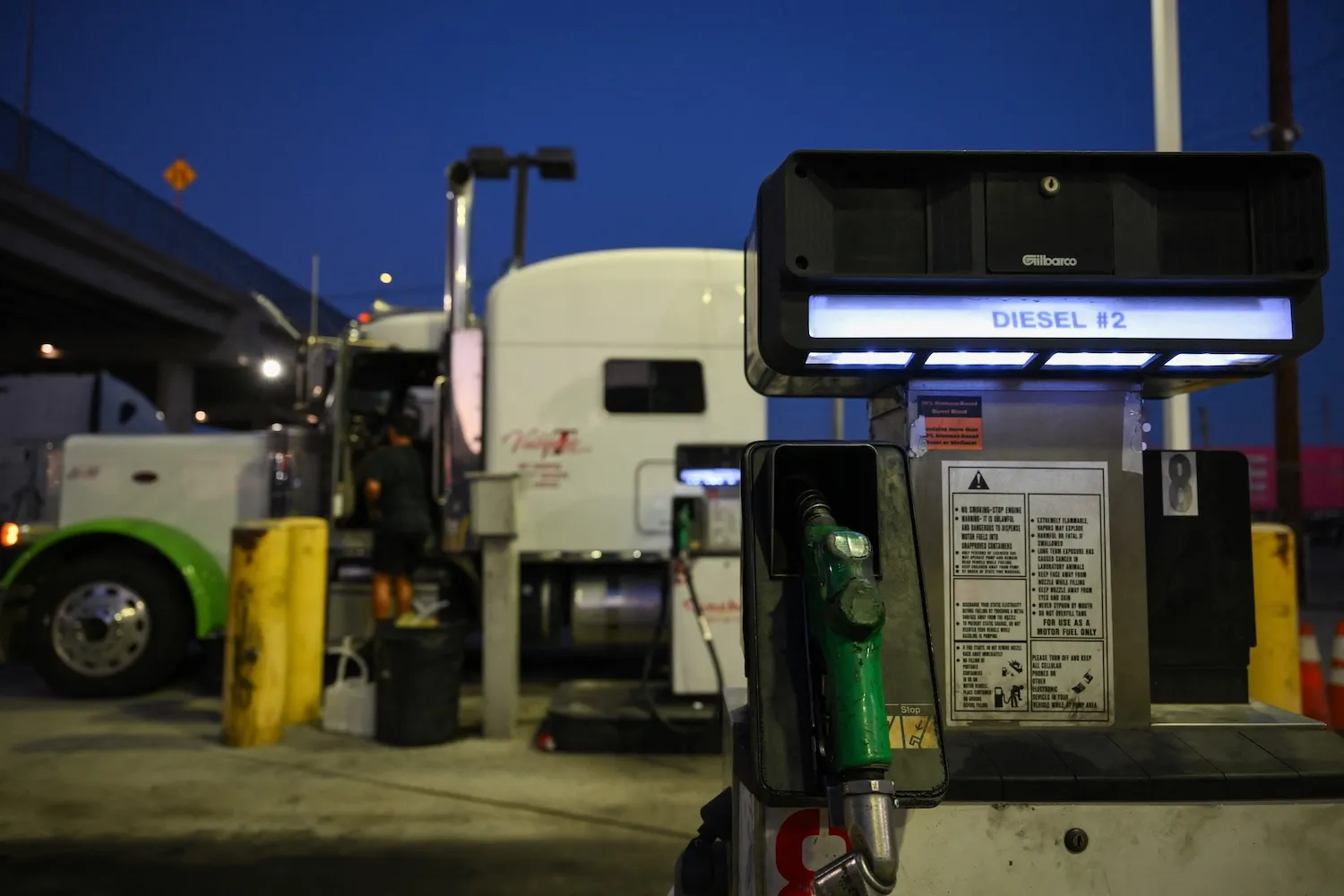
Trump’s proposed solution to rising diesel prices would backfire economically and geopolitically. By , a columnist at Foreign Policy and the founding director of Columbia University’s Center on Global Energy Policy, and Bob McNally, the founder and president of Rapidan Energy Group. A truck sits parked at a diesel fuel pump in the Wilmington neighborhood of Los Angeles, California on September 22. A truck sits parked at a diesel fuel pump in the Wilmington neighborhood of Los Angeles, California on September 22. Patrick T. Fallon / AFP via Getty Images September 29, 2026, 9:28 AM As inventories run dry and the Iran war continues to disrupt transit routes, oil has surged back to more than $100 per barrel. Diesel fuel—the workhorse of the agricultural and trucking sectors—has now soared to historic highs, pushing U.S. exports to record levels. With the U.S. midterm elections approaching, Republicans in farm states such as Iowa and Nebraska are demanding relief. In response, U.S. President Donald Trump has endorsed a flawed idea from the 1970s: banning exports. Keeping energy at home to lower prices may seem like common sense, but in reality, this would backfire. If enacted, a diesel export ban would eventually lead to higher prices, discourage investment in supply over time, and undermine the administration’s energy dominance agenda. As inventories run dry and the Iran war continues to disrupt transit routes, oil has surged back to more than $100 per barrel. Diesel fuel—the workhorse of the agricultural and trucking sectors—has now soared to historic highs, pushing U.S. exports to record levels. With the U.S. midterm elections approaching, Republicans in farm states such as Iowa and Nebraska are demanding relief. In response, U.S. President Donald Trump has endorsed a flawed idea from the 1970s: banning exports. Keeping energy at home to lower prices may seem like common sense, but in reality, this would backfire. If enacted, a diesel export ban would eventually lead to higher prices, discourage investment in supply over time, and undermine the administration’s energy dominance agenda. The wars in Iran and Ukraine have squeezed diesel supplies from two of the world’s most important sources. Prior to the war, the Middle East represented more than 15 percent of global diesel exports. Yet attacks on refineries and restrictions on shipping through the Strait of Hormuz have lowered refinery runs by more than 25 percent since last year and thus sharply curtailed refined fuel exports. Meanwhile, Ukrainian strikes on Russian refineries have helped drive diesel production nearly 30 percent below 2025 levels. Russia, normally the world’s second-largest diesel exporter, has restricted exports to conserve fuel at home and announced plans to import diesel to meet domestic demand. After Iran choked off most transit through Hormuz, the United States and other International Energy Agency members released record volumes from their strategic reserves—but those stocks consisted largely of crude, which must be refined before consumers can use it. The world has far fewer buffers against shortages of diesel. Refineries globally are already running near full capacity to capitalize on high fuel prices, while nearly 2 million barrels per day of refining capacity has been lost across the United States, Europe, and parts of Asia since 2020. The only significant spare capacity lies in China, which has restricted fuel exports to protect domestic supplies. As a result of these shortages, diesel prices have soared to record highs of more than $6.50 per gallon. U.S. refiners have responded by surging output and exporting record levels of diesel to fill the global shortage. With few options to rein in high prices—and farmers, truckers, and other consumers feeling the pinch—Trump said last week, “Let’s not send out the diesel.” The temptation is understandable. Trapping fuel at home would temporarily lower prices in some regions, mainly the U.S. Gulf Coast, where refinery output would build up inventories and lower prices at the pump. But brief localized price dips would soon be reversed. Faced with the sudden loss of export demand, refiners would soon reduce operations. Moreover, because refineries produce several fuels together, lower refinery runs would also reduce supplies of gasoline and jet fuel, causing prices for those products to rise. In the longer term, an export ban would lower prices and weaken refiners’ incentives to sustain output or invest in additional refining capacity. As refinery output declines, refiners would buy less crude oil—and that drop in demand would discourage producers from investing in additional supply, ultimately lowering U.S. oil production. The international repercussions of an export ban would also negatively impact U.S. markets. The United States is the world’s largest diesel exporter, supplying roughly one-fifth of seaborne traded diesel. Restricting those shipments would drive up prices abroad, hurting not only customers in Europe and Latin America but also consumers in coastal U.S. markets that rely on imported fuel. What’s more, an export ban would also hand China a geopolitical advantage. The countries most dependent on U.S. diesel—such as Mexico, Chile, Ecuador, Peru, and Brazil, along with large European buyers such as the Netherlands and United Kingdom—would be forced to seek supplies elsewhere. With the world’s only significant spare refining capacity, China would be best positioned to help so long as it agreed to relax its export restrictions. Washington would thus push its own allies toward Beijing, giving China greater leverage over their energy security. Washington has long championed open, reliable energy markets and criticized countries that hoard supplies during crises. That position reflects a principled commitment to free trade but also U.S. self-interest. When hurricanes shut down Gulf Coast production and refineries, for example, access to global supplies helps cushion the blow for U.S. consumers. An export ban would further undermine confidence in the United States as a reliable supplier, making foreign buyers more reluctant to sign long-term contracts and investors more wary of financing U.S. energy projects. It would strain relations with allies, potentially trigger trade retaliation, and weaken Washington’s standing to challenge Beijing’s restrictions on rare earths and other critical materials. U.S. objections to economic coercion carry less weight when the United States, too, withholds essential supplies under pressure. Finally, this approach has been tried before and has failed. In the 1970s, Washington adopted export bans on crude oil and refined products to keep scarce oil at home and support price controls. But these measures backfired, depressing domestic production and raising prices. Subsequent political leaders then reversed this ill-fated experiment. The Reagan administration first lifted restrictions on refined products, and then the Obama administration and Congress lifted restrictions on crude oil. Rather than banning diesel exports, Trump should learn the lessons of history and not sacrifice U.S. energy clout and geopolitical strength for fleeting political relief. United States Jason Bordoff Jason Bordoff is a columnist at Foreign Policy and the founding director of Columbia University’s Center on Global Energy Policy. He is a professor of professional practice in international and public affairs, co-founding dean emeritus at the Columbia Climate School, and former senior director on the staff of the U.S. National Security Council and special assistant to former U.S. President Barack Obama. X: @JasonBordoff Bob McNally is the founder and president of Rapidan Energy Group and author of Crude Volatility: The History and the Future of Boom-Bust Oil Prices. In 2001-03, he served as a special assistant to U.S. President George W. Bush on the National Economic Council. Read More U.S. President Donald Trump is seen standing behind Gen. Dan Caine at the White House. By Nearly Every Metric, the U.S. Is Losing the Iran War “It’s irrefutable that the U.S. failed in its main strategic goals,” one expert said. A large ship is seen on the water at sunset. Don’t Blame Ukraine for High Gas Prices Kyiv’s energy war on Russia may hurt on the margins, but the real culprit is Trump’s war on Iran. OTHER SUBSCRIPTION OPTIONS Stories Readers Liked Go to slide 1 Go to slide 2 Go to slide 3 Go to slide 4 Go to slide 5 Go to slide 6 Go to slide 7 Go to slide 8 Go to slide 9 Go to slide 10 A statue of a seated, bearded man with a bare torso and draped cloth around his waist, holding a scroll in one hand, positioned in front of a row of large classical columns. An illustration of Donald Trump in a blue suit and long red tie gesturing with open hands in front of a grid patterned background with jagged red, blue, and black line graphs diving downward. Five people sit in folding chairs pushed up against a wall, all of them on their phones and several looking board. Text on the wall behind them says "AI for Real" with images of robotic arms and household appliances printed around it. An illustration depicting a man submerged up to his nose in water. The wavy water is divided horizontally into three color bands that mimic a flag: white foam at the very top peaks, a deep blue middle section filled with bubbles, and a red lower section covering his neck and suit jacket. His blue eyes look upward with a wide, strained expression. As the Tide Turns Against Putin, Beware the Drowning Man By Peter Frankopan Negotiators from the United States, Canada, and five European countries converse after finishing the draft of the North Atlantic Treaty in Washington on March 18, 1949. Trans-Atlanticism Isn’t Dead—It’s Being Renegotiated By Alexandra de Hoop Scheffer A woman crosses a road in front of a mural depicting Russian President Vladimir Putin in Kashira, Russia, southeast of Moscow, on Oct. 16, 2017. The Western Myth of Russian Greatness By Christian Caryl An illustration of a vintage-style map featuring North America and parts of Europe and Africa. Overlaid on the map are 3D red brick walls shaped exactly like the borders of the contiguous United States and Alaska, casting long shadows to the right. America, the Once Global Nation By Odd Arne Westad A creative illustration against a pale yellow background showing a garden planter containing a dense green hedge. Five human arms emerge from the hedge, with four of the hands holding small flags of China, Russia, the United States, and the European Union, while the fifth hand holds the flag of India. An illustration showing a pair of hands tightly wringing out an American flag. Water droplets shaped like missiles squeeze out of the twisted fabric and fall toward a puddle shaped like the map of Iran on a red background. An aerial photo shows Doha in the booming petrostate of Qatar.
Don’t Ban Diesel Exports
Full Article
Original Source
Read the full article at Foreignpolicy →KhanList aggregates and links to publicly available news content. We do not host full articles from third-party sources. Always verify important information with original sources.