
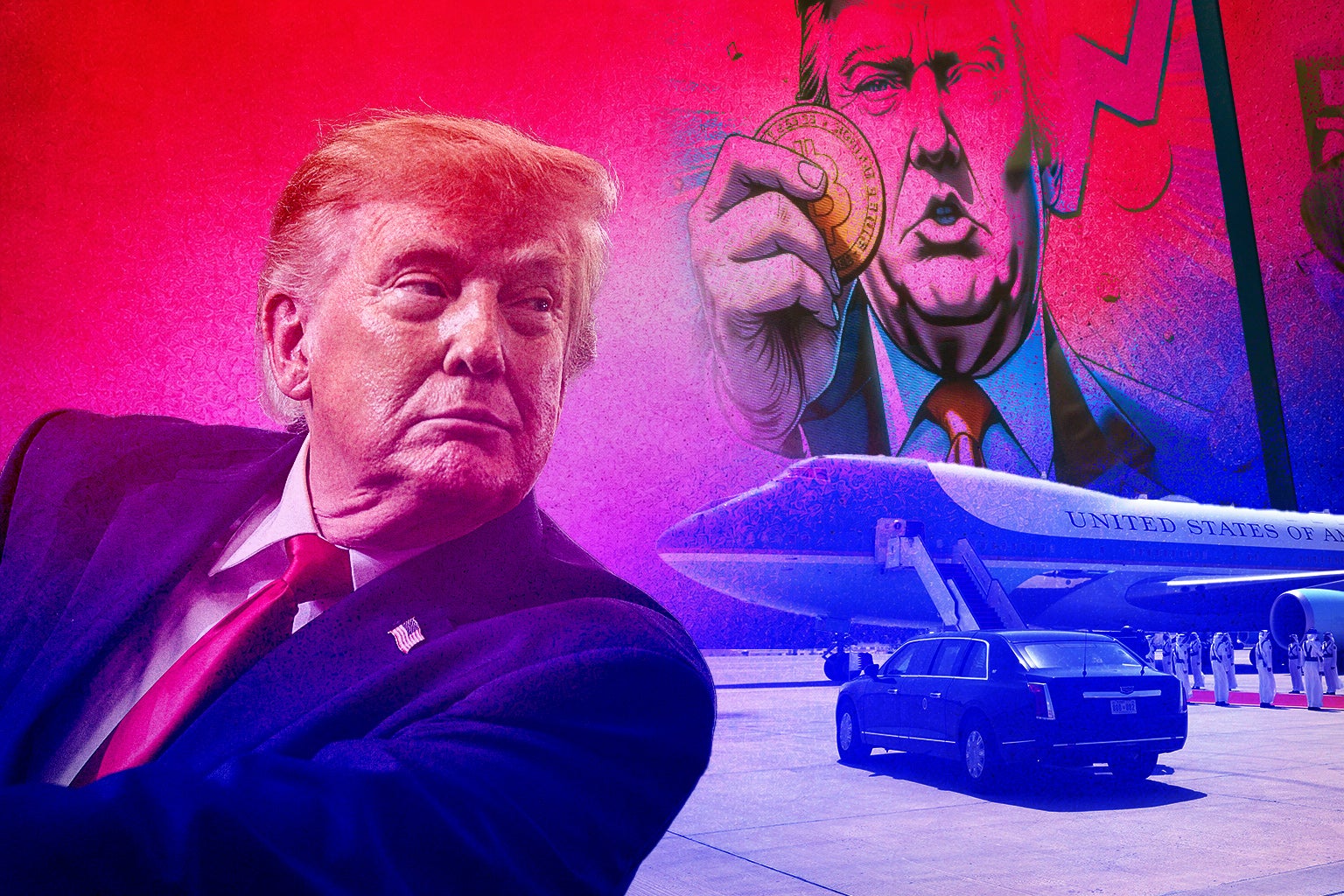
Jurisprudence Photo illustration by Slate. Photos by Mladen Antonov/AFP via Getty Images, Chip Somodevilla/Getty Images, and Win McNamee/Getty Images. This is the fifth in a series of articles, “Try, Try Again?,” drawn from my new book—Great and Dangerous Offences: The Case For (and Against) Impeaching Trump a Third Time—due out in early 2027. The most common ground for impeachment throughout Anglo-American history has been corruption, the misuse of the status and powers of office for private gain, either for oneself or for one’s family, friends, or political allies. Both Parliament and the American Framers abhorred official corruption and made it impeachable because it undercuts the basic contract between rulers and the ruled—that the rulers will not place their private interests, whether in wealth or increased power, over the interests and well-being of the nation. Donald Trump has broken this covenant by repeatedly, corruptly accepting payments and gifts from foreign powers, thereby violating the foreign emoluments clause and betraying the national interests of the United States. This conduct is a clear impeachable offense. Corruption can take many forms, from simple bribery to complex networks of exchanges of money, commercial concessions, and political favors. An especially insidious form of corruption, one especially to be feared from a monarch or president, is the sale of the nation’s interests to a foreign power. The American Framers repeatedly mentioned corruption as being, next to treason, the most necessary ground for presidential impeachment. George Mason spoke of the “corruptibility” of presidents as a primary justification for impeachment. Gouverneur Morris specified “corruption” as one of the “few” offenses for which he would favor impeachment. Among the definitions of impeachable conduct provisionally approved early in the Constitutional Convention were “treason, bribery, or corruption” and then “treason or bribery.” “Bribery,” a specific form of corruption requiring a quid pro quo exchange of favors for something of value, is part of the final constitutional definition of impeachable conduct. Late in the convention, the delegates adopted the additional phrase “or other high Crimes and Misdemeanors” in important part to expand the reach of impeachable corruption beyond technical bribery. The Framers’ fear of corruption is also evident in the Constitution’s emoluments clauses. The domestic emoluments clause bars presidents from taking anything beyond their established salaries from either Congress or the states. The foreign emoluments clause prohibits all federal officials from accepting gifts of valuables, office, or title from any foreign country without express congressional consent. Critically, unlike bribery as traditionally defined in the criminal law, the prohibition on emoluments is not conditional on any corrupt bargain by the public official. Likewise, emoluments are barred regardless of whether the official takes or refrains from any act whatever. The Framers understood that, even for the most virtuous, receipt of favors creates a predisposition to do favors in return. Once that disposition exists, it is only a tiny step to corrupt action. Therefore, mere acceptance of an emolument, without any accompanying promise or reciprocal official act, violates the Constitution. Violation of the foreign emoluments clause is impeachable corruption. At the Philadelphia convention, Morris several times insisted on the need for impeachment in the case of a president in the pay of a foreign power. At the Virginia ratifying convention, Edmund Randolph said explicitly that “there is another provision against the danger … of the President receiving emoluments from foreign powers. If discovered, he may be impeached.” During Trump’s first term, foreign governments or entities closely affiliated with foreign governments paid large sums to his hospitality businesses for lodging, food, entertainment, meeting services, and the like. Although the foreign emoluments clause permits receipt of emoluments from foreign kings, princes, or states with the “Consent of Congress,” Trump never sought the required consent. In his second term, Trump’s pursuit of prohibited emoluments has been far more egregious, in both its brazenness and the amounts involved. However, it is useful to think about his first-term behavior in order to frame the issues surrounding his second-term conduct. From the beginning, Trump’s business arrangements presented the troublesome question of whether domestic or foreign government payments to a president avoid the prohibition on emoluments so long as they take the form of a commercial exchange. Trump supporters argued during his first term that an arms-length business transaction is not a “present” or “emolument.” To this Trump added the more general plaint that a businessman should not have to surrender his business (or even abandon its active management) to be president. Both contentions are flawed. In the founding period, the word emolument was used to mean not only salary, but far more commonly profit, gain, advantage, or benefit. Even an arms-length commercial transaction implies mutual benefit. The seller provides a good or service and receives in return value exceeding the cost to him of the good or service—a profit. When the federal or state government or a foreign power buys from a president’s business, it confers on him a profit, gain, advantage, or benefit. It does not matter for emoluments purposes that there is no corrupt intention on either side. The point of the emoluments prohibition is to eliminate the need to prove such things. It is the conferring of the benefit that is prohibited, and the Constitution is emphatic in banning foreign emoluments “of any kind whatever.” Likewise, the contention that a president should not have to alter his profit-making activities to enter public office is wrong. The Framers wrote the salary and emoluments provisions into the Constitution to ensure that not only the wealthy could afford to serve the country, but also that the poor and those of middle station would not become wealthy (or the already wealthy wealthier) by entering public office. Trump’s position is that wealthy people like himself should be able to occupy the presidency while surrendering no private advantages, and indeed should be entitled to leverage public office to create greater personal wealth. In short, he claims a right to engage in the precise form of corrupt self-enrichment that has since the 14th century been the quintessential impeachable offense. Moreover, the Constitution does not ban foreign emoluments absolutely; it merely requires that Congress must consent to them. A businessman president who wants to both serve and continue his foreign commercial connections simply has to ask for permission, and in doing so, provide the people’s representatives sufficient information to assure them that giving permission does not impinge on larger national interests. Trump has never asked. During either of his terms. And Congress has never given permission. The most notorious gift to Trump from a foreign power was Qatar’s 2025 transfer of a luxuriously appointed Boeing 747-8 jet worth $400 million. The announced terms of the gift were that the United States would upgrade the plane for use as Trump’s presidential aircraft, known as Air Force One, but that at the end of his term, it would pass to the ownership of the Trump presidential library. In the summer of 2026, Trump seemingly began to waver on whether the Qatari plane would go to his library, or whether he might try to decommission a different presidential plane and transfer that one. The question remains unresolved. The terms of the gift as originally announced plainly violated the foreign emoluments clause. It was a gift from a foreign government to Donald Trump, to be enjoyed by him while president and to pass into the ownership of his presidential library thereafter. Congress never approved either the original gift or the proviso that it would later become the property of an entity controlled by Trump. Even if Trump ultimately changes his mind about taking the plane with him when he leaves office, the congressionally unapproved gift nonetheless violates the Constitution. The distinguishing features of the Qatari airplane are its size, comfort, and the luxury of its interior furnishings, points Trump has gushed over. Foreign gifts made for the personal pleasure or enjoyment of the president during office do not escape the emoluments clause if someone else gets to enjoy them thereafter. If, for example, a foreign country gave a president an entirely new wardrobe of tailored suits and casual wear, that would be a prohibited emolument, even if the president promised that, upon leaving the White House, he would donate the whole lot to the Smithsonian or Goodwill. Of greater ongoing concern than the Qatari airplane is the flood of commercial agreements the Trump Organization, controlled by Trump but nominally operated by his sons Eric and Donald Jr., has entered into with foreign entities. For example, only weeks before the plane gift in May 2025, the Trump Organization announced its participation in development of a $5.5 billion luxury golf resort in Doha, Qatar. Trump would doubtless argue that the resort deal is a purely private business transaction between developers in Qatar and his family business, thus not qualifying it as an emolument from a foreign state. But the Qatari development company with which the Trumps are partnering is reported to be Qatari Diar, which is owned by the Qatari government. Moreover, Qatar is an absolute monarchy ruled by a hereditary emir without whose approval no decision by a government-owned entity to do business with a U.S. president’s family could possibly occur. In 1993, the Justice Department’s Office of Legal Counsel concluded that “business corporations owned or controlled by foreign governments will fall within the [Foreign Emoluments] Clause,” a result it reaffirmed in 2009. Likewise, any contention that money received by the Trump Organization is not an emolument to Trump because his sons run the company is a threadbare fiction. So far as can be determined, Trump owns all of or controlling interests in all the entities that make up the Trump Organization. Money paid to it is money paid to him. The golf resort deal is, therefore, a prohibited foreign emolument. Worse, the Qataris’ multiple gifts to President Trump are not merely technical violations of the foreign emoluments clause, but are a classic instance of why the Framers put that clause in the Constitution to begin with. Qatar has huge stakes in its relationship with the U.S. government. U.S. trade in goods and services with Qatar exceeds $10 billion annually. More importantly, as graphically demonstrated during the ongoing Iran–U.S. war, the United States is the principal security guarantor of Qatar. Indeed, in September 2025, only four months after Qatar gave Trump an airplane and his family business a major real estate concession, President Trump issued an executive order declaring that “the United States shall regard any armed attack on the territory, sovereignty, or critical infrastructure of the State of Qatar as a threat to the peace and security of the United States,” and stating that in the event of an attack, the United States would defend Qatar. What we have here is not a plane gift made as a friendly intergovernmental gesture between traditional allies or a normal, arms-length real estate deal that just happens to involve Trump’s family business, but what normal people would see as bribes paid by a foreign government to the president of the United States to induce him to take official actions favoring Qatar. And bribery is an impeachable offense. Moreover, the Qatar golf resort deal is not the only one of its kind. According to one source, as of July 2026, 24 Trump-branded real estate projects were underway in foreign countries. Not all of the contractual counterparties to these agreements have the direct government connection of Qatar’s Qatari Diar. But some do, as was true in December 2024, a month after Trump’s second election, when the Trumps secured participation in a real estate development supported by Saudi Crown Prince Mohammed bin Salman. In addition, LIV Golf, a professional golf league financed by the Saudi sovereign wealth fund, paid the Trump family an undisclosed amount to host an April 2025 tournament at the Trump National Doral resort in Florida. Like Qatar, Saudi Arabia depends heavily on the United States for security support. Moreover, in the same period that the Saudis were paying to rent a Trump golf course and Trump businesses were moving into Saudi real estate with Prince bin Salman’s blessing, Trump’s administration was negotiating an agreement (on which Trump is now waffling) that would permit the Saudis to expand their use of nuclear power. The appearance of influence-buying is obvious. The Trump family’s cryptocurrency speculations have also involved repeated egregious violations of the foreign emoluments clause. In sum, firms backed by the government of Abu Dhabi and headed by a member of its royal family paid half a billion dollars for a 49 percent stake in the Trump crypto company World Liberty Financial, half apparently paid before Trump’s 2025 inauguration and half after. Thereafter, an Abu Dhabi–backed group invested $2 billion in crypto company Binance by purchasing World Liberty “stablecoins,” giving World Liberty $2 billion in deposits to invest. Like Saudi Arabia and Qatar, Abu Dhabi and the other members of the United Arab Emirates are deeply economically enmeshed with the United States and heavily dependent on America for national security protection. It would seem entirely accurate to characterize these investments in Trump’s crypto wealth as literal protection payments. And not unfair to suspect that the millions flowing into Trump’s personal coffers have been repaid in the coin of American lives and treasure expended defending the Emirates in Trump’s foolish Iran war. The bottom line is that Trump has repeatedly violated the letter of the foreign emoluments clause, thereby vastly enriching himself and his family businesses, while openly directing American foreign policy to favor his foreign benefactors. There can be no question that the Framers of the American Constitution would be united in finding this conduct both shameful and undeniably impeachable. Constitution Donald Trump Impeachment Jurisprudence Try, Try Again?
Donald Trump Sure Is Corrupt. If Only There Were a Constitutional Remedy for That.
Full Article
Original Source
Read the full article at Slate →KhanList aggregates and links to publicly available news content. We do not host full articles from third-party sources. Always verify important information with original sources.