
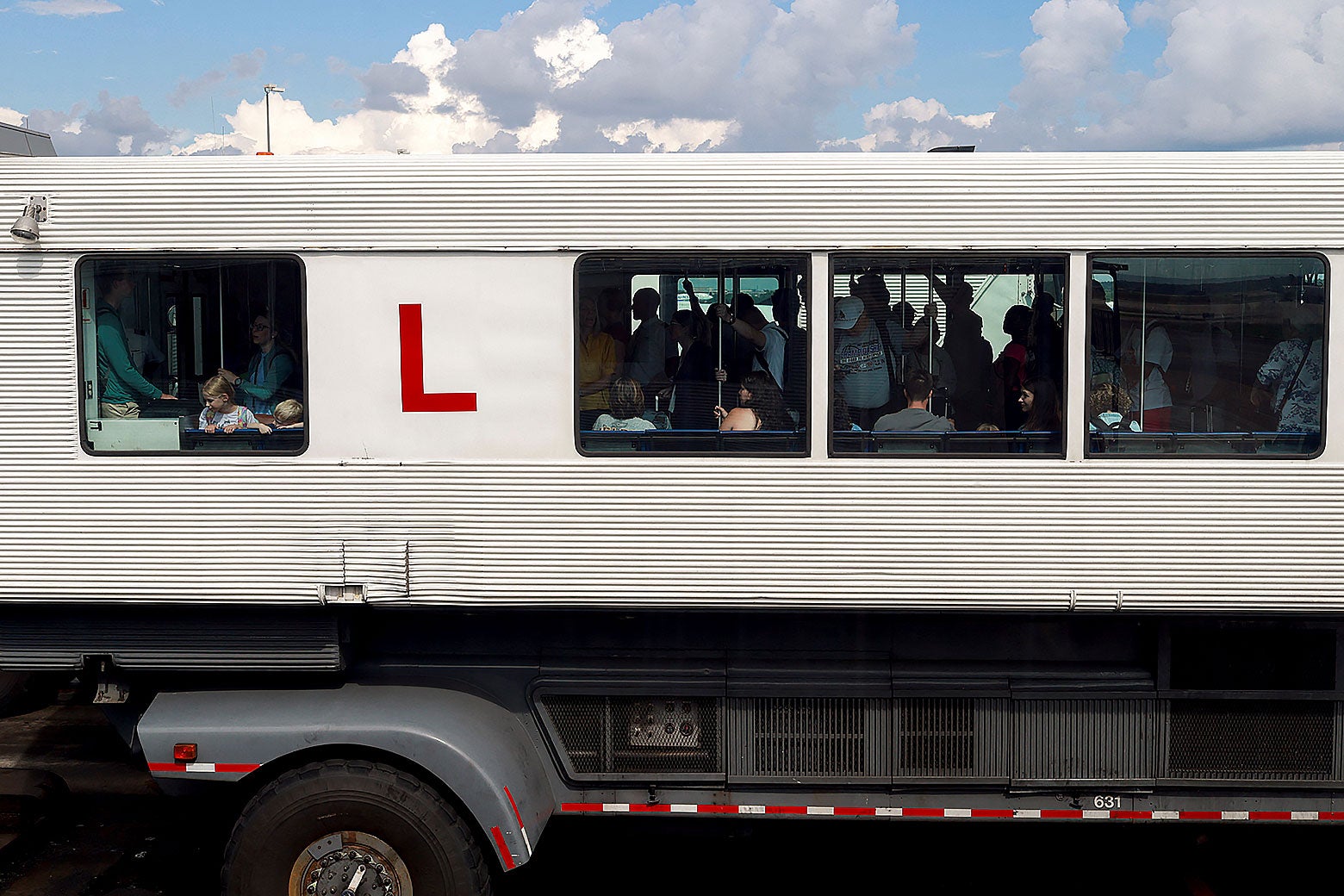
Metropolis Donald Trump Has Finally Wielded His Presidential Power For Good RIP to the Dulles Airport people mover; everybody hated you. By Enter your email to receive alerts for this author. Sign in or create an account to better manage your email preferences. Unsubscribe from email alerts Are you sure you want to unsubscribe from email alerts for Christina Cauterucci? Aug 18, 20265:45 AM Jonathan Ernst/Reuters Sign up for the Slatest to get the most insightful analysis, criticism, and advice out there, delivered to your inbox daily. When travelers enter Dulles International Airport, they pass through a time capsule from the Space Age. Designed by renowned architect Eero Saarinen and opened in 1962, the terminal has a dramatic, glass-walled facade with a sloping roofline that recalls a wingspan. The signage displays a chic Saarinen-drawn typeface that looks like it belongs in Star Trek. For the most part, the retrofuturistic vibes of the northern Virginia airport provide some aesthetic relief from the contemporary indignities of air travel. That is, unless your plane is docked at the D gates. In that case, you will likely find yourself traveling to or from the concourse on a wretched holdover of mid-century transportation design: the people mover. Euphemistically known as “mobile lounges,” these hulking, 40-ton machines from the 1960s and ’70s look and feel like paramilitary vehicles trundling through a desert dystopia. An unholy mashup of a waiting room and a bus, the people mover is slow, uncomfortable, and offensive to the eye. Mention the thing to any D.C.-area frequent traveler and you’ll likely get an earful about how dispiriting it is to get off a long flight, beyond ready to head home, only to have to spend an extra 15 minutes in a fluorescently lit space even more cramped than the plane you just departed. So it was with begrudging gratitude that D.C. residents, 93 percent of whom voted against Donald Trump in 2024, absorbed the news that the president intends to do away with the people movers as part of a $22.5 billion Dulles renovation. There is plenty to protest in the plan: Trump is threatening to install gold accents throughout the buildings, and renderings show a new covered walkway that could interrupt the clean lines of Saarinen’s facade. But if Trump can eliminate the scourge of the people mover, he will have finally wielded his presidential power for good. If you’ve never been in a Dulles people mover, you might be puzzled by the white-hot hatred they induce. Doesn’t it always suck to get around an airport, no matter what vehicle you’re on? Yes, yes it does—but in every category by which you might evaluate a mode of transportation, the people mover comes up short. Comfort? You’re either stuck to a vinyl-clad seat or grabbing up for a handrail and trying to direct your face away from the armpits to your left and right. Safety? A 2017 investigation found that there had been at least 16 people-mover accidents in the preceding decade, including a fatal one; just last November, a crash sent 18 people to the hospital. User-friendliness? Since travelers enter and exit from the same narrow end of a long rectangle, they never progress far enough to fill the room to capacity, lest they be the last ones to disembark, requiring airport staff to yell at them to keep moving. Efficiency? If you can’t fit on the one waiting in the docking area when you deplane, you’re stuck lingering for ages—a half hour or more, in some cases—until the next one arrives. Aesthetics? Excellent, if your tastes trend toward carpet tiles, hospital lighting, and the trapped-animal sensation of entering a room with no exit. Speed? With a maximum rate of 26 miles per hour, the people mover is just a touch faster than the average e-bike. And why the ominous, vaguely nonconsensual-feeling moniker? People mover?! It’s like God created all the other modes of transportation, gave each a sweet little name, then turned His attention to this abomination and merely described what it did. (The Dulles airport map, perhaps attempting a rebrand, calls it a “shuttle.”) A ride on a people mover feels even more degrading in comparison to the alternative mode serving other travelers. Like most large international airports, Dulles has an internal train line to carry people from the terminal to the various concourses and back. It’s smooth, simple, and zips along at up to 42 miles per hour. One arrives every two minutes or so at each airy, pleasantly lit station. But the Aerotrain designers did not see fit to extend the line to concourse D, in part because both C and D were built in the ’80s as temporary concourses meant to be replaced. (I’m guessing that’s why they feel like the haunted corridors of an abandoned office park. Saarinen would weep!) If you fancy a long walk, you can take the train to C and stroll over to D, but if you have a tight connection—or if you land at Dulles on almost any international flight—congratulations! You get to take a ride on a piece of history. The people mover wasn’t always judged so harshly. According to an airport historian who spoke with the Washington Post, the vehicles were “considered cutting edge” when Dulles opened. Back then, airports were growing in size as air travel became accessible, forcing passengers to walk great distances while carrying their luggage by hand. (The first mainstream suitcase on wheels was patented in 1972, and the modern rolling carry-on bag wasn’t popularized until the 1990s.) A charming 1958 promotional video for the Dulles people movers calculated that at the 10 largest U.S. airports that year, passengers walked the combined equivalent of 100 trips across the country, 20 trips around the world, and 4.5 round-trip walks to the moon. The people mover offered a revolutionary solution. By allowing planes to park on the tarmac away from the terminal building, the promo video marvels, Dulles could be more compact but less chaotic than other airports of the era, with reduced walking and taxi time required. Instead of passengers schlepping to their gates by foot, each motorized “departure lounge,” described as a “spacious room, isolated from fumes and noise,” could detach from the terminal and ferry travelers directly to their planes in seated comfort. Depicted with potted plants, ample relaxation room, and chic luggage storage under Saarinen tulip tables, the people mover, the video promises, “will perhaps be best known for its convenience and its feeling of luxury.” Such sweet, misplaced optimism! If you’re a seasoned people-mover rider, luxury is probably the last word you’d ascribe to the vehicle another mid-century promo video called a “monster on wheels.” But back when air travel still carried a connotation of leisure, before airlines upcharged for every modicum of comfort and before plane seats were designed to nestle passengers’ knees into one another’s lower backs, a ride on a people mover may have been a chicer, less crowded experience. Indeed, old photos show a room with seating for all, with sharply dressed riders reading newspapers and enjoying casual conversation rather than standing in a sweaty mob and cursing their travel agents. I say all this not to apologize for the people movers, but to facilitate a sense of closure for the D.C. metro area as we approach the people mover’s demise. When a jerk mistreats us, it can help to have an understanding of why they’ve behaved like a jerk. It doesn’t make what they’ve done OK, but it allows us to accept the harm that has been done and move on. Of course, now that the people movers are going away, like any foolish mortal leaving a toxic relationship, I’m feeling nostalgic for all the precious moments we shared: The time I watched two small children from different countries bond over the excitement of driving past all the parked jets. The time I scored a seat and managed to take a little nap on the ride to customs. The time I found myself crammed next to an honest-to-god monk with a magnificent chin mole covered in silky hairs the length of his pinkie—a sight so unexpected and mesmerizing, I wasn’t sure whether I was experiencing hallucinations after my 14-hour red-eye or admiring a real monk mole inches from my own face. I’m sure I’ll cycle through these memories on the way home from some vacation in 2030, as I ride the new, speedy, gaudily gold-plated Donald J. Trump Aerotrain segment and yearn for that loathsome piece of history we lost. Donald Trump Transportation Travel District of Columbia
Donald Trump Has Finally Done Something All of D.C. Can Get Behind
Full Article
Original Source
Read the full article at Slate →KhanList aggregates and links to publicly available news content. We do not host full articles from third-party sources. Always verify important information with original sources.