
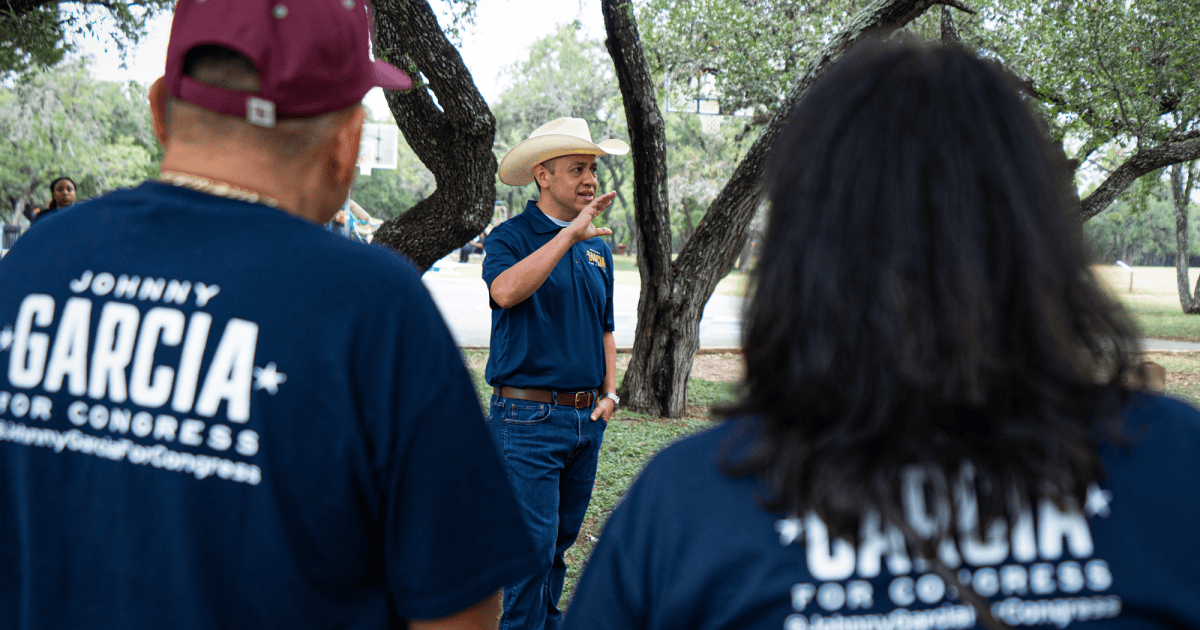
Texas Democratic congressional candidate Johnny Garcia, center, is running against Republican Carlos De La Cruz in the redrawn Texas 35th Congressional district.Bill Clark/CQ-Roll Call/Getty Get your news from a source that’s not owned and controlled by oligarchs. Sign up for the free Mother Jones Daily. Johnny Garcia, the Democratic nominee in Texas’ 35th congressional district, spent one of the last mornings before the start of early voting meeting with veterans over breakfast tacos and boxed coffee at a VFW hall in San Antonio’s Southside. That’s not surprising for a candidate running in a place known as “Military City, USA.” What is surprising? In a district Donald Trump would have carried by 11 points in 2024, a C-SPAN camera was there too, to capture the scene in what is shaping up to be one of the more unexpectedly competitive House races of 2026. It wasn’t supposed to be this close. The 35th is one of five districts that were redrawn last summer to replace incumbent Democrats with Republicans, as part of President Donald Trump’s effort to preserve his party’s House majority through a wave of mid-decade redistricting. Kamala Harris carried Rep. Greg Casar’s old 35th—which extended from Austin to San Antonio—by 34 points. The almost entirely new 35th, stretching south and east of the city into rural counties of South Texas, is solidly Republican territory. Casar moved to the neighboring 37th district, which includes his Austin base, but the race for his old seat is tight. Fox News and the Cook Political Report have shifted the race from “likely Republican” to “lean Republican.” Trump recently visited San Antonio, in part to shore up support for Garcia’s Republican opponent, Carlos de la Cruz. And the Democratic group House Majority PAC recently announced $1.2 million in spending on a race its polling showed was within the margin of error. What changed? “The district woke up, on both sides of the aisle—I’m meeting more fed-up Republicans than I ever have here,” Garcia told me when we spoke after the event. A soft-spoken, self-described “old school Democrat” from San Antonio, Garcia has a background that’s helped insulate him against standard Republican attacks: He spent nearly two decades as a Bexar County sheriff’s deputy before entering the race, and has worked as a SWAT team hostage negotiator. “We’re seeing a 16-point shift of Latinos coming back to the party—the folks that they thought were just going to vote for them up and down the ballot again this election cycle.” Leaning forward in a folding chair, wearing a white Stetson he removed only to thank an older woman for showing up, Garcia rattled off a list of Trump administration policies and economic factors that have hammered people in his district—tariffs, the never-ending war with Iran, and the rising price of everything from groceries to child care to utility bills. The average age of first-time homeowners was now 40, he noted (he’s still a renter at age 39), and even modest comforts came with a higher cost. “People just want to make it to Sunday to buy barbacoa and Big Red, and unfortunately, under this economy, it’s a whole lot harder to do so.” Working-class, heavily Latino areas of San Antonio—and across South Texas—shifted hard toward Republicans over the last few election cycles. But Garcia told me Republicans in Washington had failed their electorate. “We’re seeing a 16-point shift of Latinos coming back to the party—the folks that they thought were just going to vote for them up and down the ballot again this election cycle. The way Democrats and Biden failed us here on the border, Republicans are seeing them failing on the economic issues. The things that they promised are ultimately being kicked down the road.” The 35th district isn’t the only place where Republicans’ redistricting ambitions are facing major headwinds. While Republicans are still likely to net seats in the state, it has become an increasingly expensive endeavor thanks largely to the president’s plummeting popularity among Latino voters. The redistricting plan approved by state Republicans last summer was designed to pick up as many as five seats by eliminating Casar’s Austin seat, Rep. Al Green’s Houston seat, and Rep. Julie Johnson’s Dallas seat, and by making two Democratic seats in South Texas (held by Reps. Henry Cuellar and Vicente Gonzalez) more Republican. In response, Green and Johnson both tried to run in different districts and lost their primaries. Casar avoided a primary in a newly consolidated Austin district when Rep. Lloyd Doggett stepped aside. But Cuellar and Gonzalez, representing seats Trump carried by double digits, vowed to hold on, and they still might. The Congressional Leadership Fund, the campaign arm of the House GOP, recently cancelled $3 million worth of advertisements in Cuellar’s district, where the incumbent has weathered a bribery indictment (he was pardoned by Trump before the case could proceed and has denied wrongdoing) and consistently led his challenger. Gonzalez narrowly led Republican Eric Flores in the only public poll of his race. And while Republicans are still likely to pick up a seat in the Dallas area, Fox News shifted its rating of the newly gerrymandered 9th district near Houston from “solid Republican” to “likely Republican” last week, suggesting a tightening race between Republican Alex Mealer and Democrat Leticia Gutierrez. Meanwhile, Democrats have a real shot at flipping a South Texas seat Republicans already hold—in the 15th district, where Rep. Monica de la Cruz (Carlos’ sister) is in a tight race with Democrat Bobby Pulido, a Tejano music star. Cook now considers that race a toss-up. The Republican redistricting ploy is still unlikely, however, to prove to be a “dummymander”—a map that ends up costing the party seats by leaving Republicans more vulnerable in a wave. In part that’s because Republicans learned from their experience in 2012, when they did draw a dummymander that came back to bite them in 2018. That year, they lost 12 state House of representative seats and two congressional seats. The damage was compounded by the fact that it was suburban communities in the state’s largest metros—areas that had once helped sustain Republican rule—that shifted hardest toward Democrats in Trump’s first term. You could think of a dummymander as akin to building at sea level without accounting for climate change. (In fact, the people drawing these maps are exactly the kinds of people who would also advocate doing that.) Democrats have had to sweat to put the 35th district in play. During Garcia’s primary, Republicans appeared to spend big to elevate a rival Democrat, a sex therapist who said she would turn an ICE detention center into a “prison for American Zionists.” The race ultimately went to a runoff. But prominent Democrats, including Casar, joined ranks behind Garcia, whose law enforcement credentials and moderate disposition may be a better fit for a battleground district. Garcia argues that the residents of the district have been hammered on all fronts by policies from Washington. The war in Iran was not just driving up the price of everything, it was placing a special burden on military families. Meanwhile, the administration’s immigration policy was making life more difficult for citizens and non-citizens alike. “People feel very strongly about having a strong border, but also having some common sense approaches to enforcement—and again, I’m talking to people on both sides of the aisle,” Garcia said. He recounted a recent gathering of largely Republican homebuilders, where attendees complained about the negative effects of immigration raids on their business. “I told them that ICE does have a job to do, they have to make sure that we’re not allowing the flow of illegal drugs and human smuggling coming into our communities, [that] we’re actually going after the bad actors that should not be here in our communities,” he said. But, “it also doesn’t make any sense when they’re going after five-year-old Liam Ramoses and they’re targeting our construction sites, and they’re diminishing and depleting the workforce that’s ultimately working to make housing more affordable these days.” The veterans and their advocates at the roundtable shared a litany of concerns about the administration, from the effects of DOGE at the Department of Veterans Affairs to the president’s efforts to intimidate critics like Sen. Mark Kelly (D-Ariz.). Defense Secretary Pete Hegseth was a frequent target. He recently closed two Army command posts in a city where there are still hard feelings over the 2001 closure of Kelly Air Force Base. “It’s clear as day that Pete Hegseth came into San Antonio and wanted to rip apart our armed forces here as a political stunt,” Garcia told them. The House majority, he told them, was more focused on protecting the secretary from impeachment than on passing legislation that would make people’s lives easier. When I asked Garcia whether he’d support impeachment, he demurred. “My priority is making sure that that we’re tearing down these tariffs that are hurting 97 percent of small businesses and working class families,” he said. “My priority is making sure that we’re making permanent the ACA tax credits and subsidies that make health care affordable, and once we accomplish those two priorities on the agenda list, then we can look at everything else down the road.” Garcia describes himself as a “troubleshooter,” not a “troublemaker.” His answer might not satisfy some members of his coalition demanding immediate accountability. But given how things were supposed to go in the district, it’s the kind of argument Democrats would love the chance to have.
Donald Trump Asked Texas For Five More Republicans. Voters Might Have Other Plans.
Full Article
Original Source
Read the full article at Motherjones →KhanList aggregates and links to publicly available news content. We do not host full articles from third-party sources. Always verify important information with original sources.