
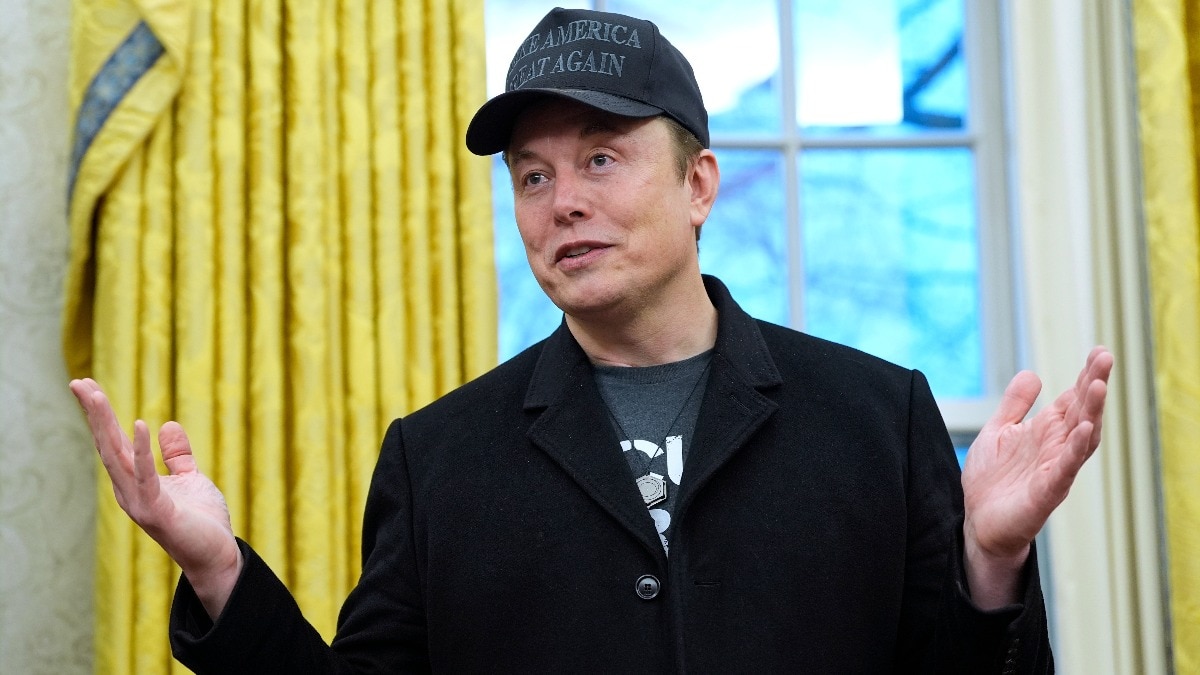
The development once again revives questions about the future of satellite networks, space infrastructure and the growing demand for artificial intelligence.Elon Musk speaks during an event with President Donald Trump. (Photo: AP)New Delhi,Nov 26, 2026 10:32 ISTThe Trump administration has authorised Elon Musk’s SpaceX to deploy up to 10,00,000 satellites carrying data-processing equipment in space, paving the way for an attempt to build artificial intelligence (AI) data centres in space.The approval came from the US Federal Communications Commission (FCC) and allows SpaceX to establish a satellite network called Starmind, which is designed to process massive amounts of data in orbit and transmit the results back to Earth.The decision marks the first time the US regulator has authorised a satellite constellation specifically designed to function as data centres in space. President Donald Trump pictured with Elon Musk at the White House. (Photo: AP) It also comes as demand for AI computing grows, putting increasing pressure on the electricity, land and water resources required by conventional data centres. WHY DOES ELON MUSK WANT DATA CENTRES IN SPACE?Data centres are large facilities housing computer servers that store, process and transfer information, making them essential to running AI applications, cloud services and other digital platforms.However, these facilities consume enormous amounts of electricity and require extensive cooling systems, often using water to prevent servers from overheating An artist's concept of Earth surrounded by satellite debris. (Photo: India Today) Elon Musk's space company believes moving some of this computing infrastructure into orbit could help address these challenges.According to SpaceX, the proposed satellites would harness almost continuous solar energy to power their computing equipment. They would be connected through high-speed optical links, allowing them to exchange information and operate as an interconnected network.The processed data would then be transmitted back to Earth.SpaceX has argued that this approach could lower operating costs and reduce the environmental footprint associated with ground-based data centres. An illustration of a satellite constellation in space. (Photo: X) WHEN WILL THE SATELLITES BE LAUNCHED?The approval does not mean SpaceX will immediately launch 10,00,000 satellites. The company has several years to build and deploy the proposed network.Under the FCC’s deployment schedule, SpaceX must begin launching the satellites no later than November 2033, and must have at least 1,00,000 satellites deployed by November 2035 and half the approved constellation, or 5,00,000 satellites, by November 2038.The company is banking partly on its next-generation reusable rocket, Starship, to bring down the cost of launching such that many satellites. SpaceX's Starship returns to its launch pad to be caught by mechanical arms. (Photo: AP) For perspective, there are currently around 17,000 satellites in Earth’s orbit, of which just over 11,000 belong to SpaceX’s Starlink network, according to Reuters.Whether Starmind can turn the idea of data centres in space into a commercially viable reality remains to be seen.But at present, the approval marks a significant step towards bring AI infrastructure to orbit.- Ends
Donald Trump allows Elon Musk to launch 10,00,000 satellites
Full Article
Original Source
Read the full article at Indiatoday →KhanList aggregates and links to publicly available news content. We do not host full articles from third-party sources. Always verify important information with original sources.