
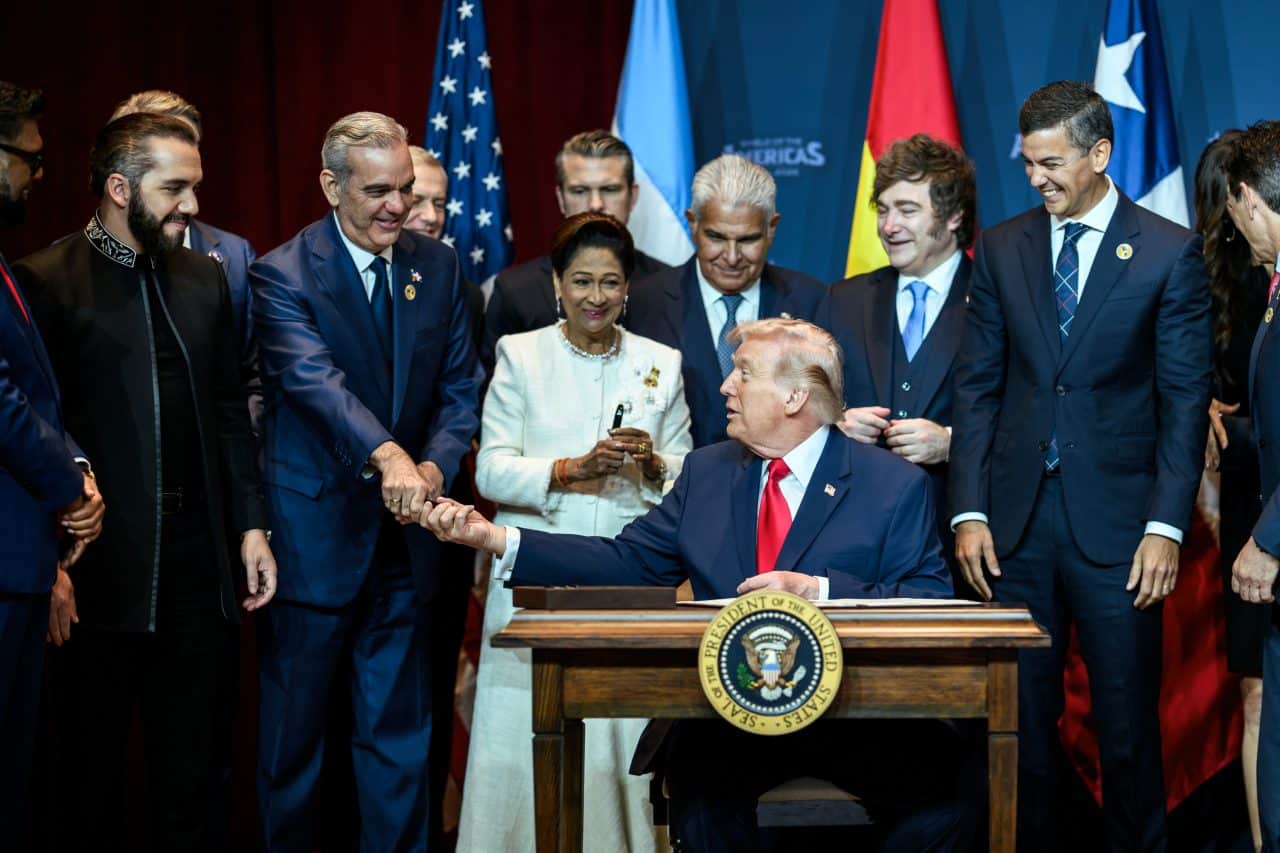
On August 24, the Dominican government adopted the International Holocaust Remembrance Alliance (IHRA) working definition of antisemitism, infamous for equating opposition to Israeli apartheid and Zionist colonialism with antisemitism. President Luis Abinader made the announcement in Santo Domingo, while speaking at an event organized by the U.S. Zionist organization Combat Antisemitism Movement. Subsequently, a statement from the Dominican Foreign Ministry justified the decision by invoking a supposed official policy against hate and discrimination dating back to 1938 when, according to the text, “the Dominican State was the only one to offer asylum in Sosúa to a significant number of Jewish refugees fleeing the war crimes perpetrated by the Nazi regime”. In 1938, the racist and genocidal Trujillo dictatorship was in power. Just as the Israeli regime pushes for the redefinition of antisemitism to shield itself, in Orwellian fashion, Abinader is rewriting the past to accommodate the neo-Trujilloist present. It is not surprising that the Dominican government, led by Abinader, would uphold the Trujilloist legacy. This is a government that has denied the significance of slavery during the Spanish colonial period that preceded the formation of the Dominican state, that does not officially commemorate the genocide against Haitians in 1937, known as the Parsley Massacre, and that denies the existence of widespread racism in the Dominican Republic while keeping more than 200,000 Dominicans of Haitian descent stateless. President Abinader boasts of following the ideas of dictator Joaquín Balaguer, one of the Trujillo era’s main ideologues. Abinader follows in Trujillo’s footsteps regarding what Dominican racists dub “the Haitian problem,” as shown by his policy of mass deportations and the construction of a border wall—an aggiornamento of the Trujillo-era political program known as the “Dominicanization of the border.” Today’s neo-Trujilloist regime, with its apartheid policies of racial mass deportations, denationalization and statelessness, is coherent in its support of the genocidal Israeli regime and in claiming the legacy of the dictatorship. This is the true significance of the Dominican endorsement of the IHRA definition through a statement that upholds the legacy of a totalitarian regime that extorted and killed Jewish refugees. In the context of the ongoing genocide in Gaza, the Dominican government has signed agreements with Israel on issues such as water management and has acquired Israeli weapons. By adopting the IHRA’s working definition of antisemitism, Abinader now threatens to further erode the weak democratic rights that still exist in this Caribbean country by moving in the direction of weaponizing accusations of antisemitism to criminalize solidarity with Palestine. Abinader’s total subordination to Trump is another key driver of his support for Israel. The Dominican government has aligned itself with the pro-Trump “Shield of the Americas” regional coalition and has made its airports available for U.S. military operations in the Caribbean and against Venezuela; it has even agreed to accept deportees from third countries arriving from the U.S. The Dominican government’s alliance with Israel is part of this broader trend, and one of the clearest indicators of the region’s shift to the right is the intensification of ties with Israeli apartheid. The IHRA definition and the regional shift to the right Donald Trump poses with world leaders at the Shield of the Americas summit on March 7, 2026, in Miami, Florida. First row (from left to right): Kamla Persad-Bissessar (Prime Minister of Trinidad and Tobago), Santiago Peña (President of Paraguay), Luis Abinader (President of the Dominican Republic), Nayib Bukele (President of El Salvador), Donald Trump (President of the United States), Irfaan Ali (President of Guyana), Rodrigo Chaves Robles (President of Costa Rica), Daniel Noboa (President of Ecuador).Second row (from left to right): Rodrigo Paz (President of Bolivia), Javier Milei (President of Argentina), José Raúl Mulino (President of Panama), Nasry Asfura (President of Honduras), José Antonio Kast (President-elect of Chile). (Official White House Photo by Daniel Torok) Due to a combination of strong U.S. interference and the decline of center-left parties, elections over the past year have brought right-wing governments to power in Bolivia, Chile, Honduras, and Colombia. In the cases of Bolivia and Colombia, which had no diplomatic relations with Israel, these were immediately reestablished. In Chile and Honduras, where relations had been degraded by the withdrawal of ambassadors, there was a full diplomatic normalization. The Venezuelan government’s capitulation to Trumpism, following the U.S. military attack on January 3, 2026, and the kidnapping of Nicolás Maduro, is also part of this regional shift to the right. Interim president Delcy Rodríguez reestablished diplomatic relations with Israel in August, following a campaign of “disaster diplomacy” by Netanyahu, who took advantage of the twin earthquakes in northern Venezuela that left more than 6,500 dead and tens of thousands injured. Relations had been broken since 2009. In turn, the adoption of the IHRA’s definition of antisemitism has become an indicator of how closely Latin American regimes align with the objectives of Israeli foreign policy and their willingness to criminalize solidarity with Palestine. The definition in question was drafted in 2004 and adopted by the IHRA in 2016, after which it was promoted by Israeli foreign policy as part of its “new antisemitism” doctrine, which views opposition to Israel as the most significant form of antisemitism. Its text includes questioning the democratic character of the State of Israel among its examples of antisemitism. The definition was referenced in a Trump executive order in 2019 and in Latin America it has been adopted by right-wing governments in Argentina, Colombia, Costa Rica, Panama, Guatemala, and Uruguay before being adopted by the Dominican Republic. Over the past two years in Argentina, legal proceedings have been initiated, using the IHRA definition, against Alejandro Bodart, Vanina Biasi, and Mariano Soria, leaders of the Left and Workers’ Front-Unity, a Trotskyist coalition that holds four seats in the National Congress. In Brazil, socialist leader Zé María of the PSTU and the Jewish journalist Breno Altman have been criminalized for criticizing the Israeli state and calling for Palestinian freedom “from the river to the sea.” Zé María was sentenced to two years in prison, Altman was fined, Bodart won an appeal that overturned his conviction, and the cases against Biasi and Soria remain open. Kenneth Stern, the main drafter of the IHRA definition, who describes himself as a liberal Zionist, has criticized its use by right-wing Jewish sectors to limit freedom of expression and foster a McCarthyist environment, citing the case of Germany, where authorities have used it to label Jewish people as “anti-Semites” for opposing Israeli crimes in Gaza. Stern recommended the U.S. Senate in 2025 to not adopt the IHRA definition. Dominican legal scholar Jaime Rodríguez has pointed out that, within the Dominican legislative framework, the Abinader administration’s endorsement of the IHRA definition is not yet legally binding, though he has warned of the risks of censorship and persecution that would result from moving forward with enshrining it into law. Democratic guarantees and freedoms in the country are already fragile, and the alliance with Israel has contributed to their weakening, as evidenced by the Dominican government’s use of the Israeli spyware Pegasus against journalists. But the peril is an even greater one. There is a clear affinity between the Neo-Trujillista regime led by Abinader and the Zionist project, as Israel is viewed by the Dominican right as a blueprint for Dominican apartheid. Neonazi organizations regularly wield Israeli flags at racist marches against Haitians. Much like Trujillo in 1938, Abinader is unconcerned about antisemitism or discrimination more broadly, as the regime he leads is carrying out a brutal crackdown on Haitian migrants and Dominicans of Haitian descent, conducting a campaign of more than one million deportations over the past six years during which dozens of people have been killed and many more subjected to horrific violence. Normalizing genocide abroad is a way of normalizing apartheid and ethnic cleansing it at home.
Dominican Republic becomes latest Latin American country to adopt IHRA antisemitism definition amid regional shift to the right
Full Article
Original Source
Read the full article at Mondoweiss →KhanList aggregates and links to publicly available news content. We do not host full articles from third-party sources. Always verify important information with original sources.