
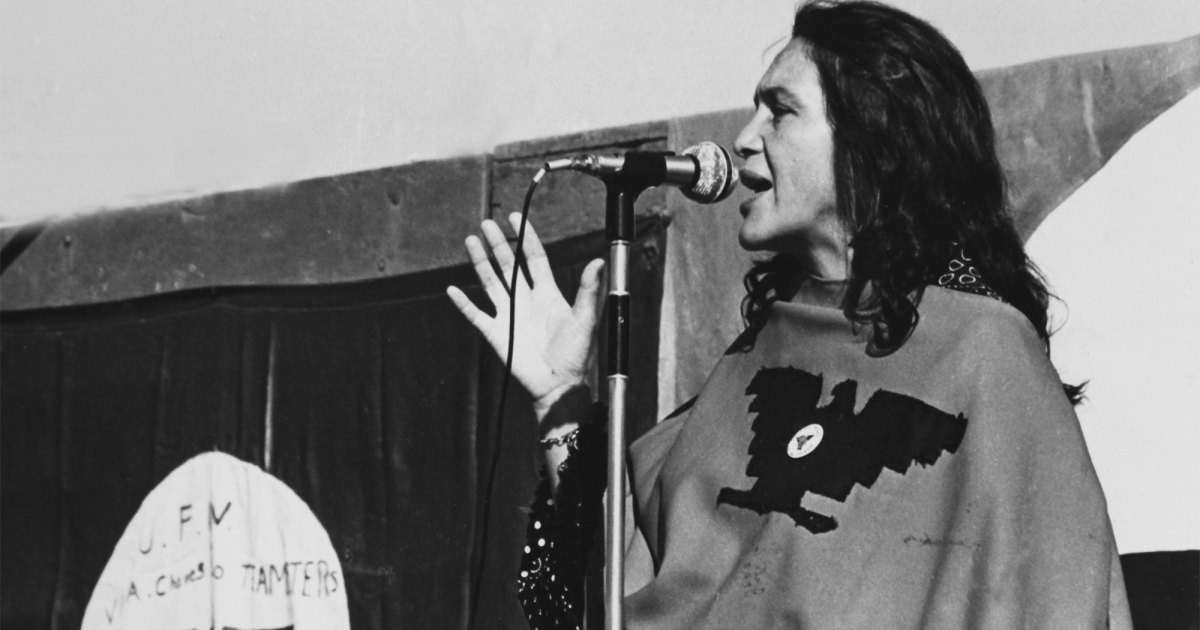
American labor activist and United Farm Workers of America co-founder Dolores Huerta speaking during a rally in California in the mid-1970s.Cathy Murphy/Getty Get your news from a source that’s not owned and controlled by oligarchs. Sign up for the free Mother Jones Daily. Communities across the country are grieving the death of Dolores Huerta, the renowned labor and feminist activist who empowered California’s immigrant workers. Huerta died Wednesday at the age of 96. Best known for her work advocating for farmworker rights, Huerta co-founded with Cesar Chávez in 1962 the organization that would eventually become the United Farm Workers, and organized protests and walkouts pushing for laws and labor practices to protect the immigrant communities who worked in the fields, including winning them the right to organize unions in California. Following the 1965 Delano grape strike, Huerta led a successful national boycott of table grapes that resulted in better wages and working conditions for grape pickers. She also is widely credited with conceiving and popularizing “¡Sí se puede!”—Yes we can!—a chant that still reverberates across protests and picket lines across the US. Though her advocacy for farmworkers’ rights was most prominent in the 1960s and 1970s, Huerta’s activism never stopped. She campaigned for voting rights and pushed against voter suppression. She was a strong supporter of women’s rights, including campaigning for reproductive justice. Throughout her life, she advocated for immigrant rights, most recently speaking out against Trump’s deportation campaign. As the founder and president of the Dolores Huerta Foundation, she kept speaking in support of movements, leaders and legislation in support of civil rights until the very end of her life. Despite her prominence as a feminist activist, Huerta, like many women, struggled with machismo internal to the UFW. After the group successfully lobbied for the controversial 1986 Immigration Reform and Control Act, for instance, Chavez told Huerta she needed to go to Florida immediately to address a crisis. Huerta wasn’t made aware that she would miss a news conference celebrating the win; later, she realized they wanted to take credit for her work. Men in power are men in power, regardless of the ideals they stand for; labor leaders, sadly, are no exception. Early this year, the New York Times published an investigation uncovering Chávez’ long pattern of sexual abuse of women and girls involved in the movement, including some as young as 12 and 13. The story shook the country, which had long revered Chavez as a Mexican American hero and a beacon of farmworker rights. Huerta, too, was harmed. Throughout their time in United Farm Workers, Chavez, she told the outlet, had raped her twice, resulting in two pregnancies. She arranged for the children to be raised by other families, and kept them, and the sexual violence she had experienced, a secret. “I believed that exposing the truth would hurt the farmworker movement I have spent my entire life fighting for,” she said in a statement. She told the Times that she wasn’t aware of Chávez abusing children until the outlet shared these reports with her. “My heart aches for everyone who suffered alone and in silence for years.” But after sharing her story, she learned her world was ready for what might have at one point felt like a contradiction. As Latino organizations grappled with the allegations against Chavez, some floated renaming streets and centers that once bore his name with her own. Many murals that once depicted Chavez were painted over, at least one replaced with Huerta’s image. In a 1965 speech at the California State Capitol, Huerta spoke of the farmworkers’ rights that would become her legacy. “To the governor and the legislature of California, we say you cannot close your eyes and your ears to us any longer,” she said. “You cannot pretend that we do not exist. You cannot plead ignorance to our problems, because we are here and we embody our needs for you. And we are not alone.” “The social and economic revolution of the farmworkers is well underway and it will not be stopped until we receive equality,” she continued. “The farmworkers are moving. Nothing is going to stop them.”
Dolores Huerta Made Farmworkers Impossible to Ignore
Full Article
Original Source
Read the full article at Motherjones →KhanList aggregates and links to publicly available news content. We do not host full articles from third-party sources. Always verify important information with original sources.