
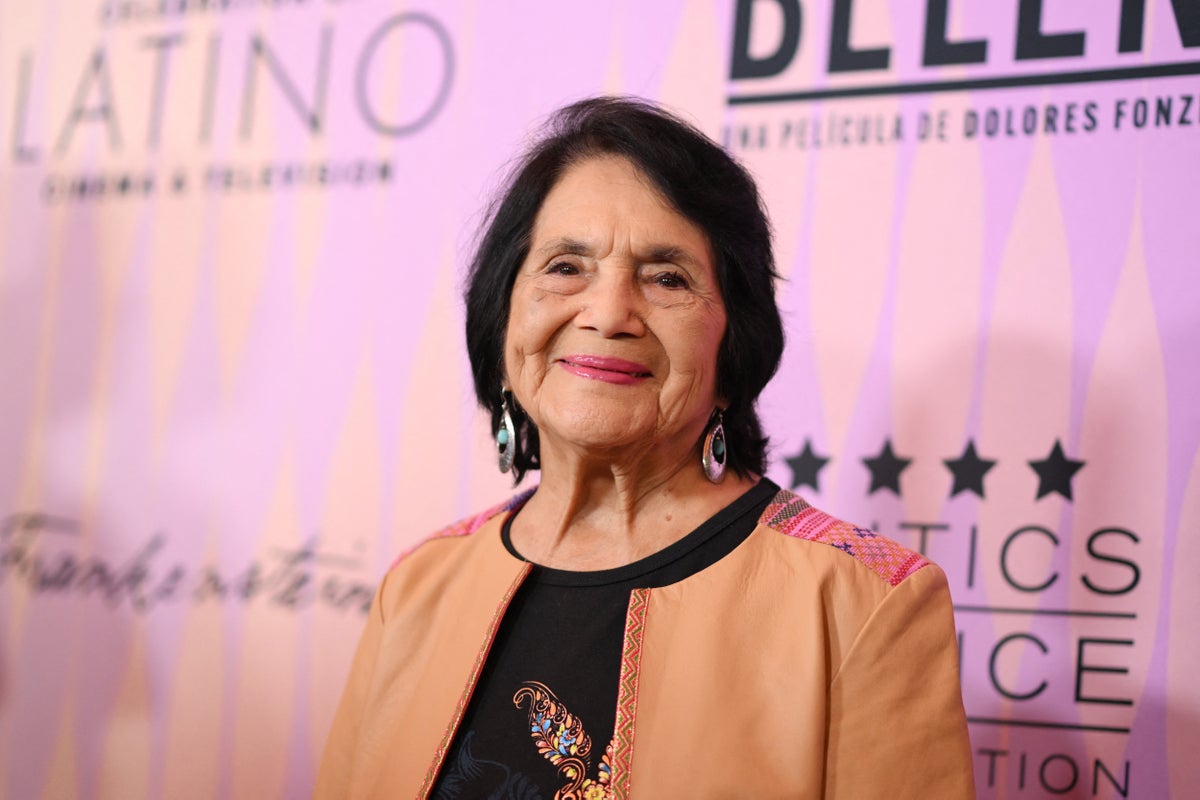
Dolores Huerta, the labor leader and civil rights figure who co-founded the United Farm Workers union, has died at the age of 96.Her family announced her death in a statement issued through her foundation, saying she died Wednesday at home of cancer.Huerta spent decades working to improve conditions in the United States’ fruit and vegetable fields. She coined the phrase “Sí, se puede!”, which went on to become a widespread rallying cry.The three-word Spanish-language slogan, which translates to “Yes, it can be done,” was grounded in her belief that people could affect change. That resolve cemented her place in history as one of the nation's most influential labor leaders, civil rights icons and feminist activists.Her work over the decades brought her a number of accolades, among them the Presidential Medal of Freedom, the nation's highest civilian honor. When then-President Barack Obama presented the award in 2012, he praised Huerta as a tenacious leader and joked that he had stolen her slogan for his 2008 campaign.Dolores Huerta speaks onstage during the Robert F. Kennedy Human Rights' 2025 Ripple of Hope Gala at New York Hilton on December 09, 2025 in New York City (Getty Images for RFK Ripple Of H)She was the first Latina inducted into the National Women's Hall of Fame, and U.S. universities have given her nine honorary doctorates. Schools in California, Texas and Colorado bear her name, as do streets, and her image graces many murals. But she did not always win favor with more liberal activists.In 2016, she endorsed Hillary Clinton rather than Sen. Bernie Sanders of Vermont in the presidential Democratic primary. Actor Rosario Dawson, a Sanders supporter who played Huerta in a 2014 movie about César Chavez, said Huerta had become “an instrument of the establishment.” Dawson and Huerta eventually reconciled.César Chavez allegationsThis year, Huerta sent shockwaves through the Latino community when she disclosed that she was sexually abused in the 1960s by the farmworker movement's co-founder, César Chavez, leading to the birth of two children.It was a secret she kept for 60 years and long after he died. Huerta said she had stayed silent for so long because she feared that coming forward would compromise her life's work and unravel all the progress made for workers.Asked during a 2026 interview with the news organization Latino USA about keeping the secret, Huerta said: “It was my personal pain, it was my personal problem and, you know, I think it was worth it because it was my cross to bear. I’ll say it that way.” From the early 1970s on, her life partner was Richard Chavez, César's brother, and together they had four kids. She also had seven children from two earlier marriages.United Farm Workers leader Dolores Huerta, center, leads a rally in San Francisco's Mission District on Nov. 19, 1988 (AP Photo/Court Mast)Emilio Huerta, one of Dolores' 13 children, once pointed to his mother's courage during an interview, saying it was one of the most significant drivers of her life's work.“To dedicate your life to building a dream of a union for farmworkers, to take on agriculture, which to this today is still a powerhouse. ... That took a lot of guts,” he had said.Homegrown activismHuerta was born Dolores Clara Fernandez in 1930 in Dawson, New Mexico. Her father was a miner and union activist who went on to win a seat in the state Legislature. Her parents divorced when she was 3, and her mother took her and her brothers to California.Growing up immersed in a melting pot of Mexican, Filipino, African American, Japanese and Chinese working families, Huerta learned from her mother, who owned a restaurant and hotel, about independence, compassion and activism.She became a young, energetic elementary school teacher in the farm-rich San Joaquin Valley. But she decided to answer another calling after growing frustrated by her students' poor living conditions.“I couldn’t stand seeing kids come to class hungry and needing shoes,” she said in a 2017 PBS Independent Lens documentary on her life. “I thought I could do more by organizing farmworkers than by trying to teach their hungry children.”Her early work with a civil rights group in Stockton resulted in her meeting Chavez.The two wanted to focus more on the plight of farmworkers, so in 1962 they started the National Farm Workers Association, which became United Farm Workers of America a few years later.She was a key leader and negotiator for the union for years. She was among those who joined Filipino grape pickers on the picket line in what became the five-year “Delano Grape Strike.”Dolores Huerta attends "REBBECA" LA Premiere on November 30, 2025 in Los Angeles, California (Getty Images for State of the Ar)With Chavez, she negotiated collective bargaining agreements and contracts with big growers, winning the first health and benefit plans for farmworkers.Chavez, who died in 1993, once described her as fearless, committed to the cause and tough when it came to negotiations. Huerta learned the art of lobbying politicians.She secured financial aid for the unemployed and disability insurance for California farmworkers.She spoke out against toxic pesticides, pushed for amnesty for immigrants in the country illegally and fought federal guest worker programs.By directing nationwide boycotts of grapes and lettuce in the early 1970s, she helped to create the economic pressure and political climate necessary for California to pass what would be the first state law recognizing farmworkers' right to collective bargaining.Her activism extended to electoral politics.She met U.S. Sen. Robert Kennedy of Massachusetts during his visit to Delano in 1968 and became a volunteer on his presidential campaign, registering Mexican Americans in California to vote.Huerta was on stage with Kennedy after he won the California primary, and he publicly thanked her moments before he was shot.The assassination devastated her, but she kept organizing for farmworkers' rights.Huerta was jailed 22 times for union demonstrating.In 1988, she was seriously injured while protesting Republican presidential candidate George H.W. Bush's opposition to the UFW grape boycott during his visit to San Francisco.Caught in a crowd, she was struck by a police officer's baton, suffered three broken ribs and a pulverized spleen, and required more than a dozen blood transfusions.She reached a settlement with the city to resolve her claims.After a long recovery, Huerta shifted focus and hit the road to campaign for women's rights and encourage Latinas to run for office.She also campaigned for Democratic Presidents Bill Clinton, Obama and Joe Biden and California Gov. Gavin Newsom considered her a close friend.Well into her 90s, she kept a busy schedule, marching in protests and speaking in cities across the country about race, poverty, LGBTQ+ and women's rights on behalf of her Bakersfield, California-based foundation.Guitarist Carlos Santana later oversaw a documentary based on Huerta's life after the pair had a late-night conversation about music while in Hawaii.Santana, a Miles Davis fan, discovered Huerta was a huge fan of bebop legend Charlie Parker.“I even met Charlie Parker. That’s my claim to fame,” Huerta joked during an interview with The Associated Press when she was 87.It was her work as a leader within the labor movement that reverberated through the U.S. and beyond, making her name synonymous with civil rights.In the 2025 documentary “Seeds of Change: The Life and Legacy of Dolores Huerta,” she recounted her decades-long journey in activism and talked about the inspiration she drew from the women's movement during the 1970s, saying it provided validation that she too could stand on the stage with other labor leaders.“I hope that my legacy will be one of an organizer that organized to fight injustice,” she said in the film. “We want to give our children an inheritance of justice, right, not jewels or property or money because they’ll just fight over it. So the main thing to do is to give them this love for justice — and that is the greatest gift I think that any of us can have.”
Dolores Huerta: Influential labor leader and civil rights icon dies aged 96
Full Article
Original Source
Read the full article at Independent →KhanList aggregates and links to publicly available news content. We do not host full articles from third-party sources. Always verify important information with original sources.