
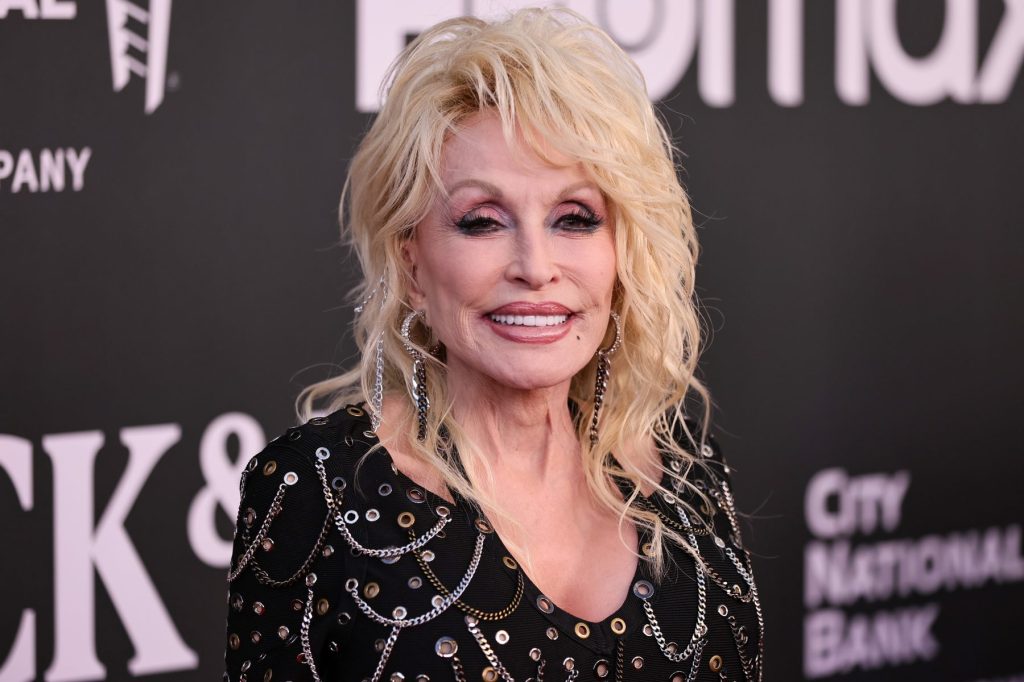
Skip to main content Dolly Parton was much more than music — her business spanned theme parks, movies, product lines and more. How did she manage it all? Dolly Parton attends the 37th Annual Rock & Roll Hall of Fame Induction Ceremony at Microsoft Theater on Nov. 5, 2022, in Los Angeles. Theo Wargo/Getty Images for The Rock and Roll Hall of Fame The outpouring of grief following Dolly Parton’s death last week at the age of 80 was universal and apt: The country icon was beloved as few are these days, both for her music and her general Dolly-ness. But just as much attention was paid to her philanthropic work and business acumen, both of which were legendary in their own right. For Parton, her business sense goes back to the very beginning of her career, when she made the decision alongside her uncles in the 1960s to launch her own publishing company — a choice that, more than 3,000 songs later, is still paying off. (“As I’ve always said, my songs are my children and I expect them to support me when I’m old,” Parton said in 2017.) Over time, that business empire blossomed into one encompassing not just publishing but record companies, brand deals, TV and film productions, books, product lines — and, of course, theme parks, with the Dollywood park in Tennessee one of her most indelible endeavors. Related In a 2020 cover story amid the COVID pandemic, Billboard wrote that Parton “has a schedule resembling that of a tech CEO with a cult following: Often starting at 4 a.m., Parton and her longtime manager, Danny Nozell, review what her team calls the ‘Ask Dolly’ list, a log of opportunities and decisions for Parton to weigh in on that Nozell keeps to no more than 50 items to present in one sitting.” But how she parsed those opportunities and made those decisions is one of her enduring legacies, and she often discussed some of her business principles in interviews over the years. Here, Billboard has compiled 10 Dolly maxims that she used to guide her business career, with a little advice from the woman herself mixed in. On Starting Her Own Label “I’ve had my own label for several years, Blue Eye Records,” she told Billboard in 2008. “I’ve been paying for my sessions for all these years and I would just lease to people like Welk Music, whom I’ve worked with a long time. Then, at the end of five years or seven years, all the masters go back to me. I own all my masters, but I just wanted a fresh start, start clean, try again, invest the money. Instead of leasing, just go ahead and hire independent record people, hire somebody to run the label, and really sink some money into it, invest in myself. People are doing that now. The majors are all going down the tubes, they’re all has-beens like they all thought I was at that time. So why not just do it? If it does well, then I make all the money. And if it don’t, nothing ventured, nothing gained.” On Knowing Herself “I’m a very professional Dolly Parton,” she said in that same 2008 interview, about herself as a brand. “I can’t tell anybody else how to run their life or their business, but I really believe I’ve got a good bead on myself. I know who I am, I know what I can and can’t do. I know what I will and won’t do. I know what I’m capable of and I don’t agree to do things that I don’t think I can pull off. Sometimes I bite off nearly more than I can chew. Sometimes I take a big, big bite hopin’ I can swallow it. I take some chances.” In the 2020 cover story, manager Nozell added more context. “[In meetings], she’s tactful in her approach, but she also will lay down what she will and won’t do,” he said. “You’ll know immediately in a room that one thing you won’t be doing is taking advantage of Dolly Parton.” On Trusting Those Around Her “God has put a lot of great people in my path to help me,” Parton told Billboard in 2014. One of those was Nozell, who she described as “a go-getter. He’s always out there working. He reminds me a lot of myself in the fact that he never stops. He’s surrounded himself with a lot of great people — a lot of great people [who] make me look good.” Later, she added, “I always pray for God to put the right people in my life and take all the wrong people out.” That became important again when she went to launch Dollywood in 1986. “I had no notion of how to run a theme park,” she said. “But I knew that I would find the right people, as you always do.” And in a resurfaced 2015 interview, highlighted by Fortune, she talked about her “own higher wisdom of knowing if I’m in the right place with the right people.” “I don’t boss anybody around, because I don’t even have the time or the energy to even do that. I just try to put people that are smarter than me in all the right places, and then I go on about my business,” she said. “We know if somebody’s not right, they’ll show themselves, or it’ll be pointed out so many times by other people that you do trust, you’ll know it’s time to move on from that person. … I try to find the best people, and I try to trust them to do what they say they can do. Then I have people looking out after all of them.” On Sticking Up for Herself On her 50th anniversary in Nashville, Parton described herself as “just a working girl. I never think of myself as a star because, as somebody once said, ‘A star is nothing but a big ball of gas’ — and I don’t want to be that.” But she was also firm in her decisions. “I’m open and I’m honest. I don’t dillydally. If there’s something going on, I just say it,” she said. “Sometimes if I get mad, I’ll throw out a few cuss words just to prove my point. I’ve often said I don’t lose my temper as much as I use it. I don’t do either unless I have to because I love peace and harmony, but when you step in my territory, I will call you on it. People say, ‘Oh, you just always seem so happy.’ Well, that’s the Botox.” [Laughs] And she knew when to trust herself and stick up for herself, like when she had the Dollywood idea, only for her lawyers to think she had lost her mind. “’I know you’re my Hollywood lawyers and accountants and all that, but I think I know a little bit more about me than you do,'” she said she told them. “And so, I went ahead and done it. Got rid of them. And it proved that I was right to go ahead with my plans.” “As the scripture says, ‘To whom much is given, much is required.’ So I look at my life with that every day and think that God expects it of me,” she told Billboard in 2020. “I expect it of myself, and I think people expect it of me. If I can be an inspiration, then I want to be that. That makes me feel good.” On Advice for Women in Business “You need to really believe in what you’ve got to offer, what your talent is — and if you believe, that gives you strength,” she said in 2014. “In my early days, I would go in, and I was always overmade, with my boobs sticking out, my clothes too tight, and so I really looked like easy prey to a lot of guys — just looked easy, period. But I would go in, and if they were not paying close attention to what I was saying, I always said, ‘I look like a woman, but I think like a man and you better pay attention or I’ll have your money and I’ll be gone.’” [Laughs] Parton, of course, was a strong woman in a field that was largely dominated by men for most of her career. That, along with her image, would cause issues from time to time. “I think there’s always the ‘good ole boy’ syndrome when it’s a girl in business,” she said. “A lot of people, especially with me, ’cos I look like trash and I did even then, I just look like I would be easy prey. But I got my business sense from my dad.” She added more advice for how to get by in that scenario in another interview in 2015. “If you’ve got a dress code, just look the best you can, take it right to the limit. You can kind of bend the rules a little bit, but if that’s the job you want and you already know the rules, then go by the rules.” On Where to Put Your Money Parton had Dollywood, of course, but also several real estate holdings and was in the process of opening a hotel. “We have a place in [Los Angeles] and a couple places here [in Tennessee]: on the lake, then we have the office complex, and I have the old [East Tennessee] place up home,” she said. “It’s investments. It’s not to say, ‘Hey, look at me.’ I’d rather buy property than play the stock market.” And upon buying the property that would become the hotel, opening later this month, she said, “Since the pandemic, commercial real estate is becoming an opportunity. I strongly believe in the future of Nashville and feel this is a great investment.” On Understanding Value Speaking of investments and value, Parton fully understood it. See the below excerpt from Billboard‘s 2020 cover story: In the mid-1970s — nearly 20 years before Whitney Houston’s cover of Parton’s “I Will Always Love You” lit up the Billboard Hot 100 — Elvis Presley famously expressed interest in recording the song himself. Parton was thrilled. But when Presley’s manager, Colonel Tom Parker, insisted that Presley also get half of the publishing, a brokenhearted Parton said no. “That was one of the hardest things I ever had to do because I loved Elvis,” says Parton. She credits her father, who was illiterate and scraped by to raise 12 children, with her business sense. “Even though my daddy didn’t get an education, my daddy was really smart in making deals and bargaining and how he raised a family like he did.” (He was also the inspiration behind her Imagination Library, which provides books monthly to children from birth to age 5 and has donated over 140 million books to date.) But Parton had scored a No. 1 country hit with the song in 1974, so she knew its worth. “That was my most important copyright at the time,” says Parton, who was already a bona fide hitmaker with 15 previous solo top 10 country hits. “If it had been a new song, I might have considered it.” It was a smart bet: In July, BMI awarded Parton a plaque acknowledging 10 million radio and public performances of the song, which places it among the top 30 of BMI’s most-performed songs of all time. Still, all these years later, she almost swoons as she adds, “He would have sung it great. Can you imagine Elvis singing ‘I Will Always Love You?’” On Perseverance The pandemic was hard on the music business in many ways, and the broader entertainment business even more still — and Parton has always traversed both. So when it came time to confront the virus, she thought first of the 4,000 employees at Dollywood. But she found ways to carry on. “We certainly are not going to have a great year this year,” Parton said early in the pandemic. “Hopefully by coming back, we’ll pick up some stuff that we’ve lost. All of the things that I’m involved in are on hold, even my production companies and the movies — everything [took] a big hit. But I still believe, still trust God, and I’m still hoping for the best.” Putting every egg in a single basket was never the Parton way, and she always endeavored to diversify her interests. “I often wonder why more artists don’t do more things like that to have something to fall back on if things don’t work out the way they’d hoped — or just to have something more,” she said. “I feel like even if I wasn’t popular anymore, I could always sing at Dollywood.” In 2022, she articulated that philosophy more succinctly: “Even if you are scared, what’s the worst that can happen? You just try again some other time.” On Ownership & Flexibility Two of Parton’s main pillars in business were ownership and flexibility. She always controlled her own publishing, and owned her masters after founding her own label in 1999. From that point on, any deal she did was a one-off, whether for music or TV, giving herself the maximum space to tailor her own image and direction. “We’re never tied in for these massive deals that we can’t get out of,” Nozell explained. “That way, if something does happen, we can take off.” That flexibility extended to pivoting her products at any given time, such as when renaming the Dixieland Stampede to drop the term that had been deemed offensive. “When they said ‘Dixie’ was an offensive word, I thought, ‘Well, I don’t want to offend anybody. This is a business. We’ll just call it The Stampede,’” she said in 2020. “As soon as you realize that [something] is a problem, you should fix it. Don’t be a dumbass. That’s where my heart is. I would never dream of hurting anybody on purpose.” And it explained her decision to partner with IMG on several branding and licensing deals later in her life. “If I didn’t work anymore, [with] these kinds of projects, you get your royalties if your stuff does well,” she said. “Danny calls it ‘mailbox money.’” On Preparing for the Future Still, though most people thought she would live forever, Parton knew that she had to plan for a future without her. That led her to explore selling her catalog in 2021, though she ultimately did not during her lifetime. “At the right time, I probably would sell it to put more money in my estate or for my family and start all over again,” she said in 2020, though she set out some terms for herself. “You still have to have some control. You don’t just say, ‘Here’s my whole life, my soul.’ You’re going to stay involved to a degree.” That story also noted that she and Nozell were often working off a three-year plan when it came to the various book, music, movie and musical projects she had in the pipeline. “I’m touched and honored that I’m still around and that I’m able to still be important in the business,” she said. “I honestly feel like I’m just getting started. I know that sounds crazy but I really feel like I might could have a big music career, record career. Who knows?” And she always kept working, with an eye on always doing more. “I keep dreaming myself into a corner,” Parton told People in 2021. “But I can’t stop now. I’ve learned you can’t just say, ‘Oh, my dream’s come true and I’m walking out of here.’ No, you’ve got to show you’re grateful and show that you’re not going to just leave it all in the hands of other people.” Daily newsletters straight to your inbox Sign Up More From Pro
Dolly Parton’s Business Maxims: How She Built & Ran Her Empire, in Her Own Words
Full Article
Original Source
Read the full article at Billboard →KhanList aggregates and links to publicly available news content. We do not host full articles from third-party sources. Always verify important information with original sources.