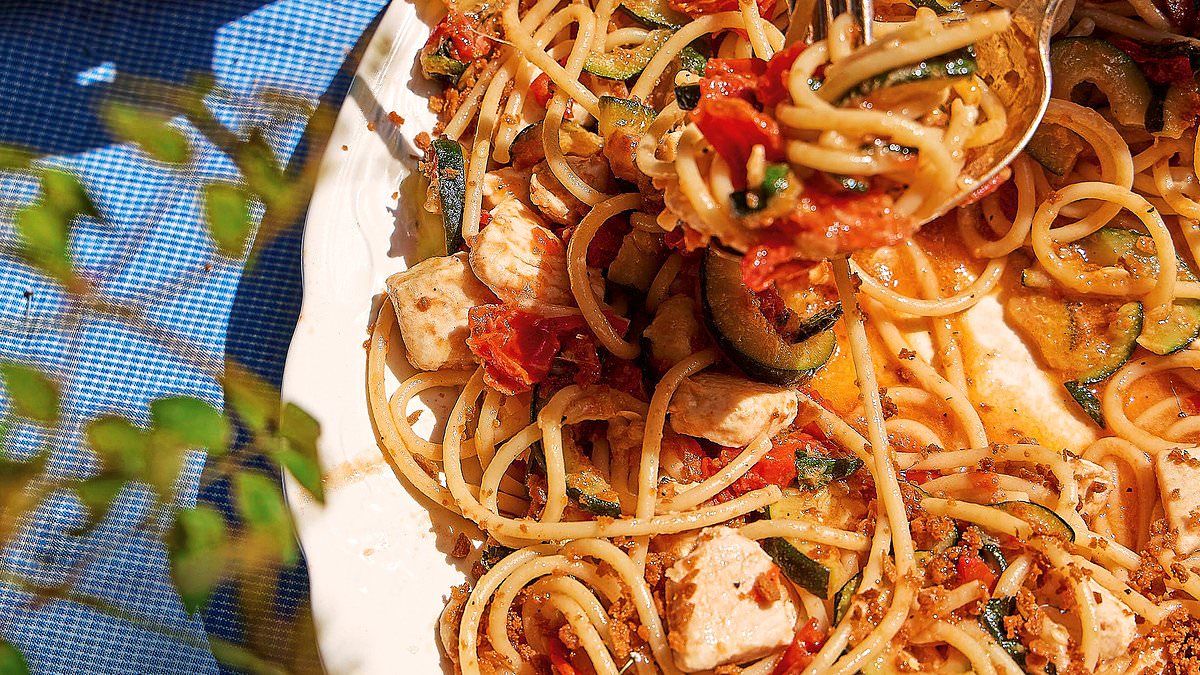
Spaghettoni with swordfish, fresh mint, courgettes and white wineThis is a pasta dish to cook on a hot summer’s day. If you can’t get hold of swordfish you can use fresh tuna instead. The mint may sound odd, but believe me, it really works and gives a unique flavour.SERVES 4500g dried spaghettoni (see tip)3 tbsp extra virgin olive oil, plus extra to serve1 garlic clove, finely sliced2 courgettes, halved lengthways then cut into half-moon slices 1cm thick500g datterini tomatoes, quartered500g swordfish, cut into 2cm strips5 tbsp dry white wine10 mint leaves, torn into quarterssea salt and freshly ground black pepper1 quantity pangrattato (see recipe below), to serve1 Cook the spaghettoni in a large saucepan of boiling salted water for 3 minutes less than the packet suggests.2 While the pasta is cooking, make the sauce. Put the olive oil, garlic and courgettes, with a pinch of salt, into a large, hot frying pan. Cook for 5 minutes over a low heat, then add the tomatoes and swordfish strips, along with the wine. Season with salt and black pepper. Leave over a very low heat.3 When the spaghettoni is cooked, remove it from the saucepan using a pair of tongs and add to the tomato, swordfish and courgettes, with a ladle of the pasta cooking water. Turn up the heat and add the mint. Stir and shake the pan so that the sauce and pasta become emulsified.4 Serve the pasta in warmed bowls with a drizzle of good oil on top and a generous sprinkle of pangrattato.Tip Spaghettoni is very thick spaghetti and always takes longer to cook than you think, so make sure you put it in a large pot of salted water.Casarecce with pistachio pesto Pistachios are grown in abundance in Sicily, and this recipe is a perfect example of using produce that is local and plentiful in a healthy, delicious dish. Casarecce is the best pasta for this dish as its shape scoops up all the sauce.SERVES 4200g shelled unsalted pistachios½ garlic clove75g pine nuts50g basil leaveszest of 1 lemon75g parmesan, grated, plus extra to serve2 tbsp warm water5 tbsp extra virgin olive oil500g casarecce or farfallesea salt and freshly ground black pepper1 Put the pistachios into a saucepan of boiling water and cook for 1 minute, then drain and cool down on paper towels so they are dry.2 Place the garlic into a large pestle and mortar and crush to a fine paste. Add the blanched pistachios and pine nuts and work them in until smooth. Add the basil and pound to a fine pulp, then stir in the lemon zest, parmesan and warm water. Finally, drizzle in the olive oil slowly so the sauce emulsifies; check the seasoning, adding salt and black pepper to taste.3 Pour the casarecce into a large saucepan of boiling salted water and cook for 2 minutes less than the packet suggests. Remove from the saucepan using a slotted spoon and place in a large frying pan over a medium heat, along with a ladle of the pasta cooking water.4 Add half the pistachio pesto and stir so that the sauce and pasta become emulsified and cook for 2 minutes. Check the seasoning, serve in warmed pasta bowls with the remaining pistachio pesto on top, and a little extra grated parmesan on the side.Spaghettoni with fresh sardines, pine nuts and fried breadcrumbsI first had this dish almost 30 years ago in a restaurant in Palermo. Wow, it was incredible: the sardines were just cooked, the pine nuts were long and chewy and had soaked up the oil from the sardines, and the sultanas were the perfect quantity.SERVES 4-64 tbsp extra virgin olive oil, plus extra to serve1 small white onion, thinly sliced1 fennel bulb, thinly sliced (reserve and finely chop the fennel fronds)6 anchovy fillets in olive oil, drained50g pine nuts30g sultanaspinch of saffron threads8 fresh sardines, filleted into 16, with all bones removed, then cut in half to give 32 pieces (see tip)5 tbsp dry white wine500g dried spaghettonisea salt and freshly ground black pepperFor the pangrattato100ml sunflower oil1 garlic clove100g fine breadcrumbs1 For the pangrattato, heat the sunflower oil in a small saucepan and add the garlic. When the garlic is a light brown, remove from the pan and add the breadcrumbs. These will cook very quickly, so have a slotted spoon and a plate with a few sheets of paper towel ready. When the breadcrumbs are a lovely golden-brown colour, remove them with the slotted spoon and place on the paper towel to drain. Add some salt and leave to one side.2 Put the olive oil, onion and fennel into a large, hot frying pan and cook gently for 5 minutes. Add the anchovies, pine nuts, sultanas and saffron and stir together until everything is incorporated. Season the sardine pieces then carefully place on top of the onion, fennel, saffron, pine nuts and sultanas. Add the wine, place a lid on the pan and remove from heat.3 Put the spaghettoni into a saucepan of boiling salted water and cook for 3 minutes less than the packet suggests. When it is cooked remove from the saucepan using a pair of tongs and add to the pan with the sardines, plus a ladle of the pasta cooking water. Add the fennel fronds, place back over the heat, give it a shake and check the seasoning.4 Serve in warmed bowls with the pangrattato on top, a drizzle of good oil and a grind of black pepper.Tip When prepping the sardines be sure to remove all bones. I find long-nosed pliers are good for pulling them out.Red prawn linguine Red prawns are considered a real delicacy and mostly found in the warm waters of the Mediterranean. You can find them frozen, in boxes, in good fishmongers but you can substitute them with large shell-on prawns. You need them to be shell-on as the shells create a rich, sweet stock, which makes the dish.SERVES 41kg red prawns or large tiger prawns, with heads and shell on4 tbsp extra virgin olive oil, plus extra to serve2 celery sticks, roughly chopped1 carrot, roughly chopped1 leek, washed and chopped4 plum tomatoes, finely chopped1 garlic clove, sliced500ml water400g dried linguine2 tbsp flat-leaf parsley, choppedsea salt and freshly ground black pepper1 Rinse the prawns in cold water, remove all the heads and shells and keep to one side. Cut the back of the prawns to remove the vein, then cut the prawns in half lengthways. Season with salt and black pepper and 1 tablespoon of the olive oil, mixing so they are all covered in the olive oil. Put to one side.2 Place all the heads and shells in a hot saucepan with 1 tablespoon of olive oil. Stir and cook for 5 minutes so the shells turn bright red. Bash them, so all the juice comes out of the heads. Add the celery, carrot, leek, tomatoes, garlic and water. Bring to a simmer and cook slowly for 20 minutes, stirring occasionally to get as much flavour out of the shells as possible. Strain the stock, squeezing every last drop out of the shells, and keep to one side.3 Cook the linguine in a saucepan of boiling salted water for 3 minutes less than the packet suggests.4 Remove the linguine from the water to a large, hot frying pan, along with a ladle of the pasta cooking water and the prawn stock. Cook over a medium heat and, after a minute of the sauce and pasta reducing, add the seasoned prawns, parsley and the remaining 2 tablespoons of olive oil. Stir and mix well so that the pasta and the sauce become emulsified, then check the seasoning.5 Serve in warmed pasta bowls with a little extra olive oil on top.Fettuccine Amatriciana Amatriciana is a sauce that is strictly made with guanciale (an Italian salted cured meat), passata and pecorino, and that’s it, though the proportions of the ingredients are very important. Traditionally this would be served with bucatini pasta, which is lovely, but I do like it with fettuccine. If you can’t find guanciale then use a good-quality pancetta.SERVES 4200g sliced guanciale, cut into small strips600g tomato passata150g pecorino romano, grated500g fresh fettuccinesea salt and freshly ground black pepper1 Put the guanciale into a large, hot, nonstick frying pan and cook until it has turned crispy, light brown and all the fat has rendered (keep the fat in the pan as this is part of the sauce).2 Add the passata, turn down the heat and cook for about 15 minutes to reduce by half. Check the seasoning, adding salt and black pepper to taste, and scatter half of the grated pecorino on top of the sauce. Leave to one side.3 Cook the fettuccine in a large saucepan of boiling salted water for a couple of minutes – you want it very al dente – then take out with a pair of tongs and place in the frying pan with the sauce. Add a ladle of the pasta cooking water, place the pan over a high heat and cook for 3 minutes so the pasta cooks and absorbs the flavour of the sauce. Stir together so the pasta and sauce become emulsified and the pecorino has melted and is totally combined.4 Check the seasoning, adding salt and black pepper to taste, and serve in warmed pasta bowls with black pepper and the remaining pecorino sprinkled over.Mezze maniche with smoked prosciutto, pistachio and cream‘Pesto’ means pounded or crushed, so it has many variations from Liguria to Sicily, and this recipe uses pistachio nuts, which are in abundance in Sicilian cuisine. Mezze maniche is the perfect pasta for this, as it has a lovely bite and the sauce always gets stuck inside the tube.SERVES 42 tbsp extra virgin olive oil150g speck, cut into 1cm strips1 white onion, finely sliced100ml double cream500g dried mezze manicheSea saltFor the pistachio pesto1 garlic clove100g shelled, peeled pistachios100g basil leaves100g Parmesan, finely grated2 tbsp water50ml extra virgin olive oil1 For the pistachio pesto, in a pestle and mortar, crush the garlic with a good pinch of flaky sea salt until it is a smooth paste. Add the pistachios and crush to a paste. Add the basil and pound to a paste, then add the Parmesan and water. Mix well, then add the olive oil slowly so the pesto becomes emulsified. Leave to one side.2 Put the olive oil, speck and onion into a large, hot frying pan and cook slowly for 10 minutes over a low heat so the onion is soft. Add the cream and cook over a low heat.3 Meanwhile, cook the pasta in a large saucepan of boiling salted water for 3 minutes less than the packet suggests.4 When the pasta is ready, remove it from the cooking water using a slotted spoon and add it to the frying pan with the onion, speck and cream, along with a ladle of pasta cooking water. Cook for a couple of minutes, stirring and shaking the pan so the sauce is emulsified.5 Add half the pistachio pesto and mix well so the pesto is combined. Serve in warmed pasta bowls with the remaining pesto on top of each dish.Risotto primaveraRisotto primavera is a dish we put on the menu when the first asparagus and peas of the season arrive in the kitchen. I have made a purée of the blanched vegetables, which is stirred through the risotto to make it creamy and green.SERVES 42 litres water250g leeks, washed and finely chopped400g courgettes, cut into rough 2cm pieces250g podded fresh peas250g asparagus spears, tough ends removed, cut into 2cm pieces3 tbsp extra virgin olive oil2 celery sticks, finely chopped1 small white onion, finely chopped350g carnaroli risotto rice70ml dry white wine8 basil leaves, torn75g unsalted butter100g Parmesan, grated, plus extra to serveSea salt and freshly ground black pepper1 Put the water into a large saucepan, season with salt and bring to the boil. Add the leeks and blanch for 2 minutes, then remove. Bring the water back to the boil and blanch the courgettes, peas and asparagus, one after the other, for 2 minutes until tender. Strain the vegetables but keep the blanching water as this is going to be used as the stock.2 Put a quarter of the vegetables and 250ml of the blanching water into a jug and blend to a fine purée using a hand-held blender, then put to one side. Set aside 1.5 litres of the remaining blanching water.3 Put the olive oil, celery and onion into a large, straight-sided saucepan and cook for 3 minutes over a medium heat. Add the rice and cook for a further 3 minutes until the rice absorbs the olive oil and turns translucent. Add the wine and cook until absorbed. Then, start adding the hot vegetable blanching water, ladle by ladle, stirring until the rice is only just covered with liquid before adding more. Keep doing this for 10 minutes, then add another ladle of vegetable water and check the seasoning. The risotto should be wet at this point, almost soupy, and the rice should have a good bite.4 Add the asparagus, leeks, peas and courgettes and keep stirring until the risotto starts to thicken. Give the pan a good shake. When you feel the risotto is becoming emulsified, add the puréed vegetables and basil. Stir vigorously, then add the butter and Parmesan and stir again until everything is combined and the risotto is becoming thick and creamy.5 Take the pan off the heat, place a lid on top and leave for 2–3 minutes (this will help the risotto rice to absorb more of the liquid and become plump). Take the lid off and check the seasoning, adding salt and black pepper to taste. Give the risotto one last vigorous stir and serve in warmed pasta bowls, with a little extra grated Parmesan on top.Tagliatelle with clams, mussels, prawns and squidPasta allo scoglio is one of Italy’s favourite seafood pasta dishes, and you will find it up and down the coasts, with variations of spaghetti, linguine and paccheri pastas, but I have chosen tagliatelle in this recipe. I have also taken all the clams and mussels out of the shell to make it a little more luxurious. The big flavour comes from the mussel and clam juice, so it’s very important to make this dish with really fresh shellfish.SERVES 41kg clams in the shell1kg mussels, thoroughly washed200ml dry white wine4 tbsp extra virgin olive oil, plus extra to serve1 garlic clove, finely sliced200g tomato passata8 peeled raw tiger prawns, halved lengthways200g cleaned squid, sliced into 2cm rings1 tbsp chopped flat-leaf parsley500g fresh tagliatelleSea salt and freshly ground black pepper1 Wash the clams in cold water and throw away any that are open. Place them in a colander with running water over them and give the colander a really good shake. Keep to one side.2 Put the mussels and half the wine into a hot saucepan, cover and cook for 5 minutes, so all the shells open. Give the pan a shake and pour the liquid from the pan through a fine sieve or, better still, through paper towels to pick up any loose shell or grit, over a bowl to catch the juices. Keep to one side. Do the same with the clams, using the remaining wine.3 When the mussels and clams are cool, take them out of the shell and keep them in their respective cooking juices.4 Put the olive oil, garlic and passata into a large, hot frying pan. Cook for about 15 minutes to reduce by half, then add the mussel and clam liquid. Bring to a simmer then add the prawns and squid and cook for 2 minutes before adding the cooked mussels, clams and chopped parsley. Check the seasoning, adding salt and black pepper to taste.5 Put the tagliatelle into a saucepan of boiling salted water and cook for 3 minutes, or until al dente, then take out the tagliatelle with a pair of tongs and add to the saucepan with the sauce. Mix well by stirring or tossing the pan and cook for 2 minutes more. Add a drizzle more olive oil and check the seasoning. Serve immediately in warmed pasta bowls.Pesto alla TrapanesePesto alla Trapanese, unsurprisingly, is a pesto inspired from its origins in Liguria and reinvented in Trapani, Sicily. Instead of pine nuts, local almonds are used and the addition of fresh tomatoes makes this Sicilian pesto light and fresh. I have used fusilli – it is the perfect shape for this sauce as the sauce gets stuck in the spirals. As I always say, ‘There is a pasta for every sauce and a sauce for every pasta.’SERVES 4100g whole blanched almonds500g ripe tomatoes, skinned and deseeded1 garlic clove100g basil leaves100g pecorino romano, grated, plus extra to serve5 tbsp extra virgin olive oil500g dried fusilli or busiatesea salt and freshly ground black pepper1 Preheat the oven to 200C/180C fan/gas 6. Spread the almonds on a baking sheet and toast in the oven for 10 minutes so they are lightly golden, then leave to cool down.2 Chop the tomatoes very finely so they are almost a pulp. Place the pulp in a sieve, add a pinch of salt and stir the salt in – this will extract water from the tomato, making it less wet and easier to make the sauce. Keep to one side.3 In a large pestle and mortar, crush the garlic with a generous pinch of flaky sea salt so the garlic is a smooth paste. Add the toasted almonds and bash and break the almonds until they have become smooth. Add the basil and bash until smooth, then add the tomatoes and grind so they become mixed with the almonds. Add the pecorino and mix well, then add the olive oil slowly so the sauce has become emulsified. Leave to one side for 1 hour, so the sauce can develop in flavour.4 Cook the fusilli a large saucepan of boiling salted water for 2 minutes less than the packet suggests, then remove it from the cooking water using a slotted spoon and place in a large frying pan, along with a ladle of pasta cooking water.5 Add half the pesto Trapanese and stir and toss so the sauce and pasta are emulsified. Check the seasoning, adding salt and black pepper to taste, and serve in warmed pasta bowls with a generous spoonful of the room temperature pesto on top of each serving. Serve with a little extra grated pecorino.NOW BUY THE BOOK Our recipes are from The Italian Table by Theo Randall with photographs by Lizzie Mayson (Quadrille, £28). To order a copy for £23.80 until 16 August, go to mailshop.co.uk/books or call 020 3176 2937. Free UK delivery on orders over £25.
Dolce vita eats: Delicious summer pasta coming up with classic Italian recipes from THEO RANDALL
Full Article
Original Source
Read the full article at Dailymail →KhanList aggregates and links to publicly available news content. We do not host full articles from third-party sources. Always verify important information with original sources.