
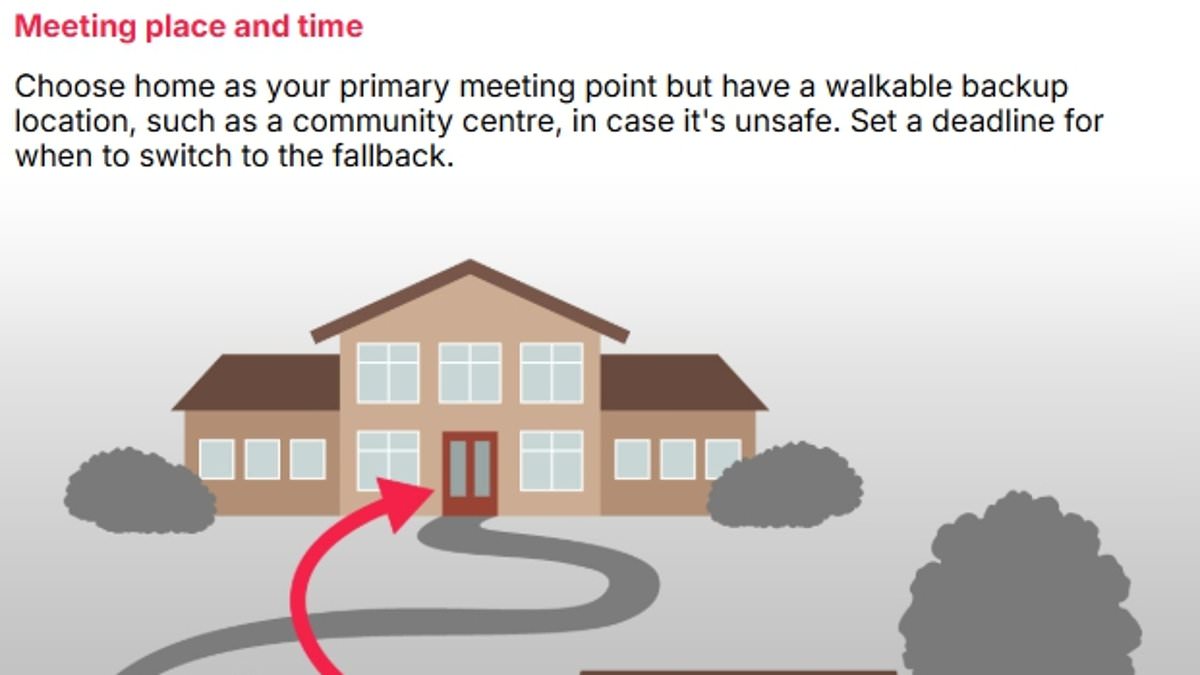
The Government's new 'Be Ready' campaign urges Britons to stock up on essentials in case of emergencies, ranging from power cuts to severe weather.But one researcher says the advice is missing something just as important as food, water and medicine – a family crisis plan.James David Raven, a doctoral researcher at Anglia Ruskin University, argues that knowing exactly what to do in an emergency could prove crucial if communication networks go down.He said families should discuss in advance where they would meet, who would collect children and how they would stay in touch if disaster struck.'The Be Ready guide is, in effect, little more than a shopping list,' he explained on The Conversation.'It does not mention behaviour or actions and is missing something just as important as stockpiled tins and bottles: a firm, agreed plan.' In War of the Worlds, a family struggles to stay together as disaster unfolds, highlighting the importance of having a plan before an emergency strikes Even in the comedy horror Shaun of the Dead, surviving a crisis depends on having a clear plan and knowing where to meet loved ones Key points your crisis plan should consider Meeting place and timeHome is the obvious first choice, but you need a fallback location if it could become unsafe (due to flood risk, for example). This should be somewhere walkable and less reliant on power, such as a community building.It is crucial to set a time rule. If by an agreed time you haven't met at home, go to the fallback location.Phone timesIf the power fails but the networks stay on, every bit of battery counts. If you need to talk to someone regularly, agree to turn phones on for ten minutes every three hours.Choose an easy pattern so you can all remember it, even under stress: at midday, 3pm, 6pm and so on.Pickup plansSchools will wait for an adult, so decide who will collect children or other dependants. Agree in advance to prevent both of you from turning up, or worse, each assuming the other will go.Write it downMost important, agree on these things together long before anything goes wrong. It doesn't need to be a formal crisis–style talk – doing it over dinner, for example, can make it less alarming for children.Source: James David Raven on The Conversation Mr Raven compared the idea to arrangements people often make before visiting somewhere crowded.'When families visit a busy theme park or festival, they often agree a rule like "if we get separated, meet at the entrance",' he said.'Few realise this kind of accepted information has a name: common knowledge.'The concept refers to information that everyone in a group knows, while also knowing that everyone else knows it too.'When everyone hears the rule together, each person knows the others also know it. Nobody wonders whether the others will turn up, and nobody is left guessing,' he said.He argues that such planning becomes even more important during major disruptions when phones and internet services may not be available.'A blackout is like getting lost in a theme park, except there's no tannoy and no phone,' he said.'With a quick text or call off the table, the rule must be in place before you need it. We therefore need to stockpile common knowledge, just as we stockpile water, food and medicine.'Mr Raven explained that without an agreed plan, family members could make different assumptions about what to do next.'If disaster strikes, one person might wait at the office while another stays put at home,' he said.'Both might then go out looking for each other. Without common knowledge, neither has any idea where to go or what to expect. The film Contagion explores how quickly normal routines can break down during a public emergency, highlighting the importance of preparing in advance'While tinned food and bottled water are essential in a crisis, common knowledge is what makes any plan work when stress and confusion are likely to peak.'Mr Raven outlined four key points your crisis plan should take into consideration.The first is a meeting place and time. While home is the obvious choice, it's a good idea to have a fallback location in case the area where you live becomes unsafe due to hazards such as flooding.This should be somewhere walkable and less reliant on power, such as a community building, he said.It's also a good idea to have pre–agreed phone call times in case power fails but networks stay on.'If you need to talk to someone regularly, agree to turn phones on for ten minutes every three hours. Choose an easy pattern so you can all remember it, even under stress,' he said.It is crucial to have a school pickup plan in advance to prevent both parents – or worse, neither – turning up to collect children.And finally, he suggests writing down the key points on a piece of paper and keeping copies in key places.'My plea is therefore a simple one. Sit down with your family this week and agree your plan,' he concluded.'Follow the government's stockpiling advice, of course, but add one thing to your checklist: a plan that everyone already knows.' Earlier this month, experts created an interactive tool which reveals exactly what your family would need to survive during a national disaster.The Buy to Survive tool uses government guidelines and climate information to work out the perfect doomsday shopping list.All you need to do is enter the size of your family, how long you want the stockpile to last, and what kind of weather conditions you expect to encounter.The tool will then generate a list of everything you need, from food and water to essential tools and electronics.And the results suggest that most people could be dangerously underprepared for a serious catastrophe.Mark Riley, an army veteran and founder of Mathison AI, who created the tool, said: 'Most people are aware they need three days of food, but I doubt many have two weeks of food, water, power sources and other gear, including medical and sanitary goods.'
Does your family have a doomsday plan? Crisis expert reveals the essential steps to prepare for a disaster - from emergency meeting points and child pick-ups to when to make contact
Full Article
Original Source
Read the full article at Dailymail →KhanList aggregates and links to publicly available news content. We do not host full articles from third-party sources. Always verify important information with original sources.