
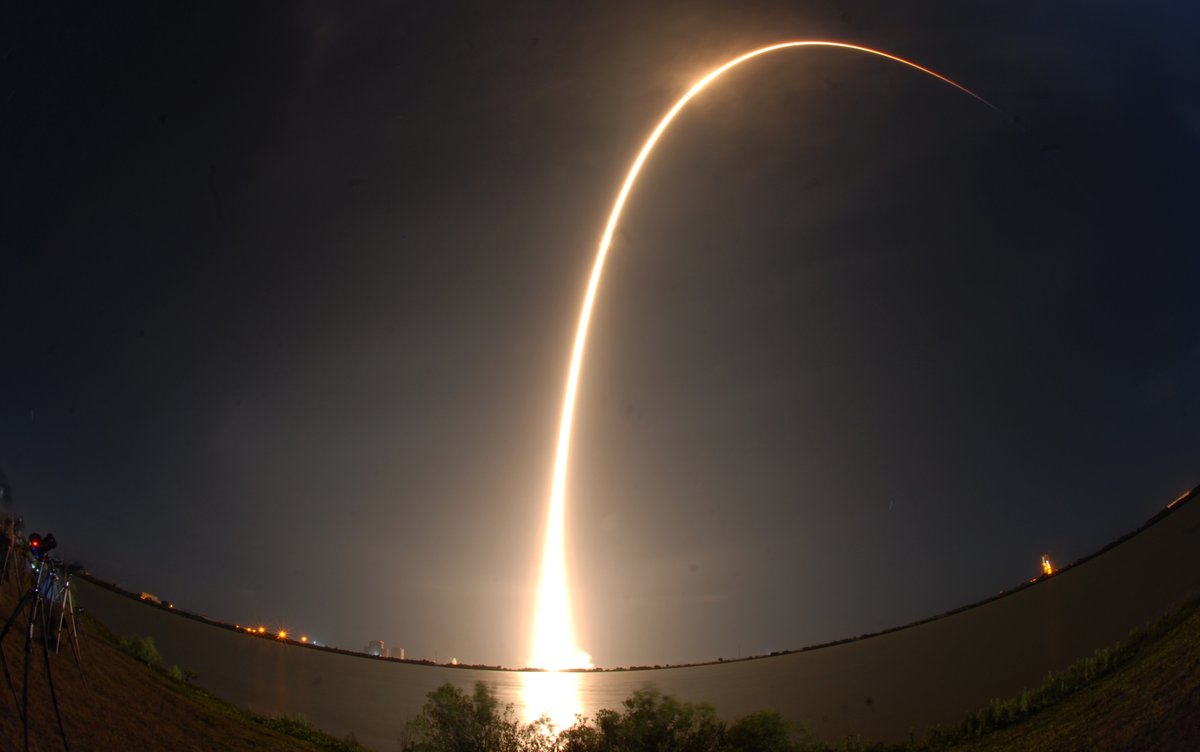
Forget boot prints on the moon or human missions to Mars—the real 21st-century space race is shaping up to be more about who can launch the most rockets and satellites.At least, that’s what’s suggested by the U.S.’s newly updated National Space Transportation Policy (NSTP), which demands a rapid expansion of the nation’s spaceports. Issued by the White House in a presidential memorandum on August 20, the policy declares that U.S. “space transportation ranges must grow to support more than 1,000 launches and reentries every year” by 2030. That’s more than five times the 181 launches that occurred on U.S. soil in 2025. And that figure itself exceeds, by 10-fold, the number of U.S. launches in 2013, the year the Obama administration created the previous NSTP.The push for more spaceports reflects skyrocketing demand for commercial satellites, as well as surging governmental interest in developing more in-space infrastructure and on-orbit servicing for military and civil applications. Some analysts argue orbital data centers for artificial intelligence will be the next frontier as opposition grows against such facilities being built on Earth. SpaceX, by far the country’s and the world’s most active company in the areas of space launches and satellites, supercharged its recent record-setting initial public offering (IPO) with a plan to dominate this emerging market. And it has just secured land for a new $100-billion spaceport in Louisiana as part of its sprint to place up to a million satellites in orbit to act as data centers.On supporting science journalismIf you're enjoying this article, consider supporting our award-winning journalism by subscribing. By purchasing a subscription you are helping to ensure the future of impactful stories about the discoveries and ideas shaping our world today.SpaceX already operates its Starbase spaceport in rural Texas, as well as launchpads at government spaceports on the coasts of California and Florida. The company’s addition of another high-capacity facility in Louisiana is emblematic of the new NSTP’s lofty goals, as well as its underlying purpose, says Jonathan McDowell, an astrophysicist who tracks launch and spaceport statistics.“That’s critical, I think, for the future of all of SpaceX’s plans,” he says, because the company is looking to place many of its AI satellites in polar orbits that are hard to access from its preexisting spaceports. Hurling those satellites to a polar orbit from SpaceX’s launchpads in Florida and Texas would require rockets that would overfly perilously close to large cities, but launches from Louisiana could get there by flying over open ocean and parts of Mexico. Other U.S.-based options for polar orbits are few, he adds: too many people live near Vandenberg Space Force Base in California for the company’s numerous, noisy Starship launches to be tolerable. Meanwhile the Pacific Spaceport Complex–Alaska, while remote enough, is severely limited by Arctic winter weather and, as yet, has no SpaceX presence.SpaceX’s Louisiana purchase illustrates the strain U.S. spaceports are already facing. While not exactly at capacity, their infrastructure isn’t keeping pace with the emerging space-access needs of government and industry, says Brian Weeden, director of civil and commercial policy at the Aerospace Corporation’s Center for Space Policy and Strategy. And the fix isn’t as simple as merely building more launchpads—the supporting infrastructure is critical, too: “things like replacing bridges that happen to be choke points or upgrading the on-site fuel storage or fuel generation or customer cryogenics,” Weeden says. One particular pain point, he adds, is payload processing facilities.“You’ve got to have a building to be able to take in the payloads as they’re being shipped to site.... There’s just not enough of those—particularly for larger, more complex payloads and also [national] security payloads that need special protections.”Spectators watch a Blue Origin New Glenn rocket preparing to launch from pad 36 at Cape Canaveral Space Force Station on April 19, 2026 in Cape Canaveral, Florida. Paul Hennessy/Anadolu Agency/Getty ImagesScott Pace, director of the Space Policy Institute at George Washington University, says an update to the NSTP was overdue, necessitated by associated sweeping technological and political changes since the Obama administration. Pace was a key architect of U.S. space policy in Trump’s first term and notes that the rise of satellite megaconstellations such as SpaceX’s Starlink Internet service during that time was already putting pressure on the tenets of the preexisting NSTP. Besides the spaceport push, he says, this update also merits praise for designating a radio frequency spectrum for launch and for modernizing policies concerning aerospace technology exports and licensing control.One area where he’d like to see “a little bit more clarity,” however, is the matter “of shifting away from government-operating space facilities to private sector,” he says. Outside of threats to national security or public safety, he adds, the standard of U.S. space policy has been and remains that commercial space activities will not be precluded or deterred.That standard has aided the meteoric rise of SpaceX and, more broadly, a U.S. commercial space sector that is the envy of the world. But, Pace says, those successes also should raise questions among policymakers about whether and why a civil government agency such as NASA needs to operate launch sites in the first place. For example, Pace argues that NASA’s Kennedy Space Center (KSC) in Florida chiefly exists to support the space agency’s Space Launch System megarocket for its Artemis missions returning astronauts to the moon—just as it previously supported the space shuttle program. Meanwhile, he says, most actual demand for KSC’s launchpads is commercial, largely because of the clamor for megaconstellations. “If megaconstellations prove not to be commercially viable in the longer term, then a lot of this goes away,” he adds.As for reentry sites, the new presidential memorandum directs the identification of an additional designated reentry zone on federal lands, as well as consideration of key associated safety criteria. Much like launches, reentries can drop hazardous debris on the ground below, and for safety’s sake require large stand-off zones kept clear of people and sensitive infrastructure. Besides needing to accommodate numerous reentries from SpaceX’s and Blue Origin’s multi-use rockets, another type to consider comes from Sierra Space’s Dream Chaser space plane, which recently gained new contracts for its inaugural orbital flight. Another broad concern, Pace says, is environmental issues arising from the sheer volume of satellites reentering Earth’s atmosphere as their orbits decay.The updated NSTP’s directive for more spaceports might, at first, appear unnecessary because the Federal Aviation Administration currently lists more than 20 licensed spaceports in the U.S. Many of these, however, are quite limited in their capabilities and operations, and American spaceports in general have struggled with consistent revenues; a 2014 paper in Technology in Society by attorney Roger B. Handberg, for example, traces state commercial spaceports that did not meaningfully launch because of “changes in technology, markets and the paucity of options.”Sierra Space Corporation’s Dream Chaser spaceplane, Tenacity, as seen during preparations for acoustic testing at NASA’s Kennedy Space Center’s Space Systems Processing Facility in Cape Canaveral, Florida.Sierra SpaceMore recently, Spaceport America in New Mexico said its chief customer Virgin Galactic’s long pause between flights is affecting its revenues. And a proposed Maine Spaceport Complex—designed to support bluShift Aerospace, which recently pivoted more to hypersonic aircraft—has had few updates since 2024.The new NSTP does not offer a detailed outline for how, exactly, a surge in U.S. spaceports is meant to occur, but McDowell suggests there are lessons to learn from attempts by other countries to stand-up spaceports of their own. Location, for example, is only one of many important factors, such as having sustained support not only from any surrounding communities but also from commercial customers.“One interesting example is Alcântara in Brazil, where they’ve been trying to commercialize that for decades,” he says. Those efforts, he adds, have sought to lure international customers—such as the Ukrainian and Russian governments, as well as the South Korean start-up company Innospace. But success has been elusive—which, McDowell says, is all the more remarkable, given the site’s near-ideal remote, equatorial locale. (Rockets launching close to the equator can gain more speed from Earth’s rotation, saving on fuel.)Another knock-on effect of the U.S. asking for more ranges and reentry areas is international competition that may “dilute the market” for the very services the country wants to offer in-house. For example, McDowell says, start-ups around the European Union are using—or building—various newer spaceports around the continent. New Zealand has a fairly mature market, thanks to the presence of Rocket Lab. While Canada has more of a start-up scene, it appears committed: a young spaceport by Maritime Launch Services in rural Nova Scotia received 200 million Canadian dollars ($145 million) in government funding earlier this year, in large part for defense reasons.The combination of international competition and lack of sustained effort on the part of customers at spaceports may show there is no viable commercial model for the growth in U.S. spaceports that the NSTP calls for. The recent struggles of Spaceport America and the Maine Spaceport Complex, as well as the closures of spaceports that saw demand fall, such as Spaceport Camden in Georgia, are indicative of basic market economics: supply and demand. The key is offering not only extra capacity but also a sustained demand signal. Although the end-of-decade deadline for supporting more than 1,000 annual flights is only a few years away, U.S. policymakers should realize the goal itself may require decades-long investment well beyond 2030.
Does the U.S. need more spaceports?
Full Article
Original Source
Read the full article at Scientificamerican →KhanList aggregates and links to publicly available news content. We do not host full articles from third-party sources. Always verify important information with original sources.