
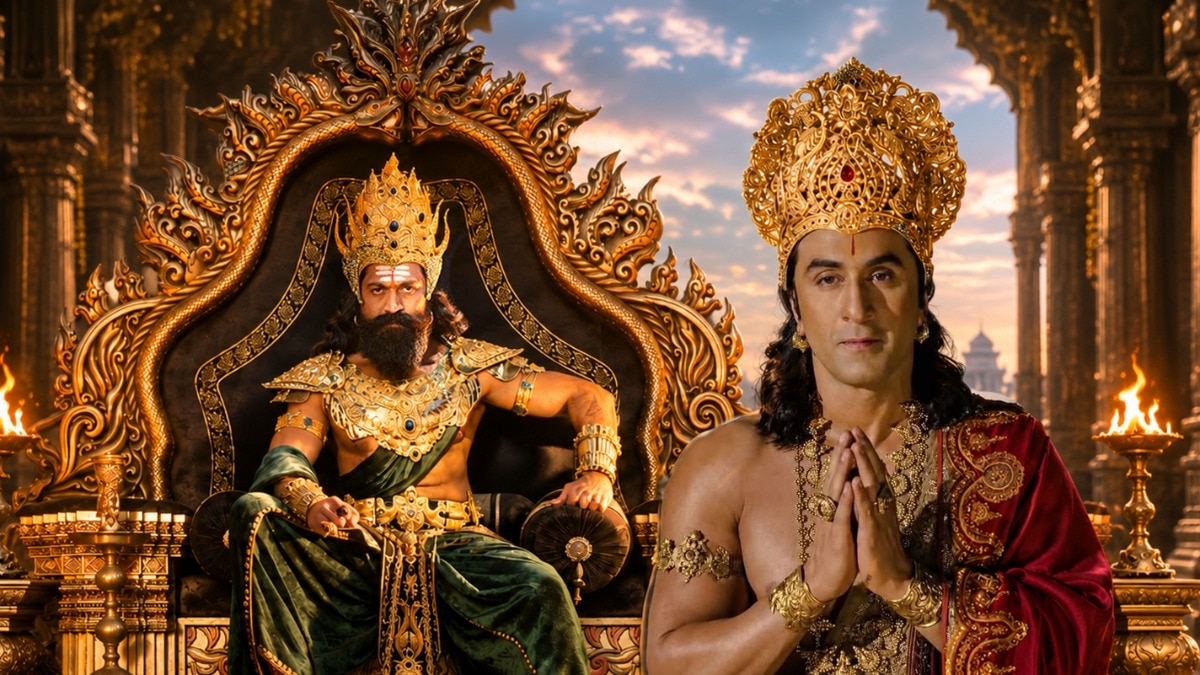
Nitesh Tiwari's Ramayana, based on one of India's most influential ancient epics, has started its run with praise for its emotion, performances and spectacle. But social media users have a lot to say about its portrayal of Ravana, played by Yash. The internet, never known for restraint, says the film is so taken with its demon king that Rama is stuck playing a guest role in his own epic. That's an exaggeration. But it isn't entirely without reason.The online criticism has been particularly sharp. One user accused the film of glorifying Ravana, portraying Lord Rama as a weakling, depicting the devas as oppressors and presenting Surpanakha as a victim. Another user claimed that while the traditional Ramayana belongs to Lord Rama, Namit Malhotra's version belongs to Ravana, also criticising Ranbir Kapoor's dialogue delivery and portrayal.The villain gets the prestige treatmentRavana's introduction is a full origin story. His clan is persecuted by the devas, the celestial beings or gods in Hindu mythology, forced into servitude under Kubera, the god of wealth, and eventually pushed into rebellion. He performs penance, acquires divine boons and takes Lanka, the island kingdom he eventually rules. By the time he rises to power, the film has given audiences a clear picture of how he got there.So does the film glorify Ravana? Look closely, and you’ll find both merit and fault in that assumption. Credit where it's due: the film doesn't turn him into a misunderstood hero. His ego keeps surfacing, most damningly when he kills Vidyutjihva, his sister Surpanakha's husband, over a personal slight. A man who murders a family member over bruised pride is not a revolutionary. He's a tyrant with a grievance. The film's interpretation of Ravana's ten heads as competing voices and personalities also gives Yash room to play a ruler, warrior, devotee and deeply flawed individual. It's an interesting choice, allowing the actor to explore different sides of the character. But it also sets up the film's trickiest question: what exactly drives Ravana to abduct Sita?Revenge is only part of the storyIn the film, Surpanakha's humiliation becomes an important trigger for Ravana's decision to abduct Sita. Her encounter with Rama and Lakshmana, her disfigurement and her appeal to her brother set the conflict in motion. The writers deserve credit for giving her a layered characterisation. She is portrayed with considerable sympathy, as a woman with legitimate grievances rather than merely a character who exists to move the plot forward. That's a valid creative choice. But it is not the only way to interpret her role in Valmiki's account. Valmiki, the ancient Sanskrit poet traditionally credited with composing the Ramayana, offers a more complicated explanation for Ravana's actions. In the Aranya Kanda, the section of the epic dealing with Rama's years in the forest, Sarga 34, Surpanakha describes Sita's extraordinary beauty to Ravana and encourages him to make her his wife. She tells him that seeing Sita would leave him struck by the arrows of Manmatha, the Hindu god of love and desire, often compared to Cupid. She subsequently suggests that Ravana kill Rama and Lakshmana so that he can possess Sita.In Sarga 46, when Ravana approaches Sita in Panchavati, the forest region where Rama, Sita and Lakshmana live during their exile, disguised as an ascetic, Valmiki again describes him as being overcome by desire. His attraction to Sita and his possessiveness are central to the episode. Surpanakha's humiliation adds another dimension to his decision, but it does not erase the role of lust and entitlement.This is where the film's emphasis becomes significant. By foregrounding revenge, it shifts the weight of Ravana's motivations. Audiences could come away seeing a powerful king retaliating against those who humiliated his sister, rather than a man whose desire, arrogance and sense of entitlement lead him to commit an unforgivable act.However, the film does offer another perspective. In the ten-headed Ravana sequence, one of the versions acknowledges his lust and desire for Sita. This gives the makers some ground to argue that Ravana's motivations are not limited to revenge. Yet, there is also merit in the criticism that this is merely a passing reference, without enough emphasis on an aspect that is central to the source material.While the scene establishes that lust is part of Ravana's motivations, it does little to make it as central to his characterisation as revenge. Giving Surpanakha depth is a welcome change, but her grievance should not overshadow the desire, arrogance and entitlement that ultimately drive Ravana's actions. Meanwhile, in AyodhyaThe sharper complaint here is about the balance between the two character arcs. Ravana gets considerable room for his clan, ambition, relationships and rise to power, while Rama's life is presented through a montage of significant moments. His marriage, exile and journey into the forest are all covered, but some of these developments could have benefited from more time to register emotionally.That said, the film is not entirely lacking in emotional depth when it comes to Rama and those around him. There are some genuinely beautiful moments between Rama and Lakshmana, Rama and Sita, and Sita and Kaikeyi. Lakshmana's decision to leave Ayodhya and accompany his brother into exile, in particular, carries an emotional weight that the film does manage to capture in parts. These moments offer a glimpse of the relationships that make Rama's journey more than just a sequence of events.There is, however, an interesting contrast in the way these relationships are explored. The film spends time developing Ravana's relationship with Vidyutjihva, a character with a relatively limited place in the larger epic, while Dasharatha's promise to Kaikeyi and the emotional circumstances leading to Rama's exile move at a comparatively quicker pace. Neither choice is necessarily misplaced. Exploring Ravana's personal relationships adds layers to a character often reduced to his antagonism, just as the emotional moments surrounding Rama give the audience reasons to connect with his journey. The question is whether both sides receive enough room to breathe. The film has moments of emotional richness on either side, but the difference in the depth and time devoted to their respective backstories makes the imbalance noticeable. None of this makes Rama weak, whatever the angrier corners of social media might suggest. His dharma, the principle of righteous conduct and moral duty, and his identity as Lord Vishnu's incarnation remain central to the story. And the epic has a built-in reason for his human birth.In the Bala Kanda, the opening section of the Ramayana, Sarga 15, Ravana receives a boon protecting him against the devas, gandharvas and yakshas, celestial beings and supernatural groups in Hindu mythology. He does not seek protection against human beings because he considers them insignificant. Vishnu consequently agrees to take human birth to defeat him.Rama's human existence is central to the purpose of his incarnation. His strength is not simply about demonstrating divine powers, but about fulfilling that purpose while upholding dharma. That is a different kind of heroism, and one that needs emotional space to register on screen.Does a great villain need a lesser hero?There is a legitimate cinematic argument behind the filmmakers' approach. Ravana isn't a henchman with a grudge. He is a powerful ruler whose strength threatens the celestial order. Establishing his rise, ambitions and personality helps audiences understand the magnitude of the challenge Rama eventually faces.A formidable villain makes the hero's eventual victory more meaningful. Humanising Ravana isn't the same as glorifying him. Exploring the persecution of his clan, acknowledging his achievements or giving Surpanakha a more layered characterisation does not automatically mean endorsing his actions. Understanding how someone becomes monstrous is not the same as excusing what they do.The stakes are higher because of the film's global ambitions. Viewers raised on the epic bring their own cultural and literary understanding of these characters. Those encountering the Ramayana for the first time may rely largely on the film to understand its moral and emotional foundations. That doesn't mean filmmakers must reproduce every detail of one version of the epic. The Ramayana has been retold across regions, languages and traditions, with different interpretations of its characters and events. Creative freedom allows for reinterpretation. But the choices made in that process inevitably shape how audiences perceive its central characters. Is it really a Ravana centric?The film doesn't demonise Rama, nor does it entirely excuse Ravana. It presents the latter as an arrogant ruler whose power and ego eventually become his downfall.Ultimately, much of this debate also comes down to how viewers experience the film. Those who feel emotionally connected to Rama's journey and the relationships surrounding him may find certain portions underdeveloped and the attention given to Ravana disproportionate. Others, who find the film's exploration of Ravana compelling and believe Rama's emotional moments work, may not see the same imbalance. Neither response necessarily invalidates the other. The question is whether the film gives both sides enough emotional and narrative weight to make their eventual confrontation meaningful.There is also a reason to hold fire. This is only the first instalment. The decisive confrontation between Rama and Ravana has not happened yet, and the second part has room to give Rama's journey the emotional weight it needs while exploring Ravana's motivations in greater depth.- Ends
Does Ramayana glorify Ravana? The uncomfortable question internet is asking
Full Article
Original Source
Read the full article at Indiatoday →KhanList aggregates and links to publicly available news content. We do not host full articles from third-party sources. Always verify important information with original sources.