
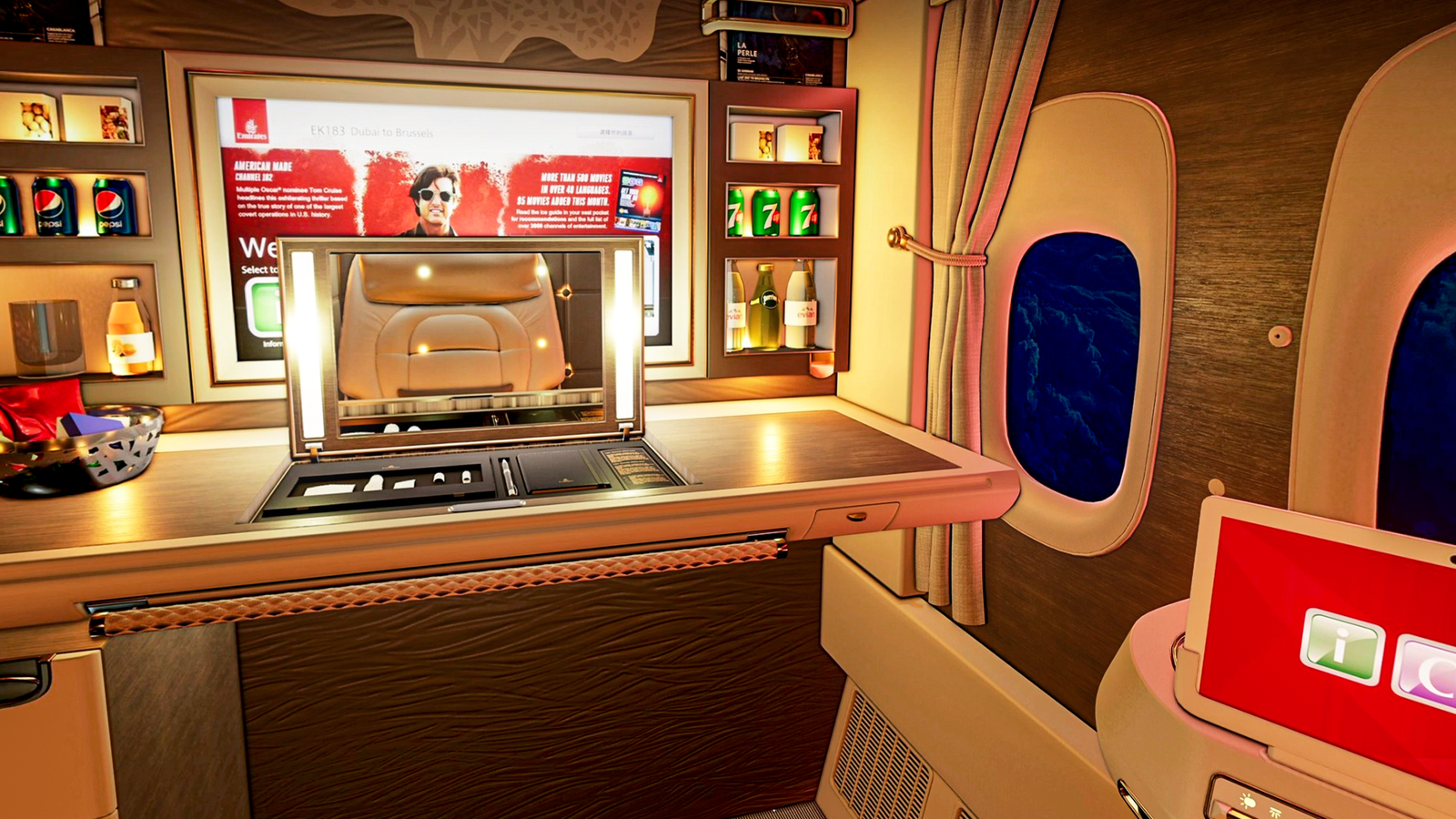
Published Sep 23, 2026, 1:01 PM EDT Airline and Airport Management Graduate, Student Commercial Pilot and Commercial Aviation Writer. Based in London & Nagoya Paying three to four times more for an international first class ticket no longer guarantees a single extra inch of sleeping surface over the business class suite located directly behind the curtain. Across global long-haul fleets, the dimensions of premium flatbeds have completely converged, leaving carriers charging five-figure fares for sleeping areas that are dimensionally equivalent to those available at a fraction of the cost. Carriers like Emirates, Lufthansa, Cathay Pacific, and Qatar Airways have engineered modern business class suites that match or exceed traditional first class beds in length, lateral width, and mattress depth. As a result, now is really the time to begin a re-examination of premium passenger economics. If an 82-inch (208 cm) flatbed, plush duvet, and proactive turndown service are now standard in business class, what specific tangible or environmental mechanics actually determine how well a passenger sleeps? The Competitive Benchmark Credit: Virgin Atlantic The distinction between first and business class sleeping surfaces blurred when the 82 inches (208 cm) lie-flat berth became the competitive benchmark. Modern engineering developments from seating manufacturers allow airlines to fit full-length sleeping surfaces into business class configurations without sacrificing overall passenger density. Flagship business class products, including the Japan Airlines Business and Virgin Atlantic A350 Upper Class now match the exact 82 inches (208 cm) bed length historically considered to be only for ultra-exclusive first class suites like the Emirates Boeing 777-300ER Game Changer. Developing this dimensional parity further, some next-generation business class seats actually exceed standard first class sleeping dimensions. As per The Points Guy, Lufthansa's Allegris business class cabin introduces a central Extra Long Bed seat option that stretches to an extraordinary 86 inches (218 cm) in lie-flat mode. When compared against standard first class berths that cluster between 80 inches (203 cm) and 84 inches (213 cm), these ultra-long business class seats are a sign that tall travelers no longer need to purchase a top-tier ticket simply to avoid touching the footwell wall. Longitudinal bed measurements show total parity across cabins, but for many, length represents only one vector of sleep ergonomics. A passenger can stretch out fully on an 86 inches (218 cm) mattress, but restricted lateral elbow room or narrow footwells can still prevent natural sleep movement and comfortable side-sleeping positions. First Class Is Being Left Behind? In select flagship configurations, business class seat design actively surpasses first class. While traditional business class seats taper at the shoulders or narrow into constricted footwells, staggered layouts now allow forward-thinking carriers to expand lateral mattress width well beyond historical norms and offer something truly different to the market. As noted in seating analysis from Simple Flying, All Nippon Airways redefined lateral sleep ergonomics with its Boeing 777-300ER business suite, known as The Room. Its alternating forward-and-aft design provides up to 38 inches (97 cm) of lateral width and a 33-inch (84 cm) wide sleeping surface, making it substantially wider than standard first class seats that average 28 inches (71 cm) to 30 inches (76 cm). The hardware expansion is matched by soft-product convergence, with business class suites routinely offering sliding privacy doors, multi-layer mattress pads, pajamas, and proactive turndown service. If business class can offer 86 inches (218 cm) bed length, 38 inches (97 cm) mattress width, and turndown service, the hardware justification for first class vanishes. Passengers do consistently report deeper, less fragmented sleep in an eight-seat first class cabin than in a 50-seat business class section on the exact same aircraft. So why is this the case, and what are airlines doing to improve sleep quality further than just engineering a good seat? The Need For An Enclosed Environment Credit: Emirates The true differentiator of first class sleep is within ambient noise, foot traffic, and service pacing. According to cabin research by Kayak, dedicated first class cabins feature just four to eight seats with 1:2 passenger-to-crew ratios. This low density enables unscripted, dine-on-demand meal service tailored to individual sleep schedules rather than cabin-wide meal waves. This environment significantly reduces sleep fragmentation caused by cabin activity during night flights. Typically, service waves in a 50-seat business class cabin create continuous galley noise, overhead lighting, and aisle foot traffic that disrupt rest cycles. In contrast, an intimate first class cabin minimizes aisle movement and service noise, allowing passengers to achieve longer periods of uninterrupted sleep. Low-density cabins remove the environmental noise and service disruptions, but the way in which the seat actually works still dictates how easily a passenger moves from sitting to sleeping. In most lie-flat configurations, converting a seat into a flat surface requires motorized actuators and toppers that necessitate passengers vacating their seats mid-flight. Making Rest Far More Uninterrupted Credit: Singapore Airlines Mechanical seat conversion disrupts sleep cycles by requiring passengers to stand while crew install mattress pads, or wait through motorized motor adjustments. Dual-furniture suite designs solve this friction by providing a dedicated armchair alongside an entirely separate, permanently made mattress surface. As noted in Simple Flying coverage, flagship products like Singapore Airlines' Airbus A380 Suites feature a distinct swivel chair alongside a standalone 76 inches (193 cm) bed. On the surface, it may seem purely aesthetic, but this dedication to detail eliminates seat creases, foam joins, and crew conversion delays during crucial sleep windows, showing the practical side of such inclusion. While permanent dual-furniture beds eliminate mechanical sleep disruptions, reserving up to 50 square feet (4.6 square meters) per passenger is something that, from a commercial standpoint, is often hard to justify when other cabin classes like premium economy offer far more to the per-flight revenue breakdown. This is exactly what many airlines find challenging: providing uncompromising luxury when high-density business suites that generate far higher revenue per square foot can be prioritized. Time To Phase Out First Class? Credit: Benson Truong | Shutterstock The rapid extinction of dedicated first class cabins is fundamentally reshaping widebody cabin layouts and fleet planning. As per market reporting by Simple Flying, the number of international airlines operating dedicated first class cabins has fallen by more than 40% since 2019. As older widebody aircraft retire, carriers are now replacing eight-seat first class sections with high-density business class suites that maximize overall revenue per departure. Such a commercial shift is evident in the fleet decisions of major international carriers. Airlines such as United Airlines, Delta Air Lines, and Air New Zealand have completely removed international first class in favor of upgraded business class suites. Even legacy operators like Qatar Airways initially opted to forego first class on their future Boeing 777X fleets, relying instead on privacy-door business class products like the Qsuite to satisfy premium demand, though the airline later reversed this decision. High-end business class suites are continuing to absorb the dimensional and soft-product privileges of first class, and now more than ever before, airlines face a strategic crossroads. The remaining carriers offering dedicated first class need to show whether unscripted service and ultra-exclusive cabin acoustics can justify a cabin that occupies massive floor space while serving only a handful of passengers per flight. The Final Evolution Of Long-Haul Seating Sleep is not something that every premium passenger wants, but when they do need it, the cabin needs to be able to facilitate rest to the best of its ability. Especially when many travelers are paying a premium for these kinds of seats, no element of the product can really fall short. As business class suites become fully enclosed with sliding doors and multi-layer mattress pads, the privacy divide becomes almost invisible. A top-tier first class bed is no longer exclusive, and is beginning to find a new home in business class. With next-generation ultra-long-haul aircraft deliveries, first class may be even more under threat. Carriers planning to operate 20-hour non-stop routes, such as Qantas with its Airbus A350-1000ULR fleet in the near future, are limiting first class to just six bespoke suites with separate armchairs and 80 inches (203 cm) beds, while filling the remaining premium footprint with business suites. These extreme stage lengths will be the ones that show whether dedicated dual-furniture first class suites remain commercially viable, or if front-row business class seats will absorb the flagship market entirely. The ongoing rollout of premier front-row business suites, offering extra legroom and ottoman space at a fraction of first class operating costs, suggests that the final evolution of long-haul seating is here. Passengers seeking the best possible sleep now really should consider whether first class offers enough of a product upgrade over business class, which in many cases now does not. The future of premium sleep rests not in purchasing a higher class of service, but in selecting the exact seat location and cabin architecture that minimizes noise and maximizes unscripted rest.
Does First Class Buy You Better Sleep Than Business? What Actually Changes
Full Article
Original Source
Read the full article at Simpleflying →KhanList aggregates and links to publicly available news content. We do not host full articles from third-party sources. Always verify important information with original sources.