
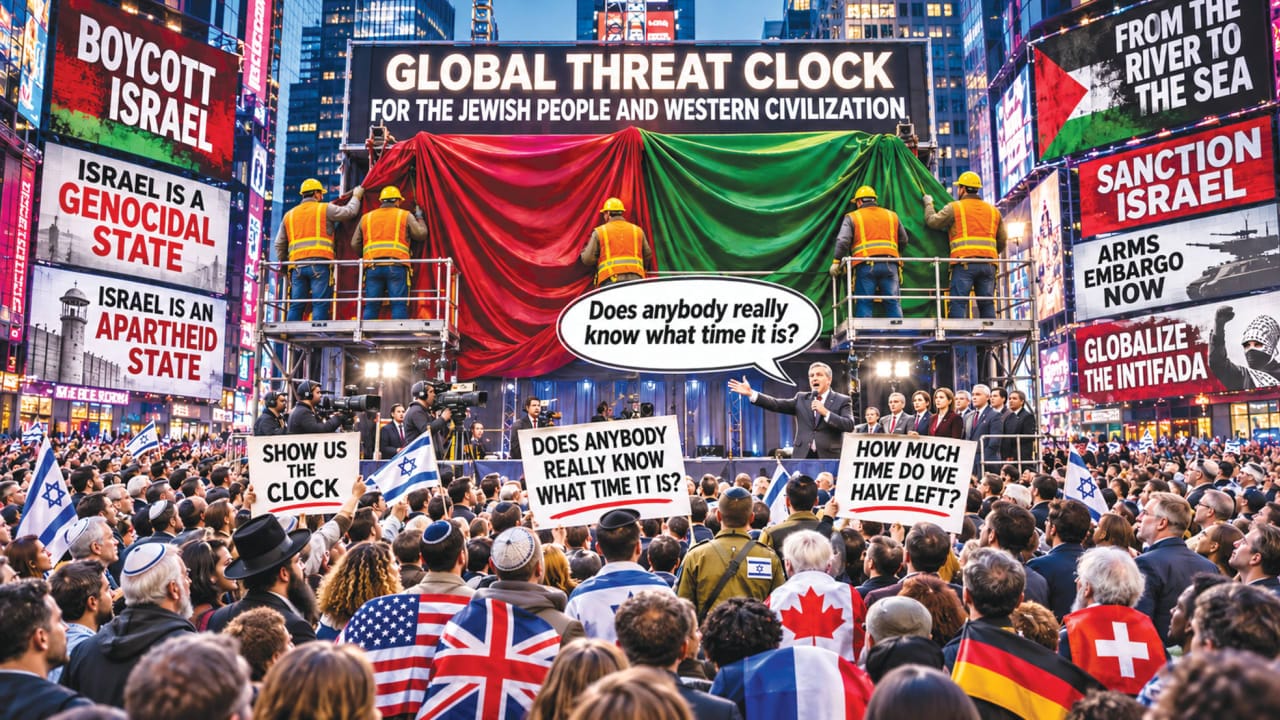
NOVEMBER 27, 2026 21:20In 1969, the American rock band Chicago released a song that asked a deceptively simple question: “Does Anybody Really Know What Time It Is?” Written by Robert Lamm, it questioned a society so preoccupied with everyday routines that it had seemingly lost sight of what really mattered.More than half a century later, I find myself asking that same question from Jerusalem, but with a far more ominous and potentially existential meaning.Does anybody really know what time it is for the Jewish people? For Israel? For Western civilization?We have had clocks measuring America’s national debt and humanity’s proximity to nuclear catastrophe. Yet we have no comparable clock measuring the evolving threats confronting the Jewish people and Western civilization or, more importantly, how much time remains to mitigate them.And unlike an ordinary clock, this one is accelerating.People walk past a projection depicting Israeli and US flags on the walls of Jerusalem's Old City on Oct. 22, 2025. (credit: AHMAD GHARABLI / AFP)The psychology of not knowingHow could millions of European Jews, surrounded by sophisticated institutions, intellectuals, and communal leaders, find themselves trapped in a catastrophe whose warning signs had appeared years earlier?Many recognized increasing antisemitism and sought escape or organized resistance. But recognizing familiar forms of persecution was not the same as recognizing their transformation into an unprecedented machinery of extermination, and this resulted in the death of the overwhelming majority.The Nazis did not begin with gas chambers. They began by changing the conditions under which Jewish life could exist: employment, citizenship, property, political influence, and legal protection.How disturbing are some of the parallels emerging today?Psychologists identify mechanisms that help people accommodate to disturbing realities: normalcy bias, cognitive dissonance, confirmation bias, motivated reasoning, and habituation. We seek reassuring evidence, adjust to deteriorating circumstances, and convince ourselves that tomorrow will resemble yesterday.Reminiscent of Stockholm syndrome, appeasing those who threaten us can become a perceived survival strategy. Are some Jewish leaders falling into this psychological trap by accommodating movements that disguise antisemitism as anti-Zionism? It certainly seems so.The metaphoric lesson of how to boil frogs by gradually increasing the heat of the water is imperfect. Unlike frogs, human beings possess sophisticated communication, institutions, leadership, and collective intelligence.But what if nobody has a thermometer?Without an instrument measuring cumulative danger, our psychological defenses become strategic liabilities, allowing us to rationalize successive warning signs until it may be too late.Underestimating accelerationConsider humanity’s awakening to the potential dangers of artificial intelligence.Some of the very individuals responsible for developing AI warned that its capabilities were advancing faster than our ability to understand, regulate, and mitigate their consequences.What changed was not simply the recognition of danger. It was the recognition of acceleration.Are we making a comparable mistake?We count antisemitic assaults, synagogue attacks, campus intimidation, threatening demonstrations, and political developments. But who is measuring the cumulative impact of the above as well as the financial, ideological, technological, and institutional infrastructure through which hostility propagates?Iran, Qatar, and the convergence of Islamist and radical Left movements (the red-green alliance) represent different dimensions of this landscape. Their activities need not originate from a single command structure to produce mutually reinforcing consequences.We must distinguish recognizing a threat from identifying its source. The former determines whether the clock advances; the latter helps determine how to respond.How the clock should workNot every development should advance the clock equally.An antisemitic assault is a terrible crime, but legislation depriving Jews of equal rights or excluding them from public office could fundamentally alter the security of an entire population.One event might advance the clock a minute. Another might advance it 15 minutes. A third might change the speed at which every subsequent minute passes.Consider the implications of transforming accusations against Israel into collective indictments of Zionists. Once an entire population is portrayed as complicit in genocide, hostility against its members becomes easier to rationalize, influencing political behavior, institutional policies, and the willingness of others to defend Jewish rights.The clock must measure four interconnected variables: the magnitude of the threat, its velocity, its acceleration, and our remaining capacity to mitigate it.Midnight need not represent the catastrophe itself. It could represent the point at which our ability to prevent it becomes critically compromised.The disappearing shieldIsrael’s strategic dependence on Western powers, particularly the United States, leaves it vulnerable to changing political attitudes. Calls for boycotts, arms embargoes, and sanctions, once largely confined to the political fringes, have entered mainstream discourse.These developments must influence the clock.I recently visited the Gaza-border kibbutzim with international guests from Asia. We met IDF reservists providing an additional protective layer for communities devastated on October 7.Their commander expressed deep concern about potentially withdrawing that protection amid the resource demands of a prolonged multifront war, leaving local civilian emergency response squads with greater responsibility.At Kibbutz Nir Oz, standing outside the Bibas family home, looking at the remnants of children’s toys and family possessions, I could not escape the horrifying reality of what had happened to those children.The consequences of failed mitigation, and the potential consequences of future failures, became painfully tangible.The threat from Hamas must be measured against Israel’s ability to neutralize it. Yet that ability depends not only on military capabilities but also on the freedom to exercise them.Hamas’s exploitation of civilian environments, coupled with the global dissemination of images of Palestinian suffering, can impose increasingly consequential diplomatic and operational constraints on Israel.Our enemies understand that diminishing Israel’s capacity to defend itself can be strategically valuable even without defeating it militarily.The same principle applies to Jewish communities in New York, London, Paris, and elsewhere.When political influence, legal protections, institutional support, or physical security deteriorate, the clock advances, even without another antisemitic attack.The memory we keep forgettingIsrael experienced a devastating awakening in 1973 with the Yom Kippur War. America experienced one on September 11, 2001. Israel experienced another on October 7, 2023.How rapidly does the urgency generated by catastrophe dissipate? Will recent outbreaks of violent unrest in Europe similarly fade from our collective consciousness?We commemorate, build memorials, and promise “Never again.” Meanwhile, our adversaries continue learning, adapting, and developing new capabilities.Remembering a catastrophe emotionally is not the same as retaining its operational lessons.A credible threat clock would provide a continuous reminder, preventing the passage of time from becoming a substitute for evidence that the danger has receded.Synchronizing our clocksGen. Stanley McChrystal confronted an organizational paradox fighting al-Qaeda. Despite America’s overwhelming military superiority, decentralized terrorist networks exploited the limitations of its hierarchical institutions.His response, described in his 2015 book, Team of Teams: New Rules of Engagement for a Complex World, was to develop shared situational awareness, reduce organizational friction, increase agility, and empower independent action informed by collective intelligence.The Jewish world possesses extraordinary intellectual, financial, technological, and institutional capabilities. Yet without shared situational awareness, how can we establish common priorities or determine the urgency of collective action?We need interoperability, not necessarily organizational unity. We need connective tissue enabling independent Jewish and Western institutions to share intelligence, resources, expertise, and a common understanding of the strategic environment.A credible clock, informed by multidisciplinary intelligence, weighted indicators, and continuous recalibration, could provide that shared understanding.It must move backward when mitigation succeeds, not merely forward when danger increases. Its credibility must rest on evidence, not alarmism.Imagine standing in Times Square, surrounded by thousands of people, asking one another what time it is. Nobody has a watch. Nobody can agree on the hour.That, I fear, is increasingly our predicament.Chicago’s song questioned whether society understood the significance of time. Today, our question is whether the Jewish people and the West understand the significance of the time they may have left to act.Does anybody really know what time it is?The writer is a global strategist and a strategic adviser at the Jerusalem Center for Security and Foreign Affairs. Follow him on X: @jeffkahn2020Follow us on Google
Does anybody really know what time it is? - opinion
Full Article
Original Source
Read the full article at Jpost →KhanList aggregates and links to publicly available news content. We do not host full articles from third-party sources. Always verify important information with original sources.