
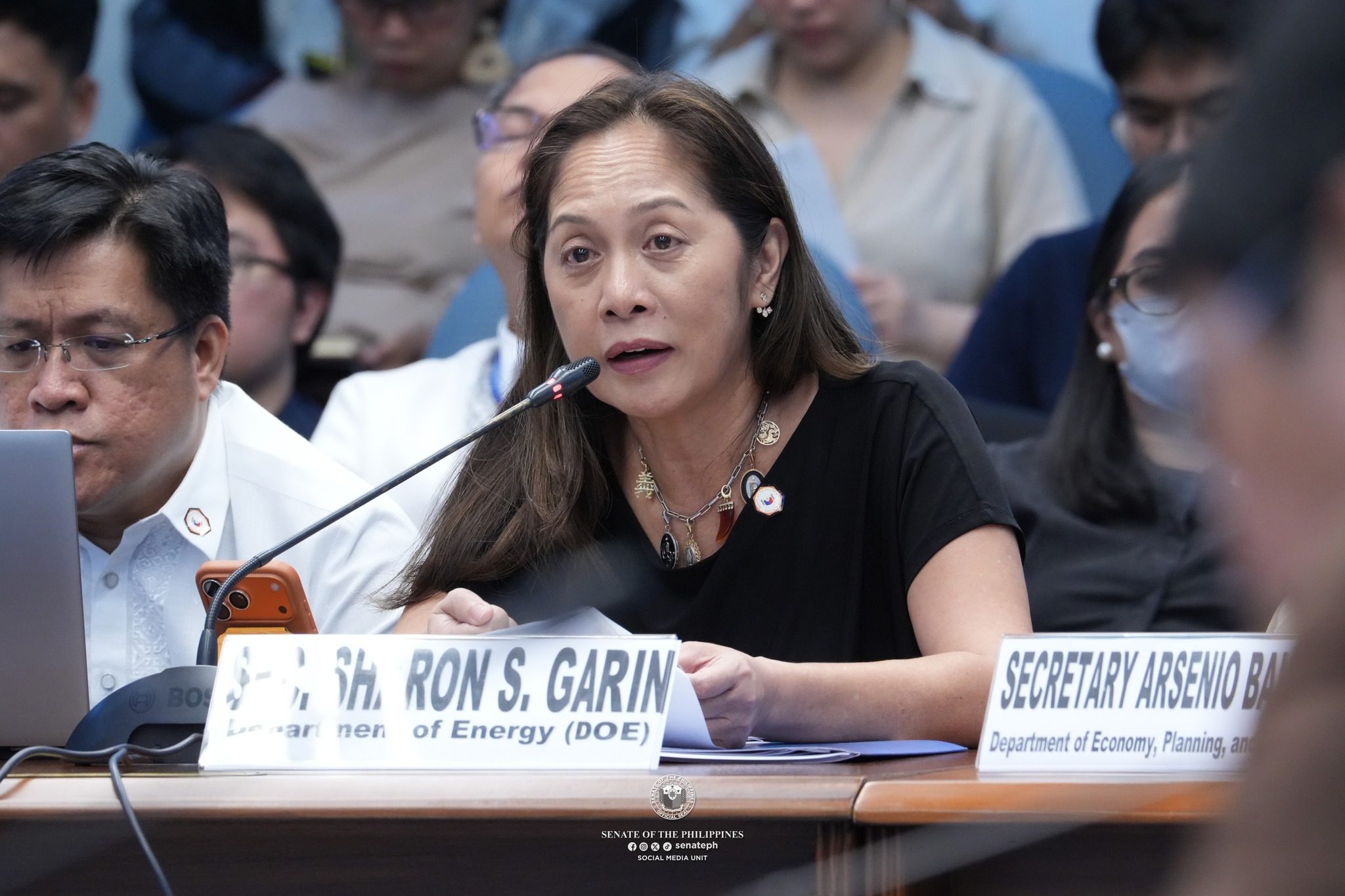
COMMITTEE HEARING. Energy Secretary Sharon Garin at the Senate PROTECT committee hearing on Monday, April 3, 2026. Voltaire F Domingo/Senate OSEC-SMU The largest percentage increase is for the Electric Vehicle Industry Development Program, whose funding rises more than sevenfold to P228.92 million from P32.46 million in 2026 The Department of Energy (DOE) is proposing a budget of P5.58 billion for 2027, a 26% increase from 2026, with significant allocations for conventional energy development, the electric power industry, and a sevenfold increase in funding for the electric vehicle program. Most of the DOE's funding will come from automatic appropriations, particularly a Special Account in the General Fund, which has increased significantly from previous years, while new congressional appropriations are set to decrease by 31.6%. The Energy Regulatory Commission (ERC) is proposed to receive P944 million in 2027, with a slight increase from the previous year, focusing on consumer education and protection within its regulatory programs. This is AI-generated. Read the article for full context. Report any errors. MANILA, Philippines – The Department of Energy (DOE) is seeking a spending program of P5.58 billion in 2027 with the biggest allocations going to conventional energy development, the electric power industry, and energy efficiency, while funding for its electric vehicle program is set to jump more than sevenfold. The DOE’s proposed 2027 budget is up from P4.43 billion in 2026, a 26% increase. But the amount Congress is being asked to approve as new appropriations actually falls 31.6% to P2.03 billion from P2.96 billion this year. Instead, P3.55 billion will come from automatic appropriations, meaning funds already authorized under existing laws and not dependent on a new annual appropriation from Congress. Almost all of DOE’s automatic appropriations come from a P3.46-billion Special Account in the General Fund, up from P1.40 billion in 2026. The account consists of government revenues already earmarked by law for energy-related purposes and kept separately within the National Treasury. The fund traces its roots to Presidential Decree No. 910, issued in 1976 by the late dictator Ferdinand E. Marcos Sr., which created a special fund from fees, revenues, royalties, and government shares from energy resource exploration and development. The 1992 law creating the DOE later allowed up to 20% of the fund’s outstanding balance to be used for expenses necessary for the department to perform its functions. The account includes government revenues from energy projects such as Malampaya, although not all money in the account necessarily comes from Malampaya. Maintenance and other operating expenses account for the largest share of DOE’s full spending program at P3.26 billion. Capital outlays get P1.25 billion, while personnel services receive P1.07 billion. The spending plan comes after President Ferdinand Marcos Jr. made energy security and lower electricity costs an important theme of his 2026 State of the Nation Address, including bringing additional generation capacity online and pushing reforms meant to reduce electricity charges. EV program spending jumps more than sevenfold Most of the DOE’s operating programs draw the bulk of their funding from the aforementioned automatic appropriations under its Special Account in the General Fund, rather than from new congressional appropriations. For 2027, DOE’s full program funding is proposed at: Conventional Energy Development Program: P1.46 billion, up 88% from P775.86 million in 2026. It covers the promotion, supervision, and regulation of the exploration and production of conventional energy resources. Electric Power Industry Development Program: P720.92 million, up 7.4% from P671.14 million Energy Efficiency and Conservation Program: P421.08 million, down 20% from P526.03 million Downstream Energy Development Program: P236.13 million, nearly unchanged Electric Vehicle Industry Development Program: P228.92 million, more than seven times the P32.46 million programmed for 2026 Alternative Fuels and Energy Technologies Program: P222.03 million, down 51.5% from P457.83 million Renewable Energy Development Program: P165.12 million, down 14.5% from P193.03 million National and Regional Energy Planning Program: P84.82 million, down 14.8% from P99.58 million The sharpest increase is for the Electric Vehicle Industry Development Program, whose funding jumps more than sevenfold to P228.92 million from P32.46 million in 2026. The program covers the regulation, promotion, research, and development of electric vehicles and charging infrastructure, with the 2027 targets showing a greater emphasis on regulating the growing charging network. The DOE plans to process the accreditation of charging station providers and registration of charging stations within prescribed timelines and conduct eight enforcement, monitoring, inspection, and verification activities. The NEP, however, does not identify a single new project or specific allocation, such as government-funded charging stations, that accounts for the large increase. ERC gets P944 million The Energy Regulatory Commission (ERC), meanwhile, is proposed to receive P944.07 million in 2027, up just 1.4% from P931.25 million this year. Of this, P915.85 million consists of new appropriations, while P28.21 million comes from automatic appropriations for retirement and life insurance premiums. Its operating budget actually falls to P341.76 million from P363.69 million. Within its P326.15-million Electric Power Industry Regulatory Program, the largest allocation is P119.76 million for consumer education and protection. Screening and registration gets P108.27 million, monitoring of regulated entities P65.68 million, and enforcement of rules and regulations P32.44 million. The House appropriations committee will deliberate on the DOE’s 2027 budget on Wednesday, September 2. – Rappler.com How does this make you feel? Loading
DOE eyes P5.6-B 2027 budget as conventional energy, EV programs get big boost
Full Article
Original Source
Read the full article at Rappler →KhanList aggregates and links to publicly available news content. We do not host full articles from third-party sources. Always verify important information with original sources.