
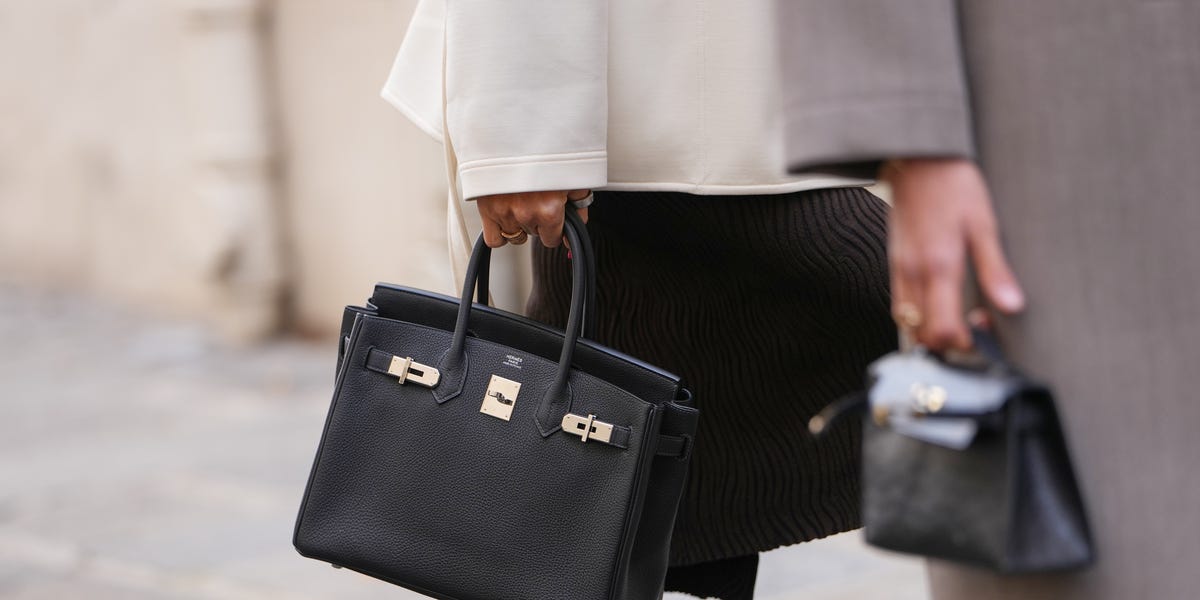
We may earn commission from links on this page, but we only recommend products we love. Promise.Edward Berthelot//Getty Images"Let's unbox my birthday bags from Paris together," a twentysomething influencer says in a TikTok video filmed from her Haussmann balcony. Casually set against the backdrop of the Eiffel Tower, she pulls two shopping bags from Chanel and Louis Vuitton into frame, explaining that after calling her mom, "she said get both."A few more scrolls and I land on a TikTok of an "impulsive Canal Street haul," as the creator describes her shopping spree at the Lower Manhattan destination known for its imitation luxury goods. "The guy asked me for $160, and I got him down to $53," she says as she shows off a black Saint Laurent Le 5 à 7 Mini-inspired bag. A total of five purses follow, prompting her to ask, "Is it too soon to go back and shop some more?"These two parallels live alongside one another, both equally praised and ridiculed in the comments. And though each focuses on a vastly different means of obtaining the luxury aesthetic, they're sending the same message: The logo matters more than where it came from.Blame social media. Luxury logos were status symbols long before Instagram, but our feeds have made them feel universal. Scroll long enough, and it starts to seem like everyone owns a four- or five-figure bag, and that you should too. Now the bag is less about the object itself and more about projecting a certain image—typically via a tiny screen—to signal that we belong.Content creator Audrey Peters, whose feed spans travel, fashion, and her own collection of designer goods, put it this way: "Because everyone recognizes them, luxury items have become an even stronger way of signaling success, taste, and identity online."The bag is less about the object itself and more about projecting a certain image—typically via a tiny screen—to signal that we belong.Vivian Tu, founder and CEO of financial literacy company Your Rich BFF, agrees, pointing to our "increasingly visual society," where carrying the right bag signals that you're part of the "in group."Beyond the pressure and illusion of status it creates, the constant stream of luxury content on our feeds also dramatically accelerates the speed at which a new bag catches on. "An It bag or accessory can become a must-have overnight," Blake Geffen, co-founder and CEO of luxury rental site Vivrelle, said. A new bag once took months to gain cultural momentum after a fashion week debut or magazine feature. Social media can now turn a runway look into a viral sensation almost instantly. So the bag that signals you're in the know this season can look dated by the next, and the pressure to keep up only grows.But "luxury goods are a terrible measuring stick," money expert, author, and entrepreneur Tori Dunlap explains, noting that many of the flashiest feeds are financed through credit cards. And on camera, a bag that's still being paid off looks exactly the same as one that isn't.Knowing all this doesn't make anyone immune, including me. I've felt the pull of luxury content myself.A couple of days before my Southern California wedding, my now-husband surprised me with my first Italian luxury bag: a Fendi Baguette in crisp white leather, featuring the iconic gold FF clasp. I was thrilled, quickly posting a photo of my new accessory while on my way to our rehearsal dinner. After working in fashion for a little over five years and only owning mid-range designer pieces, I thought, "I've finally made it."I lived and breathed fashion, and I genuinely wanted the Fendi Baguette for its craftsmanship, quality, and style. But the idea of owning luxury wasn't entirely my own. My social media feed was full of Carrie Bradshaw screengrabs and nostalgic Sex and the City quotes that cemented the Baguette as one of fashion's ultimate status symbols, alongside jewel-encrusted Manolo Blahniks (which I also secured). Then there were the endless designer bag unboxings and European shopping sprees tied to VAT refunds (girl math says you're saving money!) that filled my For You page. And The Devil Wears Prada reinforced the idea that owning luxury was synonymous with belonging in high-status arenas. My love for beautiful pieces was genuine, but it was also shaped by the content I was consuming.To be clear, wanting a designer bag isn't inherently problematic. The problem, however, is when the signal becomes the point. For some, chasing that signal can translate into overspending or financing purchases that may not be in their best interest. For others, it can look like splurging on something that doesn't matter much to them personally. Or, it can mean a constant cycle of trying to keep up, whether leaning on originals, convincing dupes, vintage boutiques, or rental services. No matter which route you take, if belonging is the motive, the pressure is the same.The solution? Asking ourselves why we really want the bag. Are capitalism and social media tricking us into thinking it's the missing piece to feeling complete? Or is it something that genuinely aligns with our beliefs, priorities, and desires? Dunlap uses one question to uncover where the appeal is coming from: "Would I still want this if I could never post it?" she asks. "If the answer is no, that's not desire—that's comparison."Would I still want this if I could never post it? If the answer is no, that's not desire—that's comparison.— Tori DunlapWhen a bag passes that test, the reason behind it tends to be personal, whether that's a memory, a milestone, or years of everyday use.For public relations and influencer specialist Kayla Hockman, the value of luxury has nothing to do with the label. Her late grandmother invested in the Louis Vuitton Neverfull. "She carried it everywhere," Hockman said. "Now I use it all the time as my laptop bag…It feels like I'm bringing a little piece of her with me."And for consultant Esmy Vergel Roman, her luxury splurge represented a career milestone. "The status doesn't come from the bag itself," she said. "The bag is just a manifestation of the hours I've worked and the way I have grown into a respectable, hardworking woman."Others value their bags for how much use they get out of them. "I bought [the Louis Vuitton Pochette] when I was 13 for around $250 but still use the bag today," travel and entertainment journalist Cassie Gill told me. Public relations and brand manager Amanda MacNeil feels the same about the $150 Dior Book Tote-inspired design she bought from a sidewalk vendor in New York City. "I use it for work every day and travel constantly with it," she said. She added, "Confidence doesn't come with an authenticity card. I'm wearing the bag; the bag isn't wearing me."As for my Fendi Baguette, I'll admit part of me bought into what it signaled. But today, it symbolizes the commitment my husband and I made, serving as a physical representation of our love story—not my status, belonging, or identity.Ruby Ford-Dunker (McAuliffe) is a fashion and lifestyle journalist featured in Vogue, InStyle, Elle, Who What Wear, Marie Claire, Brides, the New York Post, Business Insider, and more. When she’s not reporting on her latest fashion obsession, she can be found listening to Taylor Swift, hunting for the best vanilla latte, playing with her cats, or smiling her way through a dance workout. Email Ruby at therubybrand@gmail.com, and keep up with her on Instagram @rubyymcauliffe and Substack via Style Note.
Do You Want the Designer Bag, or Do You Want to Post It?
Full Article
Original Source
Read the full article at Cosmopolitan →KhanList aggregates and links to publicly available news content. We do not host full articles from third-party sources. Always verify important information with original sources.