
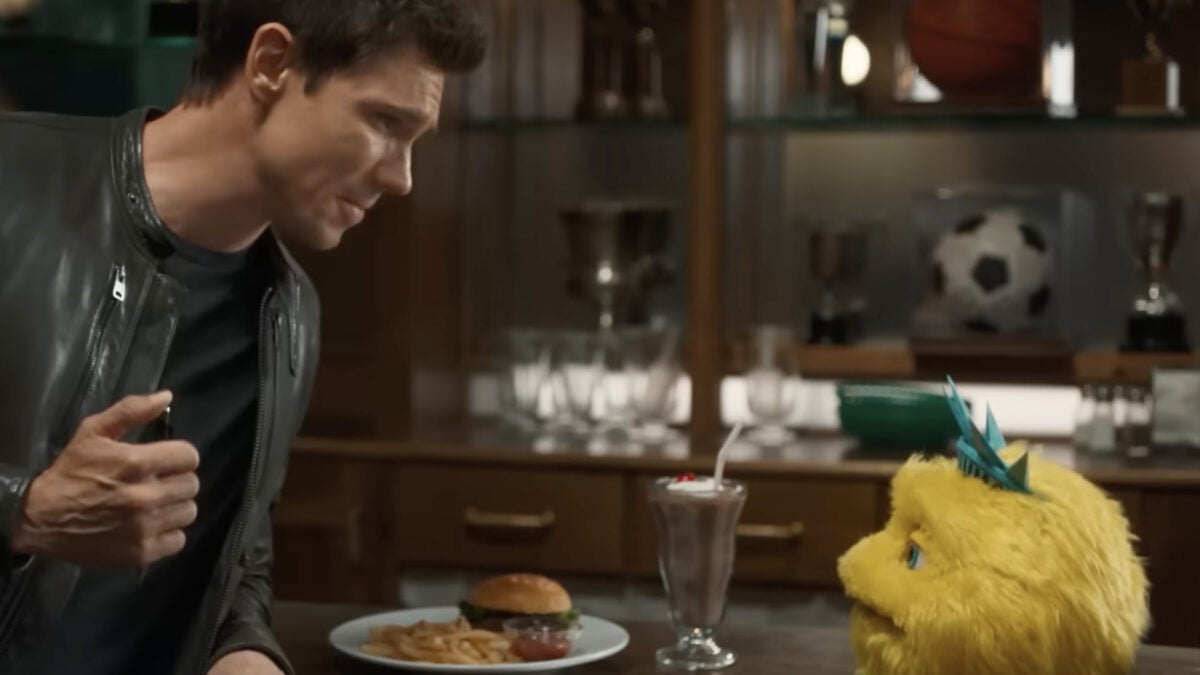
The earliest known advertisement is a 3,000-5,000-year-old scrap of papyrus from Thebes, Egypt offering a reward for a runaway slave named Shem. Ads remained fairly straightforward throughout the millennia up until their Cambrian explosion in the 20th century, generated by groundbreaking communication technology and an industry established to sell people products with it. Though their field enjoyed a brief period of artfulness—or so I’ve allowed Mad Men to convince me—the care and craft ad men and women once put into their pitches is long gone. Audience attention spans and commercial lengths are the shortest they’ve ever been, so some Madison Avenue suits are now resorting to the tactics discovered and perfected by the news and social media organizations: capturing your attention through visceral repulsion. Or so that would appear to be the case with car insurance giant Liberty Mutual’s controversial new mascot. He’s a spherical ball of yellow fur named Liberty Biberty and people fucking hate him. In just a few weeks, the collective outrage has escalated from isolated social media takedowns to a recent segment on Last Week Tonight in which John Oliver essentially declared a jihad on the puppet. One poor future regretter even got a tattoo of Liberty Biberty being churned into ground meat. A few days ago, the hate campaign entered an entirely new phase as several dozen people took to the streets in Boston to protest in front of the insurance company’s headquarters. If you don’t watch much live TV, pay for the ad-free versions of streaming platforms, and avoid certain gas pumps, you might have missed the ad campaign that kicked off this summer with Liberty Biberty’s commercial debut. Mascots are pretty tried-and-true instruments. Some cultures can’t get enough of them. So why the uproar over this fuzzball? I’ll grant his name’s fairly annoying and he’s not the most aesthetically pleasing corporate creature foisted upon us. But is he really more hideous than the Philadelphia Flyers’ Gritty or ampm’s Toomgis, two ugly ad monsters with dedicated fandoms? And in a world of AI slop, shouldn’t we be applauding the creative agency that birthed the mascot for electing to commission a practical puppet from the Jim Henson workshop? The protest’s 19-year-old organizer, a YouTuber video essayist named Connor Harvey, first announced the October 25 demonstration with a video three weeks back that has since garnered 665,000 views. The Boston Globe’s reporting of the event says there were even handmade signs claiming “Liberty Biberty is fascism” and quoted Harvey likening his rally to “the next Boston Tea Party.” He would later describe Liberty Biberty to USA Today as the peak of enshittification. But in a reality teeming with much more dire examples of authoritarian creep and capitalism ruining things we once loved, it’s clear LB’s most ardent haters are simply latching onto a meme and the bit commitment required to enjoy it. But what if this harmless fun is indicative of something a bit more tragic? This sort of memetic disgust phenomenon happens with regularity in the digital age. Before the early 2010s, you’d be unlikely to find someone telling you their most hated word is “moist.” As linguist Ben Zimmer has discussed at length, that word had just the right characteristics so that when half-serious hatred of the word first proliferated online as a “quirky fact about me,” some of those being exposed to this specific aversion for the first time went “wait, me too.” Whereas the sentiment’s originators were wearing out a joke within their in-group, latecomers swept up by subconscious herd mentality were convincing themselves that because all these seem to hate “moist,” that word must indeed sound gross, so now they are grossed out by it too. Just a decade and change past the height of “moist” enmity, society is far more atomized and online. The collective yearning to be part of a community that does things together outside of the home only grows. So it’s perfectly understandable that folks would lean in and muster up some outrage from a kernel of dislike so that they can join the partying mob to pillory Liberty Biberty passing by. But just as the No Kings protests (and all the funny signs, dance routines, and feelings of camaraderie therein) serve more as release valves for mounting outrage over problems instead of actions taken to actually redress them, playing along with a ginned-up-for-funzies controversy is a temporary balm for the deeper issue. Of course, joining a political organization, picking up a hobby, volunteering, or doing any of the other things that might actually help one find and nurture a community involve an actual, consistent commitment of one’s time and energy. And so they wait for the next protest, real or satirical, to show up in their social media troughs. Speculations abound as to whether or not this protest was all a big marketing stunt in the vein of the countless “look alike contests” that keep popping up to get bored people out of the house via stealthy product promotion in order to foment earned media hits. There’s no smoking gun that Liberty Mutual orchestrated the event, nor that they intentionally sought to create a mascot that repulsed their audience. But even if they lucked out with this fluke and are sitting back, happily soaking up the free publicity that’s coming from the plainly unserious campaign being waged against them, they’re not mad about it. They’re also strategizing about marketing campaigns months into the future. Time will tell whether or not they lean into the hate or pivot. What we can safely assume is that, even though making ephemeral, unimportant ads for an insurance company is not likely to nourish the soul in the same way time at the soup kitchen might, the shared work of making dumb Liberty Biberty commercials forged bonds and provided a sense of purpose for many on that creative team. And those feelings are likely to still be there long after the mascot’s protesters feel their highs fade and the quiet longing return.
Do You Truly Hate Liberty Biberty or Simply Yearn For Community?
Full Article
Original Source
Read the full article at Gizmodo →KhanList aggregates and links to publicly available news content. We do not host full articles from third-party sources. Always verify important information with original sources.