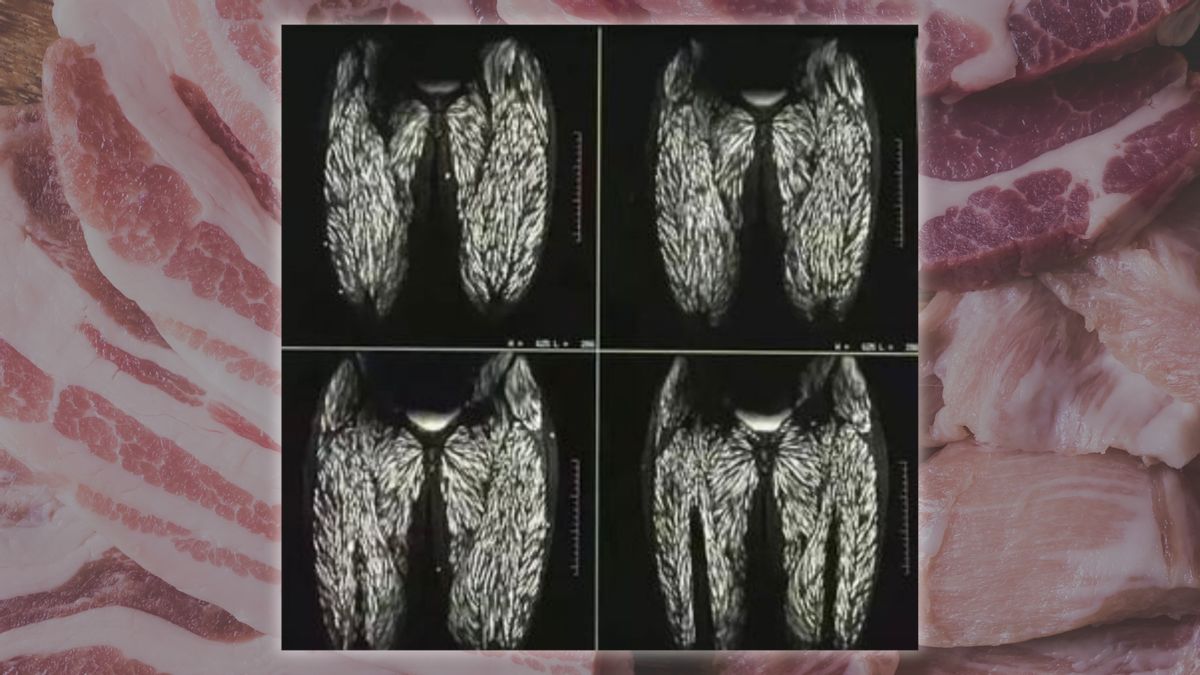
Claim: A collage of medical scans shows parasites throughout a woman's body after she ate raw pork for 10 years. What's TrueThe images came from a documented 2016 case of widespread cysticercosis in a 23-year-old woman. Her family reportedly said she began eating raw meat sometime after age 10. However … What's False… the reports didn't establish that she ate raw pork for 10 years. Eating raw, infected pork can cause intestinal taeniasis, but cysticercosis results from swallowing tapeworm eggs. What's UndeterminedThe sources did not establish how she swallowed the eggs or whether raw pork played an indirect role. In early 2026, a collage of four medical images resurfaced on social media alongside the claim that it showed a woman in China whose body was "riddled with parasites after eating raw pork for 10 years." One Reddit post (archived) captioned the collage: "A girls body in China was riddled with parasites after eating raw pork for 10 years." (Reddit user eternviking) The collage was not new. The images circulated widely on X and Threads in 2024, often prompting alarmed reactions from users who interpreted them as showing the direct consequences of eating raw pork. Snopes first investigated the claim in September 2024. In short, the images came from a documented 2016 case of widespread cysticercosis in a 23-year-old woman. Her family reportedly said she began eating raw meat sometime after age 10 and that the family ate raw pork when pigs were slaughtered. However, the reporting didn't establish that she ate raw pork for 10 years. It also didn't prove that the pork directly caused her cysticercosis. Eating raw or undercooked pork containing larval cysts can cause taeniasis, an intestinal tapeworm infection. Because the claim used images from a real cysticercosis case but included an unsupported timeline and an inaccurate explanation of the infection route, we rated it a mixture of true, false and unproven information. Where did the images come from? An article published by China News on Jan. 19, 2016, credited the report to Yunnan Net and identified reporter Sun Qinxia and intern Zhao Yantao. China National Radio and China Economic Net also shared versions of the story that day. The report identified the medical facility as Yunnan Provincial First People's Hospital, also known as Kunhua Hospital. The caption accompanying the leg scans read, translated from Chinese: "White spots on the legs are caused by parasite infection. (Photo courtesy of the First Provincial Hospital)." (news.cnr.cn) The article concerned a 23-year-old woman identified by the pseudonym Tingting. It said she sought treatment after experiencing headaches, thigh pain and unexplained pain elsewhere in her body for more than a month. Doctors reportedly performed an MRI of her brain and a full-body CT scan that showed signs of parasitic infection in her brain, behind her eyes, muscles and other tissues. A blood test reportedly detected antibodies associated with cysticercosis. A follow-up report published nine days later said doctors recovered a parasite from tissue removed from Tingting's leg, providing further confirmation of the diagnosis. It said her symptoms improved after the first stage of treatment and that another round was planned. A medical case report published in The New England Journal of Medicine later in 2016 appears to document the same patient. Written by physicians from the same hospital, including Qiang Meng, who was quoted in the news coverage, it described a 23-year-old woman with closely matching symptoms, scans and treatment. (The New England Journal of Medicine) The journal report said doctors removed a cyst from the woman's calf muscle and confirmed cysticercosis through histopathological examination. It did not name the patient or explicitly connect the case to the news reports, but the matching age, hospital, physician and clinical details make it highly likely that they described the same woman. The report said the patient was free of symptoms two months after treatment. Unlike the original news coverage, it did not attribute her infection to eating raw pork. Did she eat raw pork for 10 years? The 2016 news report said Tingting's family ate raw pork when pigs were slaughtered for festivals. Her brother-in-law reportedly said they mixed tender pieces of pork with seasonings and ate them uncooked. He added that Tingting began eating raw meat sometime after age 10 and ate only small quantities. The original Chinese wording did not identify her exact age. The article said Tingting began eating raw meat at "大概从10多岁," — roughly sometime after age 10. It did not give her precise starting age or say she had eaten raw meat regularly or continuously for an entire decade. The report also said she ate only small quantities. Because Tingting was 23, a period of approximately 10 years is possible, but the source did not establish that timeline. The evidence supports only that her family ate raw pork on certain occasions and that she began eating raw meat sometime after age 10. Does eating raw pork cause cysticercosis? The original Chinese coverage attributed Tingting's illness to eating raw pork, but it conflated two different infections caused by the pork tapeworm, Taenia solium. Cysticercosis occurs when a person swallows tapeworm eggs shed in the feces of someone carrying an intestinal tapeworm. The resulting larvae can form cysts in tissues including the muscles, eyes and brain. The CDC states explicitly that cysticercosis does not spread through eating raw or undercooked pork. Eating raw or undercooked pork containing larval cysts can instead cause taeniasis, an intestinal tapeworm infection. Raw pork could nevertheless play an indirect role. A person who develops an intestinal tapeworm after eating infected undercooked pork can shed tapeworm eggs and, through fecal contamination, expose others or accidentally swallow the eggs themselves. Swallowing those eggs can cause cysticercosis. Pork is therefore part of the parasite's life cycle, but eating it is not the direct route of cysticercosis infection. However, neither the Chinese news reports nor the later medical report established that Tingting had an intestinal tapeworm or that self-infection occurred. Raw pork may therefore have played an indirect role, but the available evidence does not show how she acquired cysticercosis. Snopes has investigated other China-related claims in the past, including whether two people damaged the Great Wall while digging a "shortcut" and whether a map accurately showed that no country in history had planted as many trees as China.
Do scans show woman's body infected with parasites after she ate raw pork for a decade?
Full Article
Original Source
Read the full article at Snopes →KhanList aggregates and links to publicly available news content. We do not host full articles from third-party sources. Always verify important information with original sources.