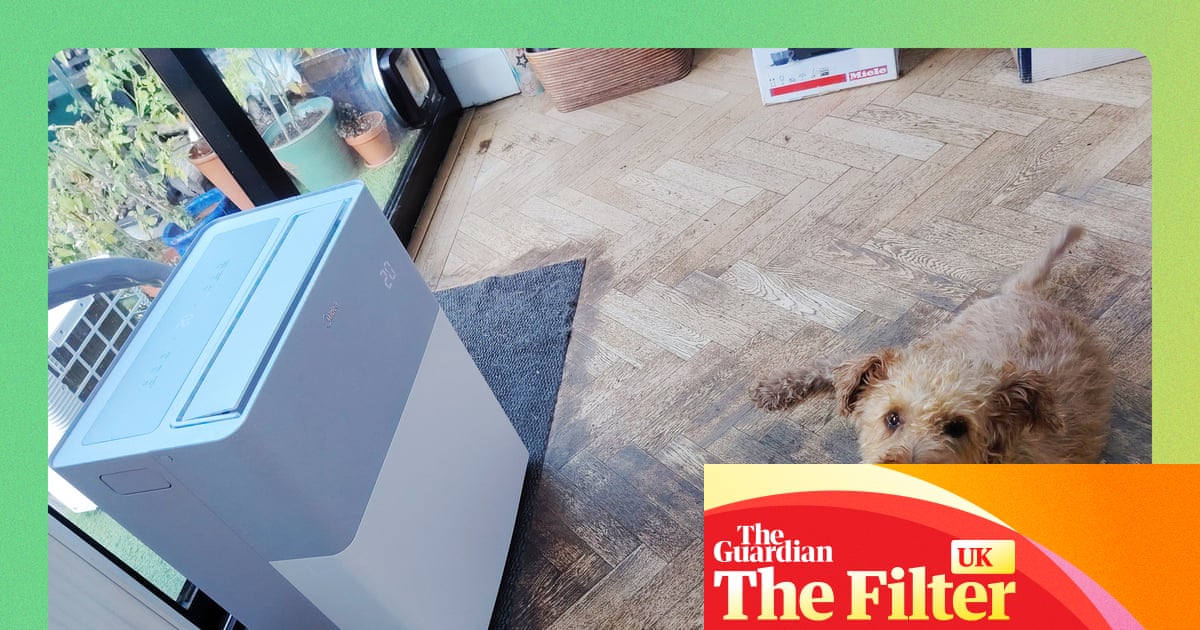
Tell people you’re testing air conditioning, and the truth soon comes out: far more people have aircon than you’d ever imagine. It’s a guilty secret, the home improvement equivalent of Botox or weight loss jabs – everyone notices the results, but nobody admits to the method. Most portable aircons are in bedrooms, hidden away from visitors, so they’re easy to keep secret. And while friends with aircon don’t suddenly look younger or slimmer, they do look suspiciously well rested during a heatwave, while you’ve spent the night tossing and turning.So if you’re using an aircon unit, why have it in the bedroom? Warm air rises, so upstairs bedrooms can be the hottest by the end of the day, making for restless nights. And if your bedroom is in a loft conversion, it’s even worse: the roof absorbs the sun’s heat all day before radiating it back into the room after dark.Most UK homes are built to retain heat, not shed it. Cooling an entire home is difficult and expensive, but a single aircon unit can make at least one room – and a good night’s sleep – more achievable.So, should you get aircon? And if you do, should you feel guilty about it? Yes and no. It depends on how you power it, whether the machine is built to last, and whether you really need it.We are in a climate crisis. This year’s hot summer hasn’t been a blip. In fact, extreme heat and flooding will worsen in the coming years. We got into this mess by burning fossil fuels, and we continue to do so, so the carbon footprint of your cooling matters. You could be making the problem worse by opting to have air conditioning. Unless you’re on a renewable tariff – or even better, producing itself yourself with solar panels – electricity use accelerates climate breakdown. (If you are looking to move to a renewable tariff, it’s worth researching those that invest most in renewables.)Before you buy, read the “What you need to know” section at the bottom of this page on the global warming potential (GWP) of refrigerants. These are used in air-conditioning units, as well as fridges, freezers, heat pumps and other appliances that move heat. Some refrigerants have a global warming impact hundreds, or even thousands, of times greater than the same amount of CO2 if they escape into the atmosphere.We were facing our fifth heatwave of the year at the time of writing, and unsurprisingly, portable air conditioning units had been in high demand. None of the options I’ve recommended is currently in stock, with the first restock due in late November, and many more expected in March 2027. If you want a good-quality, well-recommended unit that’s built to last, bear that in mind. So take your time: these units are big investments built to last, and there’s lots to consider.How can I avoid using air conditioning?Fan favourite: moving air across your skin helps sweat evaporate, making hot days more bearable. Photograph: Westend61/GettyFansThere are cheaper (and greener) alternatives to air conditioning, including fans and evaporative air coolers, both of which I’ve tested for the Filter. Fans don’t actually lower a room’s temperature; they simply move air across your skin, helping sweat evaporate and making you feel cooler, like a breeze on a hot day.If you decide to go with a fan, buy a good one (my favourite, the Lume, is now on preorder for delivery from 31 August). Cheap models are often noisy, with much of that noise being wasted energy. A well-engineered fan is noticeably quieter and more effective.As you might have already discovered, fans and air coolers often sell out during hot weather, especially the good ones. If you find a model you like on preorder, it’s usually worth reserving it. Sadly, we’re likely to see more heatwaves.Air coolersEvaporative air coolers work by drawing warm air through water-soaked pads. As the water evaporates, it absorbs heat, cooling the air by a degree or two, before it’s blown back into the room. The result isn’t the fridge-like chill of an air conditioner, but a gentler cooling effect – like a sea breeze on a hot day. The trade-off is that the fans built into evaporative coolers are often less powerful, so you don’t get the strong blast of air that you get from a standard fan.Importantly, evaporative coolers (sometimes known as swamp coolers) humidify your air, so aren’t a good option if you have damp and mould problems. They’re designed to be used with doors open and fresh air circulating. Many of the ones I recommend are now out of stock, but my favourite portable option, the Morphy Richards Flexi Freeze, was available at the time of writing.Keeping cool without electricityThere are natural ways to cool your home, too. The problem is that most houses in the UK have been designed to retain heat, not cope with prolonged hot weather. In countries where super-hot summers are the norm, homes are often built with high-thermal-mass walls, which warm up and cool down slowly, and external shutters that block the sun from entering through windows.We’ve written in depth about alternative ways to keep your home cool this summer. Closing and covering windows can keep out hot air and block solar heat by day – then opening them in the evening lets cooler air into your home, flushing out not just warm air but also the heat stored in your walls.If your home has windows on opposite sides, open both in the evening so cool air can blow through. If you live on more than one level, open windows upstairs and downstairs in the evening. Warm air will rise out of the top windows and will be replaced by cooler air that’s drawn in at the lower level.The case for air conditioningShutter speed: blocking out the sun by day can help keep indoor temperatures down before you turn to aircon. Photograph: John Keeble/GettyThere are valid reasons to own air conditioning, even during a climate crisis. Older people, young children and those with health conditions are more vulnerable to extreme heat, and some homes are simply much harder to keep cool.Like any appliance, an air conditioner has two main sources of carbon emissions: the CO2 generated from manufacturing and disposing of it (known as “embodied carbon” ) and the CO2 generated to power it over its lifetime.To reduce its overall impact, buy a unit that’s built to last, from a trusted brand with a long warranty, rather than the cheapest model you can find. A longer-lasting unit spreads its embodied carbon over many more years. Buying secondhand also reduces the impact, extending the life of an existing unit.But the biggest difference you can make is how you power your air conditioning. If you’re on a 100% renewable electricity tariff, then running it shouldn’t require burning fossil fuels (again, it pays to do your research here). Better still, if you have solar panels and a home battery, you can run aircon using electricity you’ve generated yourself. It’s a significant investment, but one that’s becoming increasingly attractive as fuel prices rise and solar panels and batteries get cheaper.Be aware that if you’re on a standard electricity tariff, the mix of fuels used to power your home will depend on the time of day. Around the middle of the day, electricity is typically supplied by a higher share of renewables. When demand peaks, typically in the early evening, gas-fired power plants are more likely to be brought online to meet it.So, if you can, run your aircon outside these evening peak hours. Use shutters, curtains, open windows and other natural cooling methods first, then use air conditioning for a short time before bed to take the edge off.I’ve tested portable air conditioners here, but for a full rundown on the types available, see the “What you need to know” section at the end of this article.Why you should trust meI’m a veteran, award-winning consumer tech journalist with decades of experience testing gadgets. I’m also a menopausal woman in her 50s, who honestly can’t recall the last time she felt cold – which may explain the appeal of wild swimming at this age. Oh, and I have a degree in engineering. Between the three, I’m well qualified to put these portable air conditioners through their paces, both from a scientific and personal perspective.How I testedTesting conditions: most units were put to work in the same room, with the exhaust hose vented through a casement window. Photograph: Caramel Quin/The GuardianUnsurprisingly, air-conditioning units have been hard to come by this summer, with many sold out, and review samples also in short supply. I focused on units that are going to be restocked and tested six, with details of stock levels and replenishment dates included, where available.Where possible, I tested units in the same 14 sq metre room with average ceiling height, and with doors and double-glazed windows closed, so it was the warmest room in the house. I opened a casement window for the hose.The only exception was the Midea PortaSplit. Its unusual design pairs an indoor unit with a rather heavy outdoor unit that remains permanently connected by refrigerant lines, so you can’t separate the two. As I couldn’t lift the outdoor unit through a window, I tested it in a larger 37 sq metre room with a sliding door – which was the only suitable space available.To test performance, I measured each unit’s power consumption at maximum draw with a plug-in energy meter, although since air conditioners cycle on and off, they don’t use that level of power all the time. The highest settings’ noise levels were recorded using a sound meter app from one metre away, and I measured each unit’s size.I also monitored room temperature with a thermometer placed on the opposite side of the room. This measured how much each unit cooled the whole room, rather than the cold air coming from the vent.Finally, I judged each air conditioner on how effective the cooling felt, how annoying I found the noise and how easy the controls were to use. I also considered the design, how easily each unit could be stored over winter and, of course, its price. Note that all models come with remote controls and on castors.All of the aircon units that weren’t collected by the manufacturers after testing were donated to charity. Some went to Furnishing Futures, a charity that creates fully furnished homes for women and children who have survived domestic abuse. And some went to Lowri House in Hackney, London, which provides safe, short-term accommodation for homeless patients leaving hospital, with support from the homeless and inclusion health charity Pathway.skip past newsletter promotionafter newsletter promotionThe best portable air conditioning units in 2026Cool contenders: six portable aircon units were assessed for cooling, noise and energy use. Photograph: Caramel Quin/The GuardianBest portable air conditioner overall: Meaco MC10000What we loveSuperb coolingWhat we don’t loveRemote is basic and there’s no app Photograph: Caramel Quin/The Guardian£459.99 at Aircon CentreCurrently out of stock; stock due 27 November This 10,000 BTU air conditioner is from the popular MeacoCool (MC) range. There are also Pro and CH models that offer a companion app and heating.It’s A-rated for energy efficiency and designed for a medium room. The controls and display sit on the top at an angle, so you can see them from a distance. This is welcome, as the remote control is pretty basic, and there’s no companion app.It uses R290 (propane) refrigerant, which has a low global warming potential of 3.3 (for more information on this, see the “What you need to know” section at the end of the page).Why we love itOn test, this was simply the best and fastest at cooling. It brought the temperature down by 3C in 15 minutes and 6C in two hours.The design is simple. For example, you have to manually open the louvres (the angled grilles on the front) and point them where you want the cold air directed. By directing them downwards, it created a cooling breeze on the floor and on my legs, which I found made everything feel cool.It also has a fan and dehumidifier. The sleep mode dimmed the display but didn’t immediately make it quieter, instead gradually increasing the target temperature by a couple of degrees throughout the night.It’s a shame that … the remote doesn’t have a display.Dimensions: 32 x 32 x 74cm (WDH)Weight: 26kgBTU: 10,000Room size: medium (up to 28m²)Warranty: three yearsMeasured power use on top setting: 890W Peak noise level on test: 60dBMeacoMC10000£459.99What we loveSuperb coolingWhat we don’t loveRemote is basic and there’s no appBest portable aircon unit for large rooms: Dimplex Eco IQWhat we loveGood cooling, app and voice controlWhat we don’t loveLoud and the remote is basicCaramel Quin testing air conditioners: Dimplex Photograph: Caramel Quin/The Guardian£599.99 at DimplexCurrently out of stockThe Dimplex Eco IQ has a really handy app featuring controls such as a 24-hour timer. It uses R290 (propane) refrigerant, which has a low global warming potential of 3.3.Why we love itThe unit looks classy, and is pretty compact considering it’s powerful enough for a large room. It offers 12,000 BTU, plus wifi and app control. This means you can control it from your Amazon Alexa or Google Assistant smart speaker if you want to control your aircon by voice.The cooling is impressive. It cooled the room by 1.5C in 15 minutes and 5C in two hours.I found the Dimplex a bit loud, though. It may measure the same number of decibels as others, but it has a fairly deep hum and a slight rattle, like the noise you hear from a fridge. This makes sense because, like a fridge, it uses a compressor and a refrigerant. The noise measured 60dB at its loudest (similar to a conversation – so you’ll definitely hear it, but you can learn to ignore it), and this went down to 55dB on sleep mode. However, I found the noise worth it for the cooling on a hot day.It’s a shame that … it’s loud. The remote control is also basic, to the point of looking a little cheap. It lacks a display, which is a shame because the unit’s display and controls are on top and so can’t be seen from across the room. You can always use the app, though.Dimensions: 29 x 34 x 70cm (WDH) Weight: 23.8kgBTU: 12,000Room size: large (up to 35m²)Warranty: one year, extended to two if registered within 28 daysMeasured power use on top setting: 1,400WPeak noise level on test: 60dBDimplexEco IQ£599.99What we loveGood cooling, app and voice controlWhat we don’t loveLoud and the remote is basicBest split portable air conditioner: Midea PortaSplitWhat we loveQuiet; energy efficient; great for suitable spacesWhat we don’t loveBulky; positioning limited because of the pipes Photograph: Caramel Quin/The Guardian£1,099.99 at JoyBuyCurrently out of stockAnd now for something completely different. This “portable split” air conditioner has an indoor and outdoor unit, connected with refrigerant pipes. The pipes are 2.5 metres long and have a 6 x 2.7cm cross-section, instead of the usual 15cm diameter air hose.The units can’t be detached from each other because the pipes are full of refrigerant (R32, global warming potential 675), so it’s suitable only if you’re able to put the outdoor unit outside and close the door to leave a 2.7cm gap. Alternatively, you can mount the outdoor unit outside permanently if you’re able to accommodate space for the pipes. I found it easiest to bring it back inside when not in use: it stores neatly on top of the indoor unit. It also comes with a kit for sealing out hot air and a window lock, consisting of two fittings to stick on to the frame with Velcro to connect them, which keeps your window gap narrow.It’s large and heavy: you wouldn’t carry it up and down stairs, although it wheels around OK. If you’d struggle to get the 32.5kg indoor unit and 9.9kg outdoor unit into place, you may find JoyBuy’s £35 installation service good value; they’ll unpack it and bring it to the right room in your home. They’ll even mount it on the no-drill-required brackets if you have a suitable window.Why we love itIt’s much quieter than a “monobloc” one-piece portable aircon unit and could be a permanent fix for renters in modern flats. If you can bring it up to your flat in a lift and have a balcony on which to put the outdoor unit, you’re winning. And it offers year-round service: it’s an efficient A++-rated air conditioner and also an A+-rated heater.And despite its bulk, it’s good-looking. Controls are intuitive, and there are three displays: one on top with the controls, one on the front showing the target temperature, and one on the remote control. You can also control it via the app and add Amazon Alexa or Google Assistant voice control.It cooled the room during testing, and the dog approved of its cooling prowess, but comparing figures would be like comparing apples and oranges: the room I tested it in was considerably larger.If the Midea suits your home – a back door or a balcony really – it’s a good option.It’s a shame that … it’s only suitable for homes that can accommodate its pipes.Dimensions: indoor unit, 52 x 34 x 65cm (WDH); outdoor unit, 50 x 26 x 44cm (WDH) Weight: indoor unit, 32.5kg; outdoor unit, 9.9kg BTU: 12,000Room size: large (up to 35m²) Warranty: two yearsMeasured power use on top setting: 680W Peak noise level on test: 40dBMideaPortaSplit£1,099.99What we loveQuiet; energy efficient; great for suitable spacesWhat we don’t loveBulky; positioning limited because of the pipesBest value air conditioner: Devola DVAC09CCBWhat we loveGood value for cooling a medium-sized roomWhat we don’t loveThere’s no display on the front, so use the app Photograph: Caramel Quin/The Guardian£439.99 at DevolaCurrently out of stock; stock expected 27 November This 9,000 BTU air conditioner is a good all-rounder for medium-sized rooms. It’s also a fan and dehumidifier, and Devola also offers a version with heating.It comes in black or white. I tested the black (known as the DVAC09CB; the white is DVAC09CW), and found the matching hose and accessories were a nice touch. It uses R290 (propane), which has a low global warming potential of 3.3.The remote is simple, without a display, and the unit’s controls and display are on top, so you can’t see them from the other side of the room. The app paired easily, however, and it meant I could clearly see and control the mode and target temperature. You can also use the app to schedule and to pair with Amazon Alexa or Google Assistant for voice control.Why we love itThe unit looks good and is lightweight enough to lift. And the cooling feels powerful for its size. It reduced the room temperature only a little in the first 15 minutes, but it had dropped by 2C after an hour and 3C after two hours.I didn’t find the noise too annoying, either. The sound is reminiscent of a fan with the added deeper hum of a compressor: I could get used to it. The sleep button had no immediate impact on noise, simply dimming the display, but it gradually reduces cooling through the night to save energy.It’s a shame that … there’s no display on the front.Dimensions: 35 x 35 x 70cm (WDH) Weight: 24kgBTU: 9,000Room size: medium (up to 28m²)Warranty: two yearsMeasured power use on top setting: 895W Peak noise level on test: 55dBDevolaDVAC09CCB£439.99What we loveGood value for cooling a medium-sized roomWhat we don’t loveThere’s no display on the front, so use the appThe best of the rest Meaco MC12000RPROWhat we loveWell-featured; powerful enough for large roomsWhat we don’t loveI found the noise annoying Photograph: Caramel Quin/The Guardian£549.99 from Aircon CentreCurrently out of stock, stock due 27 NovemberBest for: high-end air conThe 12,000 BTU capacity makes this powerful enough for large rooms, and it’s a well-featured unit too. The front display shows you the target temperature, and the remote control features a display. You can also pair it with an app for more functionality.It was immediately cooling, but performance was so-so: the temperature dropped 1C within 15 minutes and 3.5C after two hours. As with many others here, it uses R290 (propane), which has a low global warming potential of 3.3.It didn’t make the final cut because … it’s loud. It measured 60dB, like several others, but I found its deep hum annoying and had to turn up the TV.Dimensions: 47 x 35 x 76cm (WDH); weight: 29.5kg; BTU: 12,000; room size: large (up to 35m²); warranty: three years; measured power use on top setting: 1,255W; peak noise level on test: 60dBMeacoMC12000RPRO£549.99What we loveWell-featured; powerful enough for large roomsWhat we don’t loveI found the noise annoying Dreo 318SWhat we loveA good budget model for small roomsWhat we don’t loveThe hose was shorter than most Photograph: Caramel Quin/The Guardian£399.99 at DreoCurrently out of stockBest for: small roomsThis has the lowest cooling capacity (7,500 BTU) on test, so it’s suitable only for small rooms up to 14 sq metre. The 1.5m hose was too short to reach my high window, too (meaning I had to test all of the monobloc air conditioners on top of a desk, to be sure of a fair test, even though most come with 1.8m hoses).It’s small but has decent features, including a front display, companion app and voice control via Amazon Alexa or Google Assistant, and the remote control features a display. Cooling was impressive considering its size: the temperature dropped 1.5C within 15 minutes and 3.5C after two hours. I liked the flat, magnetic area on top for storing the remote control, too.Sound is a deep hum, although it’s a bit quieter on sleep mode. As with others here, it uses R290 (propane), which has a low global warming potential of 3.3.It didn’t make the final cut because … for only a little more, you can buy the Meaco MC10000, which offers much better cooling.Dimensions: 39 x 36 x 63cm (WDH); weight: 22.5kg; BTU: 7,500; room size: small (up to 14m²); warranty: two years; measured power use on top setting: 755W; peak noise level on test: 55dBDreo318S£399.99What we loveA good budget model for small roomsWhat we don’t loveThe hose was shorter than mostWhat you need to knowDog days: portable aircon can cool a single room when other ways of beating the heat aren’t enough. Photograph: Caramel Quin/The GuardianWhat types of air conditioning are there?Here I’ve tested portable air conditioners. These are freestanding units with an exhaust hose that carries hot air through an open window. They’re designed to cool a single room and can be packed away at the end of summer. They need to be positioned close to an opening window and a power socket.Most are “monobloc” all-in-one designs that sit on castors and are portable, in that they can be wheeled from one room to another. However, they’re not light, so moving them between floors is another matter entirely.Another option is a “split” air-conditioning unit, which is a permanently installed system with two separate units. The indoor unit is usually mounted high on a wall and blows cool air into the room. The other unit sits outside the home (on a roof or hanging off the wall), with pipes and electrical cables connecting the two. These systems tend to be more expensive but much quieter.This test also features a portable split air conditioner, which is a hybrid between a portable aircon unit and a fixed split system. This, too, has two units, but the outdoor one is more compact, and the pipe is thin and more flexible, making it easier to move around. It works well on the ground floor, where you can safely put the external compressor unit outside on the ground, which also makes it quieter. Using it upstairs would require the use of brackets outside, which makes it rather less portable.Air conditioners use the same tech as air-source heat pumps. By compressing and expanding a refrigerant, they move heat from one place to another. In cooling mode, they pump heat out of your home; in heating mode, they bring heat in. If you’re installing a permanent split system, go for a reversible model so you can use it to cool your home in the summer and heat it in winter.I haven’t carried out a group test of split aircon units because they require professional installation, but I have tested the Bosch Climate 3000i 3.5kW (from £2,420) from Boxt. It cools a room quickly and also works as a heater, air purifier and dehumidifier, doing four jobs without taking up any floor space.How much does air conditioning cost to use?For each aircon unit here, I’ve measured its power use on the top setting, in watts (W). Electricity costs are in kilowatt hours (kWh). If, for example, you were using a 900W aircon for an hour, it would use 900Wh. Divide by 1,000 to convert it to kilowatt hours: 0.9kWh.The energy price cap for 1 July to 30 September 2026 is 26.11p a kWh. So that’s the price to use 1kWh of energy. Multiply 26.11p by 0.9kWh, and you’ll discover it costs 23p an hour to run a 900W portable aircon unit. It’s not a fortune if you use it sparingly, but fans are much cheaper to run: the winner of my fans test cost less than a penny an hour.What is a BTU rating, and which one do I need?An air conditioner’s British Thermal Unit (BTU) rating indicates its cooling capacity. The higher the BTU rating, the larger the room it can cool. There are online BTU calculators where you can input your room measurements to find out the BTU you need. Above, I’ve given a maximum floor space for the models reviewed, assuming an average ceiling height of 2.5 metres.An undersized air conditioner will struggle, meaning it’s more likely to be on constantly and at higher risk of breakdown, so it’s important not to buy a unit that’s underpowered for your space. On the other hand, getting a more powerful unit than you need means it will be more expensive and larger than necessary. Make sure to measure your room and get a unit with the right BTU or only slightly more than you need on paper. For example, if you’re not sure which room it will be used in, buy a unit that suits your largest bedroom.What’s a window kit?When you poke the flexible hose out of the window to remove hot air, you’ll want to seal the rest of the window. How you do this depends on the type of window. I have hinged, casement windows, so I used sticky-backed Velcro to make a line around the window opening and then attached a fabric cover, with zips to open a hole to poke the hose through. Most air conditioners come with two window kits: the other is an adjustable solid cover for sash and other sliding windows.How long a warranty do I need?All the units on test have two- or three-year warranties. I’m a big fan of long product lifespans, as the “embodied carbon” used in your unit’s manufacture and shipping also matters, alongside the electricity it uses to cool you. The longer you can get your unit to last, the better. To give yours its best chance of a long life, clean or replace the air filters regularly, dry it out on the fan-only mode before winter storage, and store upright.What is GWP?Global warming potential (GWP) is a measure of how much heat a greenhouse gas traps in the atmosphere over time, relative to carbon dioxide – CO2 has a GWP of 1. This matters if the refrigerant leaks or is disposed of unsafely. Propane, used in many of these models, has a low GWP of 3.3 and is climate-friendly compared with refrigerants with a GWP measured in hundreds or thousands.What to do with your old air conditionerIf your old aircon works, try to find it a good home on a local swap site or street WhatsApp. If it’s not working, check your council website or Recycle Your Electricals. Electrical items don’t belong in general waste and, like fridges, air conditioners contain a refrigerant that needs to be removed by a specialist. If it’s allowed to leak into the atmosphere, it contributes to global warming as a greenhouse gas (which is where its GWP, above, comes in).For more, read readers’ top tips for beating the heat this summer and our roundup of the best folding fansCaramel Quin is a journalist specialising in consumer technology. She prides herself on real-world testing and plain language. Her pet hates are jargon, pointless products and overcomplicated instruction manuals. Caramel is an engineering graduate who has won awards for communicating hi-tech subjects to normal people. When she’s not testing gadgets, she’s feeding pets (16 beasts at the time of writing) or pottering at the allotment
Do I really need air conditioning in the UK? The best portable aircon tested – plus the pros, cons and alternatives
Full Article
Original Source
Read the full article at Theguardian →KhanList aggregates and links to publicly available news content. We do not host full articles from third-party sources. Always verify important information with original sources.