
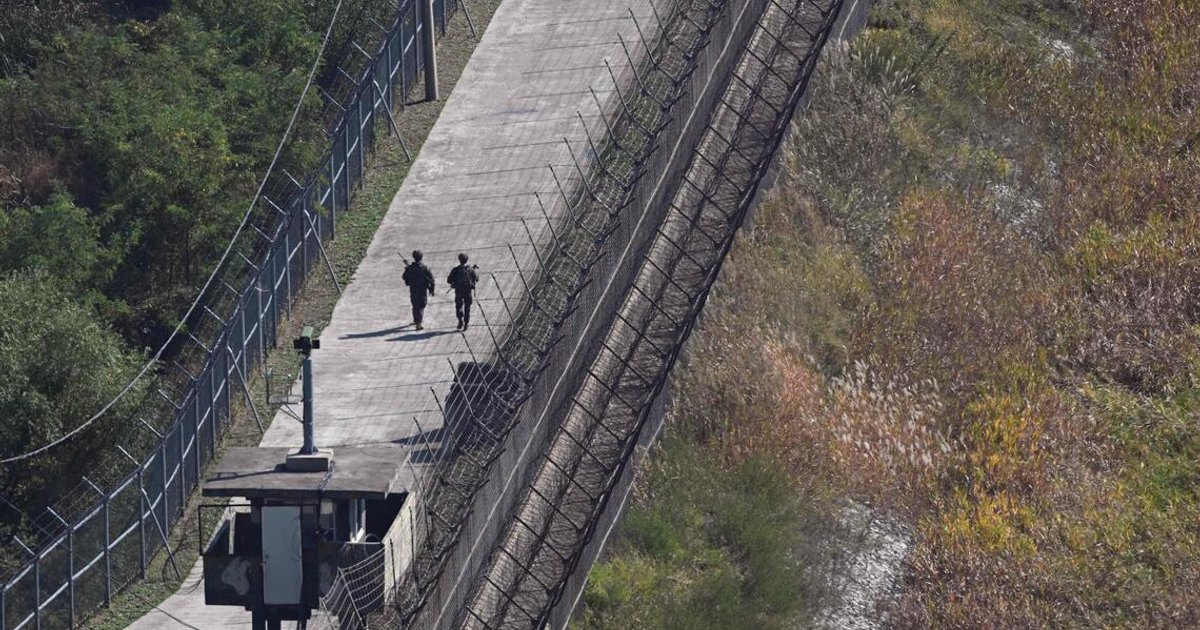
SEOUL - Escalating tensions along the Demilitarised Zone (DMZ) have spilled over into the US-South Korea alliance, exposing fault lines over military authority as Seoul pushes to assume greater control over its wartime defence.Remarks by US Forces Korea (USFK) commander Xavier Brunson on the United Nations Command’s authority within the DMZ, coupled with his comments that “conditions have changed” for the transfer of wartime operational control to South Korea, have triggered a strong backlash in Seoul.Speaking at a conference in Washington on Oct 14, Brunson had said that “from the perspective of the UN Command (UNC), the Republic of Korea begins at the southern boundary fence”. His remarks prompted ruling party lawmakers to accuse him of questioning South Korea’s territorial sovereignty. They demanded an apology and for Brunson to retract his remarks. South Korea’s constitution defines the entire Korean peninsula and its adjacent islands as its territory. The UNC has since clarified that Brunson was referring to its military and administrative responsibilities under the Korean War armistice, rather than questioning South Korea’s sovereignty.Under the 1953 armistice, the Military Demarcation Line (MDL) separates the two Koreas, which remain technically at war. The DMZ extends 2km on either side of the MDL as a buffer zone, with the UNC overseeing the administration of the southern side of the DMZ.As USFK commander, Brunson holds a “tri-command” role, leading the 28,500 US troops stationed in South Korea, the combined US-South Korean forces as well as the UNC that administers the DMZ under the Korean War armistice.His comments at the same conference that “conditions have changed” for the planned transfer of wartime operational control (OPCON), citing evolving security threats such as North Korea’s advancing missile capabilities, prompted a rebuke from South Korea’s defence ministry that the agreed conditions should not be subject to “shifting goalposts”.Under conditions agreed by South Korea and the US in 2014, the transfer of wartime OPCON hinges on three criteria: South Korea developing the military capabilities needed to lead their combined defence, the allies building comprehensive capabilities to counter North Korea’s nuclear and missile threats, and a security environment on the Korean peninsula and in the region conducive to a stable transition.Sovereignty and military autonomyUS-South Korea alliance has faced mounting strains over trade tariffs, Washington’s calls for South Korea to contribute to efforts to secure the Strait of Hormuz, and an intelligence-sharing rift over Unification Minister Chung Dong-young’s public disclosure of an unconfirmed North Korean uranium enrichment site.Brunson’s remarks touched a raw nerve in Seoul, defence analysts say, reviving deep-rooted sensitivities over South Korea’s national sovereignty and military autonomy stemming from the legacy of the 1950-53 Korean War and the continued US role in its wartime defence.Director of the Center for Security and Strategy at the Seoul-based thinktank Korea Institute for Defense Analyses (KIDA) Ham Hyeongpil told The Straits Times that Brunson’s wording was sensitive as it appeared to blur the distinction between South Korea’s territorial sovereignty and the UNC’s operational responsibilities. The retired colonel explained that South Korea’s turbulent history of war and division, coupled with the prolonged presence of US forces on its soil, “has made questions of sovereign decision-making particularly salient”.“Although the alliance has been indispensable to South Korea’s security, some South Koreans remain concerned that important decisions affecting their own territory and security can be influenced by institutions or command arrangements in which South Korea does not exercise the degree of authority it expects,” said Ham. During the Korean War, South Korea’s military came under US-led UN command. It was transferred to the joint US-South Korean forces during its set-up in 1978. In 1994, Seoul regained peacetime control of its forces, but the US still maintains command during wartime control. South Korean President Lee Jae Myung has made it a core pledge and key foreign and security policy of his administration, to regain wartime control before his five-year term ends in 2030. Brunson’s remarks on the changing security conditions for an OPCON transfer came on Oct 14, the same day North Korea test-fired two types of submarine-launched strategic cruise missiles.Tensions have been escalating between the two Koreas since a landmine blast on Sept 21 that injured three South Korean soldiers. The landmines of North Korean origin were found on the South Korean side of the DMZ. Pyongyang has denied responsibility for the blasts, with Kim Yo Jong, the sister of North Korean leader Kim Jong Un, calling it a “fabricated farce”.In a statement carried by North Korean state media on Oct 19, Kim described the border situation as “very unstable” and threatened to resume propaganda loudspeaker broadcasts against Seoul while deploying more tactical strike assets to the DMZ. Seoul’s defence ministry hit back on Oct 20, warning of “decisive retaliation” if Pyongyang continues its provocations. On Oct 19, Lee reiterated his belief that South Korea was “sufficiently capable” of shouldering its national defence. He told reporters at an impromptu press conference at the Blue House that he sees military sovereignty as a core component of national sovereignty, and thus OPCON “must be swiftly returned for South Korea to meet the minimum requirements as a state”.Kim Ju-hyung, a non-resident fellow with the 38 North programme at the Stimson Center, acknowledged that North Korea’s expanding nuclear and missile arsenal, coupled with its military cooperation with Russia, posed challenges that warranted a fresh assessment of South Korea’s operational readiness.But he said these developments did not necessarily justify introducing new conditions for the transfer of wartime OPCON, arguing instead for updated technical assessments within the existing framework.“Specifically, South Korea should demonstrate its ability to maintain command-and-control functions under missile and cyberattacks, coordinate integrated air and missile defence, manage American reinforcements, and sustain prolonged military operations,” he said.Warning against prioritising a politically driven deadline over operational readiness, Kim Ju-hyung said a predetermined timeline for the OPCON transfer could create opportunities for North Korea to exploit gaps in South Korea’s military capabilities, particularly if efforts to meet the deadline came at the expense of addressing critical shortfalls.Ham shares a similar assessment, stressing that the two allies should prioritise the need for clear benchmarks, objective evaluations of progress and bilateral consultations to resolve differences.He said: “Ultimately, a successful OPCON transition should strengthen the alliance by giving South Korea greater leadership responsibility while maintaining the combined capabilities and US commitment necessary to deter North Korea.“It should be treated not as a contest over sovereignty between allies, but as an opportunity to build a more mature and sustainable alliance.”
DMZ dispute exposes deeper fault lines in US-South Korea alliance
Full Article
Original Source
Read the full article at Straitstimes →KhanList aggregates and links to publicly available news content. We do not host full articles from third-party sources. Always verify important information with original sources.