
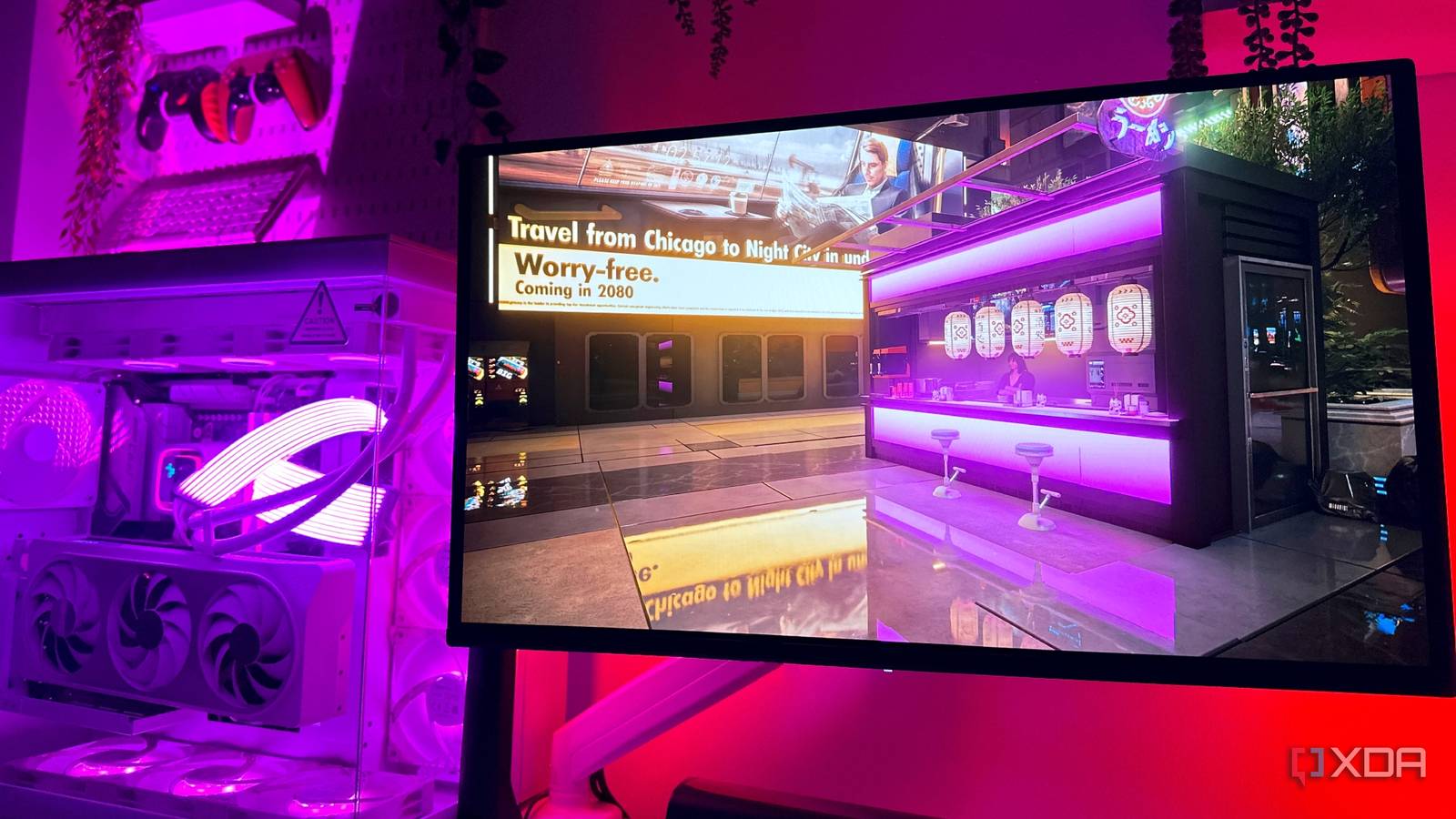
Published Sep 7, 2026, 7:00 AM EDT Gaming has been Samarveer’s greatest passion, and the Literature graduate in him takes immense joy in dissecting games for their themes, messages, and impact. Samarveer holds a deep appreciation of gaming, and considers the platform to be the most immersive and impactful across all media. He can be found engaging with gaming communities online, always ready to debate the finer points of ray tracing or itching to write an 8-page collegiate thesis on any game that impacts him emotionally. Ever since Nvidia released DLSS 4.5 in early 2026, it has occupied the throne by being the most stable and impressive upscaler on the market. I've tested DLSS 4.5 on every RTX series card from the 20 series to the 40 series, with nothing but splendid results. However, DLSS 4.5 remained incomplete due to its lack of Ray Reconstruction implementation. Now, however, the pieces of Nvidia's AI rendering stack that enthusiasts have always treated as separate compromises are beginning to look like one coherent system. Ray Reconstruction tackles the ugly side of ray tracing which raw resolution can't fix. With a more capable transformer model and the ability to work alongside DLSS 4.5 Super Resolution, Nvidia is finally attacking Ray Reconstruction's limitations from another angle. DLSS 4.5 fixes the strangest problem with Ray Reconstruction It's no longer "and/or" between better upscaling and improved ray tracing Ever since March 2026, using DLSS Super Resolution's 4.5 version came with the caveat of not being able to use Nvidia's Ray Reconstruction with it. When DLSS Super Resolution 4.5 arrived, enabling Ray Reconstruction meant falling back to the older upscaling technology that came bundled with the reconstruction model. You could either have the newer upscaler, or the better ray-tracing denoiser, but never both. That made very little sense on the face of it. After all, Ray Reconstruction is supposed to improve the image that ray tracing produces, but activating it would put your upscaler half a generation behind. In heavily ray-traced and path-traced titles, you'd effectively have to pick which half of Nvidia's rendering technology you want to be more modern — a remarkably silly compromise for something Nvidia otherwise markets as a unified AI rendering pipeline. To manually set DLSS 4.5 Ray Reconstruction, open the Nvidia App > Graphics > Global Settings > DLSS Override – Model Overrides > Ray Reconstruction Preset F. DLSS 4.5 Ray Reconstruction has finally fixed that architectural mismatch. Nvidia has moved Ray Reconstruction onto its second-generation transformer architecture, meaning its combined denoising and upscaling model now finally incorporates the same generation of technology behind Super Resolution 4.5. Nvidia says the new model processes 20% more parameters with 35% more compute capability while maintaining similar performance to the previous version. In other words, Ray Reconstruction has finally stopped being the odd one out in the DLSS stack, now that it analyzes spatial and temporal engine data while handling both denoising and Super Resolution. Nvidia finally lets Ray Reconstruction be Ray Reconstruction Ray tracing no longer looks worse than it should Nvidia hasn't simply given Ray Reconstruction a larger brain. DLSS 4.5 moves it to the second-generation transformer architecture introduced with DLSS 4.5 Super Resolution, making this the third major iteration of Ray Reconstruction after DLSS 4.5 and DLSS 4. With ray-traced and path-traced games becoming more common, this matters more than ever. After Ray Tracing gives you incomplete and noisy samples, Ray Reconstruction's job begins, and it's tough as nails. It has to determine what is noise and what is genuine visual information, then preserve the latter. The practical difference is immediately visible in the places where previous versions tended to fall apart. Fine foliage is better defined, reflections retain more texture, and those irritating "boiling" artifacts on surfaces are substantially reduced. In real-life application, the difference is immediately visible, especially in the places where previous versions tended to fall apart. Fine foliage is better defined, reflections retain more texture, and those irritating "boiling" artifacts on surfaces are substantially reduced. With DLSS 4, metallic surfaces or patchy temporal artifacts were particularly unstable, especially so in path tracing — signs that the reconstruction process was visibly struggling to decide what belongs in the frame. With the new Ray Reconstruction model, DLSS 4.5 has genuinely gotten better at understanding what's noise and what's detail. The biggest and most obvious difference I saw was in Resident Evil Requiem, where every metal surface remained shimmery and patchy regardless of which setting I ran the game at. When I enabled path tracing, though, the visual noise from the earlier DLSS 4 Ray Reconstruction was impossible to ignore. With DLSS 4.5 Ray Reconstruction enabled, these patches that stuck out like sore thumbs completely disappeared, turning good-looking path-traced graphics into great-looking ones. There's also a subtler improvement in motion. The new model has deeper spatial awareness and makes better use of motion data and temporal information. This is what helps reduce ghosting and the smeary quality that can appear when the camera moves. With DLSS 4.5 Ray Reconstruction, the temporal reconstruction process still has finite information to work, but it does make that compromise considerably less obnoxious. Looking at these changes, it's easy to claim that Ray Reconstruction is improved, but DLSS 4.5 is genuinely getting better at understanding the difference between noise and detail. It's clear that Nvidia has expanded the model's training dataset and given developers finer control over temporal accumulation. Ray Reconstruction is finally becoming a reason to use path tracing A breakthrough for path tracing at playable frame rates To call DLSS 4.5 Ray Reconstruction "game-changing" is genuinely justified, but there's an important bit to remember here — when it comes to path tracing, the entire frame is rendered differently, which results in the entire image being improved significantly. That distinction matters because path tracing's biggest problem isn't simply that it is expensive. It is that the limited number of rays used to keep it playable leaves behind an incomplete, noisy image that reconstruction has to intelligently fill in. DLSS 4.5 gets better at preserving the detail within those samples, meaning reflections, lighting, textures, and fine geometry survive the reconstruction process more convincingly. And yet, I wouldn't tell you path tracing has suddenly been solved. Motion can still expose artifacts, particularly in scenes with lots of moving objects, and even Nvidia's own demonstrations weren't completely free of reconstruction weirdness. The breakthrough is more practical: DLSS 4.5 makes the visual penalty of using aggressive ray tracing substantially smaller without demanding a corresponding performance penalty. NVIDIA App All those improvements and no performance cost this time That might ultimately be the most compelling part of DLSS 4.5 Ray Reconstruction. PC hardware enthusiasts are accustomed to making compromises: better image quality usually means fewer frames, and more demanding lighting usually means reaching for another setting to turn down. Here, Nvidia has managed to improve the reconstruction without asking your GPU to foot a substantially larger bill. That makes this one of those rare upgrades where there isn't much of a reason to talk yourself out of using it. You don't need a new GPU, you don't need to sacrifice performance, and you don't need to convince yourself that a handful of extra pixels somehow changed your life. If the option is sitting there, I genuinely can't see a good reason not to turn it on.
DLSS 4.5's ray reconstruction isn't "improved" — it's game-changing
Full Article
Original Source
Read the full article at Xda-developers →KhanList aggregates and links to publicly available news content. We do not host full articles from third-party sources. Always verify important information with original sources.