
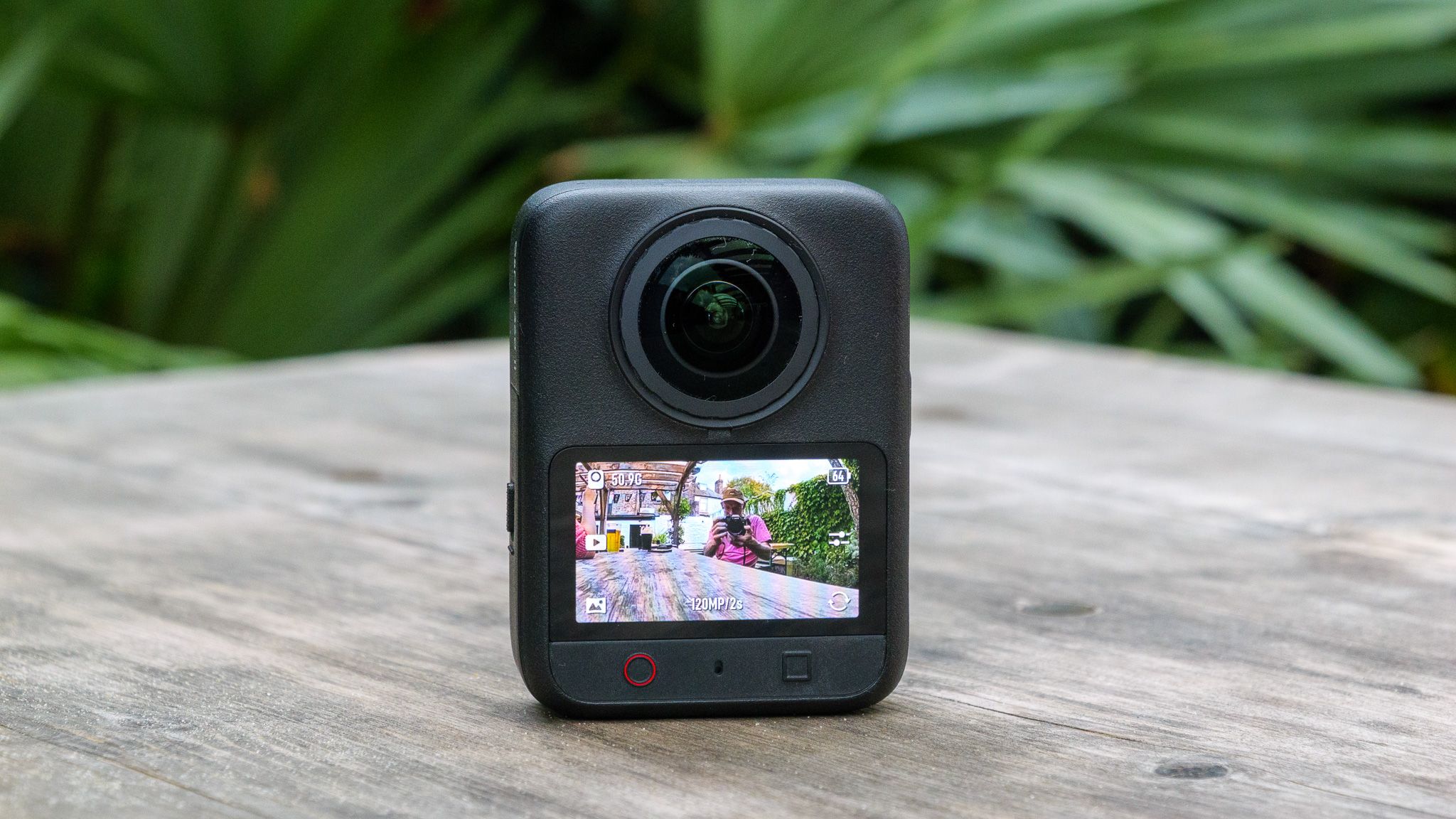
TechRadar Verdict The DJI Osmo 360 II is proof of just how quickly a manufacturer can turn a promising first-generation product into a compellingly well-rounded one. In the space of just a year, DJI has fixed the lens replacement issue, warmed up to underwater shooting, and pushed image quality forward across the board — all while keeping the price well below that of the Insta360 X6. The Osmo 360 II isn't a transformative leap in outright image quality, but it's nevertheless an excellent 360 camera that gives both the GoPro Max 2 and the Insta360 X6 a serious run for their money, particularly after dark. Pros +Now includes user-replaceable lenses +Excellent all-round 360 image quality +Cheaper than the Insta360 X6 Cons -Price increase over original Osmo 360 -Not available in the USA Why you can trust TechRadar We spend hours testing every product or service we review, so you can be sure you're buying the best. Find out more about how we test. Jump To: Two-minute review Specs Price Design Performance Image quality Testing scorecard Should I buy? Also consider How I tested DJI Osmo 360 II: two-minute reviewJust a year after launching its debut 360 camera, the Osmo 360, DJI has delivered a sequel that addresses pretty much every complaint I had with the original — without asking you to pay through the nose for the privilege.The Osmo 360 II looks and feels almost identical to its predecessor: same dimensions, same weight, same general shape. But DJI has used that 12-month gap wisely, fixing the two biggest issues I had with the original Osmo 360 in one swift update.First, the lenses. They're now built with a tougher optical coating, and — far more importantly — they're user-replaceable if you crack or scratch one. For anyone using this camera to capture action sports, that alone might be worth the modest price increase.Second, DJI's approach to underwater shooting has changed. The waterproof rating hasn't budged from 10m, but where DJI once actively discouraged submersion with the original Osmo 360, it now positions the Osmo 360 II as a viable sub-aqua option for snorkelers and scuba divers. (Image credit: Future | Sam Kieldsen)On the imaging side, the headline feature is native 8K video at 60fps — a first for any 360 camera, edging out even the freshly-launched Insta360 X6 (which tops out at 8K/50fps). Dynamic range, slow motion, timelapse resolution and SuperNight low-light performance have all improved too, though the underlying sensor appears to be physically the same as before, suggesting these are largely processing-driven gains rather than a major hardware leap.Performance is solid across the board: battery life is roughly on par with the original, storage remains a generous 105GB built-in, and DJI's Mimo and Studio apps are dependable if unspectacular.Is this a transformative upgrade? Not quite — image quality is a slight rather than dramatic step forward. But DJI has plugged the gaps that mattered, kept what already worked, and done it all while keeping this camera's price significantly below that of the Insta360 X6.Get daily insight, inspiration and deals in your inboxSign up for breaking news, reviews, opinion, top tech deals, and more.Against the GoPro Max 2, the Osmo 360 II's low-light performance is a clear win too. Right now, my instinct is that there's very little to separate the Osmo 360 II and the X6 on image quality alone — I'll be testing the two head-to-head in more depth soon to see which comes out on top overall — but as an all-rounder at this price, the Osmo 360 II is a seriously compelling 360 camera.DJI Osmo 360 II specs Swipe to scroll horizontally DJI Osmo 360 II specs Type: 360 camera Sensor: 1.1-inch x 2 Max aperture: f/1.9 Max video resolution: 8K / 60fps Max photo resolution: 120MP Storage: 105GB internal + microSD card slot Screen: 2-inch OLED Connectivity: USB-C 3.0, Bluetooth 5.1, Wi-Fi 6 Dimensions: 2.4 x 1.4 x 3.2 inches / 61 x 36.3 x 81mm Weight: 6.5oz / 183g DJI Osmo 360 II: Price and availabilityLaunches on September 15 2026, roughly a year after the original DJI Osmo 360Standard Combo costs £509 / AU$921, up from the original's £409.99 / AU$759The Adventure Combo (£639 / AU$1,096) throws in useful extrasThe DJI Osmo 360 II arrives around 13 months after its predecessor, and it's more expensive: the Standard Combo will set you back £509 / AU$921, compared with £409.99 / AU$759 for the original Osmo 360 at launch. That's a pretty big jump, but it doesn't stop the Osmo 360 II being significantly more affordable than its biggest rival.That rival is the Insta360 X6, which starts at £619.99 / AU$1,049.99 for its own Standard bundle. Not that the Osmo 360 II is the budget option in this category, though: the GoPro Max 2, now available for as little as £269.99 / AU$849.95, undercuts DJI comfortably if outright affordability is your main concern.If you can stretch to it, the pricier Adventure Combo (£639 / AU$1,096) is worth consideration. It throws in two extra batteries (three in total), a charging case that holds three batteries at once, plus a 1.2m selfie stick — accessories that anyone shooting for extended periods will likely want anyway, and which would cost more bought separately.As with several other recent DJI launches, the Osmo 360 II won't be arriving in the US for now, with the company's application for regulatory authorization still pending. American buyers will need to look elsewhere (or import through a third party) in the meantime.Price score: 4.5/5DJI Osmo 360 II: DesignSame 61 x 36.3 x 81mm dimensions and 183g weight as the originalLenses are now tougher and user-replaceable if damagedStill 10m waterproof case-free, but DJI now encourages underwater useHold the Osmo 360 II next to its predecessor and there's very little physical difference. DJI has kept the same 61 x 36.3 x 81mm body and 183g weight, and the overall silhouette — a squat, screen-fronted block with two bulging lenses, one on either side — is unchanged. The screen, connectivity options and mounting hardware, including the 1/4-inch tripod thread and DJI's own magnetic quick-release mount, all carry over unaltered from the original too. Image 1 of 6 (Image credit: Future | Sam Kieldsen) The main changes here are on the lenses themselves. DJI says the Osmo 360 II's lenses use a tougher optical coating that better resists scratches, and if you do manage to crack or damage one, it's now a user-replaceable part via DJI's own lens replacement kit (£35 / AU$50 — and if you prefer, there's also the option of taking or sending it to an authorized repair spot to get someone else to fix it). It sounds like a modest tweak on paper, but it's the biggest change DJI has made this generation from a peace-of-mind perspective, particularly for anyone shooting the kind of high-impact action footage where dinging the lenses is a real risk.DJI hasn't increased the Osmo 360 II's case-free waterproof rating, which remains at 10m (half of the 20m offered by the Insta360 X6). What has changed is the company's own confidence in the camera underwater: where DJI previously discouraged underwater capture on the original Osmo 360, it now positions the Osmo 360 II as a viable option for snorkelers and scuba divers working within that 10m limit.Design score: 4.5/5DJI Osmo 360 II: PerformanceBattery capacity increased slightly, and format stays interchangeable across the Osmo rangeDJI's claimed 100 minutes of 8K/30fps recording held up in testingExtended 8K/60fps recording can cause overheatingDJI has nudged the Osmo 360 II's battery capacity up from 1950mAh to 2150mAh, but real-world battery life is roughly on a par with the original. The batteries themselves remain interchangeable across both Osmo 360 generations and recent Osmo Action-series cameras, so anyone already invested in DJI's action camera ecosystem can use batteries across their various devices.DJI claims you get 100 minutes of continuous 8K/30fps recording on a full charge. In my testing, I used 25% of the battery to capture 25 minutes of 8K/30fps footage, which backs up DJI's figure almost exactly. (Image credit: Future | Sam Kieldsen)Push the Osmo 360 II to its most demanding setting, 8K at 60fps, and a warning prompt appears letting you know that overheating is a possibility. How long you actually get before that happens depends on ambient conditions, with airflow and temperature both playing a part, but in my testing indoors at room temperature, with no fan or breeze to help cool the camera, it lasted around 19 minutes before shutting itself down to cool off. If you're planning extended 8K/60fps sessions, especially somewhere warm, it's worth considering that limitation.Storage carries over unchanged from the original Osmo 360, with a generous 105GB of usable built-in space, plus a microSD card slot if you need more. The new Insta360 X6 next to the even newer DJI Osmo 360 II. (Image credit: Future | Sam Kieldsen)Already own a DJI Mic? There's a good chance it'll connect wirelessly to the Osmo 360 II for 24-bit audio, as part of DJI's OsmoAudio ecosystem. If you don't, the camera's four built-in microphones do a decent job of capturing usable sound on their own.Editing and reframing your 360 footage means going through one of DJI's two companion apps: the mobile DJI Mimo app, or desktop-based DJI Studio. I tested both, and found them solid and dependable overall, if not spectacular. Mimo's AI-assisted auto-editing tools left me distinctly unimpressed, so if you were hoping to shoot all day and wake up to a finished edit, temper your expectations — but for anyone willing to manually cut, reframe and tweak their own clips, both apps get the job done without drama. DJI Studio stood out in particular for its excellent subject tracking and the impressive 64x slow-motion mode, which uses interpolation to smooth out footage.Performance score: 4/5DJI Osmo 360 II: Image qualityFirst 360 camera offering native 8K/60fps video recordingSuperNight low-light mode now runs at up to 60fps120MP still photos with HDRThe Osmo 360 II is the first 360 camera on the market to offer native 8K video at 60fps — even the just-released Insta360 X6 tops out at 8K/50fps. That's not the only imaging upgrade either: DJI has added a stop of extra dynamic range, bumped slow-motion up to 4K/240fps (from 4K/100fps), pushed timelapse resolution to 16K/30fps (from 4K/30fps), and introduced HDR support for the 120MP photo mode. Edit your footage in DJI Studio and you can also access up to 64x slow-motion via frame interpolation.Then there's SuperNight 2.0, DJI's low-light shooting mode. I wasn't blown away by the original Osmo 360's version of SuperNight — it was decent, no more — but here the results look significantly cleaner and sharper, and you can now record at up to 60fps rather than being capped at 30fps. There is one catch: you still can't shoot in D-Log M with SuperNight 2.0 active, so you're restricted to the standard color profile (Adaptive Tone remains available, however).Interestingly, the image sensor itself appears to be physically identical to the one in the original Osmo 360, which suggests that all of the above gains have come via processing and software refinement rather than new hardware. That's not necessarily a bad thing, but it does mean these image quality improvements are evolutionary rather than the product of some new imaging leap.All the usual 360-camera fundamentals — stabilization, stitching, selfie stick removal and flare handling — are brilliantly handled here. It's a slick camera that can capture good-looking footage while requiring very little effort from the user.Taken as a whole, image quality is excellent, if perhaps not a huge leap over the original — more a slight but real improvement on what was already a very good setup built around a large, capable sensor. For the sample video embedded in this review, I shot footage using the default Standard color profile, D-Log M (graded afterward using DJI's own LUT plus some manual color tweaks), and SuperNight 2.0, all recorded at 10-bit. Everything was reframed in DJI Studio on my Mac, then edited in DaVinci Resolve.Video is, understandably, still noticeably sharper, more detailed and more impactful in daylight, but shoot with a bit of care and it's absolutely possible to capture excellent after-dark footage too.Photos are perfectly fine too, though I've never considered still photography much of a draw on a 360 camera personally — it feels like a secondary feature here rather than a primary selling point. Image 1 of 2 (Image credit: Future | Sam Kieldsen) Image quality score: 5/5DJI Osmo 360 II: testing scorecard Swipe to scroll horizontally DJI Osmo 360 II Attributes Notes Rating Price Pricier than the original Osmo 360, but significantly cheaper than the Insta360 X6. 4.5/5 Design Same body as before, but user-replaceable lenses and newfound underwater confidence are big wins. 4.5/5 Performance Solid battery life and storage, dependable apps, but 8K/60fps can trigger overheating. 4/5 Image quality First native 8K/60fps 360 camera, with better dynamic range and a much-improved SuperNight 2.0. 5/5 Should I buy the DJI Osmo 360 II?Buy it if...You want flagship features without flagship pricingThe Osmo 360 II undercuts the Insta360 X6 by over £100 while offering the first native 8K/60fps 360 video on the market, plus meaningfully improved SuperNight low-light performance.You like peace of mind when shooting action sportsCheap, user-replaceable lenses mean a cracked or scratched lens is no longer catastrophic — a direct answer to one of the biggest weaknesses of the original Osmo 360.You regularly shoot in low lightSuperNight 2.0's jump to 60fps and its cleaner results make this a far stronger nighttime shooter than the GoPro Max 2, which stumbles noticeably once the sun goes down.Don't buy it if...You're on a tight budgetIf price is your primary concern, the cheaper (if lower-spec) GoPro Max 2 undercuts the Osmo 360 II comfortably, especially now that it's available at discounted pricing.You're based in the USThe Osmo 360 II isn't launching stateside for now, with DJI's regulatory authorization still pending — so US buyers are out of luck unless they're willing to import.Also considerIf money is no object and you want the sharpest, cleanest 360 footage around in any light, the Insta360 X6 remains the camera to beat — it's just going to cost you considerably more than the Osmo 360 II.Read our full Insta360 X6 reviewGoPro's comeback 360 camera is significantly cheaper than the Osmo 360 II and delivers excellent daylight image quality, but its low-light performance can't compete, and its own replaceable lenses haven't been engineered for the same low-light or dynamic range gains DJI has made here.Read our full GoPro Max 2 reviewHow I tested the DJI Osmo 360 III tested the DJI Osmo 360 II Adventure Combo ahead of its official releaseI shot video across a long weekend trip to northeast England, plus my hometownI used the included 1.2m selfie stick and a car mount, in daylight and at night (Image credit: Future | Sam Kieldsen)I was sent a DJI Osmo 360 II Adventure Combo a few days ahead of its official release for testing. I put the camera through its paces on a long weekend trip to the northeast of England, as well as around my Kent coast hometown, mounting it on the included 1.2m selfie stick for on-foot shooting and attaching it to my car for vehicle-mounted footage. I tested it across a range of lighting conditions, from strong daylight to full nighttime darkness, and also shot a handful of 120MP stills alongside my video testing. I also tested both DJI's desktop and mobile companion apps, using them to reframe footage and photos.First reviewed September 2026 Sam has been writing about tech and digital culture for over 20 years, starting off in video games journalism before branching out into the wonderful worlds of consumer electronics, streaming entertainment and photography. Over the years he has written for Wired, Stuff, GQ, T3, Trusted Reviews and PC Zone, and now lives on the Kent coast in the UK – the ideal place for a camera reviewer to ply their trade. You must confirm your public display name before commenting Please logout and then login again, you will then be prompted to enter your display name.
DJI's Osmo 360 II fixes its predecessor's flaws, and remains much more affordable than Insta360
Full Article
Original Source
Read the full article at Techradar →KhanList aggregates and links to publicly available news content. We do not host full articles from third-party sources. Always verify important information with original sources.