
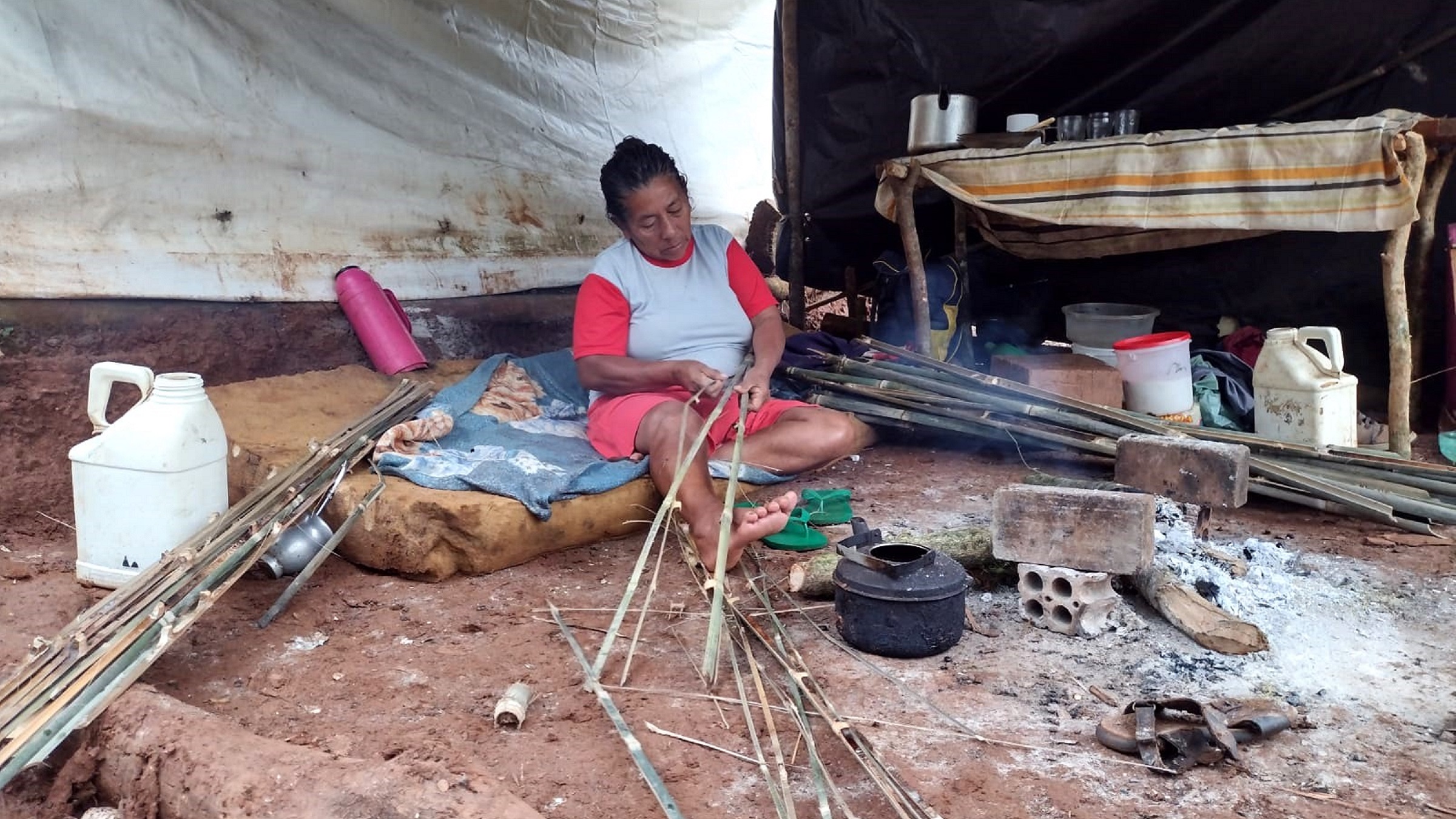
Camping under plastic tarps in rural Pitanga, in the Brazilian state of Paraná, about 300 Indigenous Kaingang have been waiting to return home since an attack destroyed their village in January 2025.Displaced residents say they were driven out by fellow Kaingang from another village, exposing an internal feud over illegal leasing of Indigenous lands to local farmers.While residents of the camp are planning retaliation, the Federal Public Prosecutor’s Office is attempting to broker an agreement to replace the leases with farming managed by the Kaingang community. PITANGA, Brazil — Since February 2025, around 300 Indigenous Kaingang people have been living in rural Pitanga, a municipality in central Paraná, Brazil. Camping in a wooded area on private property, they survive in makeshift shelters covered with tarpaulins, without electricity or running water. The camp is not a village. Displaced residents describe it as a temporary shelter that seems to be turning into a permanent home with each passing day. Conditions at the camp are precarious. Families shelter under plastic tarpaulins battered by constant storms associated with El Niño, which further worsen their living conditions. Hunger is also part of daily life. The families’ only steady income is Bolsa Família, a federal welfare benefit, which runs out long before the end of the month. Job opportunities are scarce. Farms across the region have spent years replacing manual laborers with machinery for planting and harvesting. Finding work in downtown Pitanga is hardly an easy alternative: The daily round trip covers more than 40 kilometers (25 miles), most families have no car, and there is no public transportation serving the rural area where the camp is located. The roughly 300 people living at the Pitanga camp were forcibly driven from their village in January 2025. Unlike in other parts of Brazil, they were not expelled by agribusiness. According to the residents, they were driven out by members of their own people amid a conflict that has dragged on for nearly three years and stems from a practice prohibited by law but established in the region for at least two decades: the illegal leasing of Indigenous lands. On Jan. 4, 2025, an armed, violent raid destroyed any prospect of peaceful coexistence between the two villages of the Ivaí Indigenous Territory, Paraná’s second-largest Indigenous reserve, located between the municipalities of Pitanga and Manoel Ribas in southern Brazil and home to the Kaingang. At dawn, more than 100 Kaingang from Ivaí village, armed with shotguns, machetes and wooden clubs, marched on the village of Serrinha. They burned every house and car and injured dozens of Indigenous residents. Since then, the displaced Kaingang have been waiting for the Federal Court, the Federal Public Prosecutor’s Office (MPF) and the National Foundation for Indigenous Peoples (Funai) to grant them the right to return to their lands. A river running through the camp provides water for drinking, bathing and other needs. Image by José Pires. A conflict shaped by agribusiness Although agribusiness was not directly responsible for expelling the Indigenous residents, it plays an important role in the conflict between the two villages. Local farmers have been leasing areas inside the Ivaí Indigenous Territory to grow monocrops since the mid-2000s, according to a Funai document. Leasing Indigenous land violates Brazil’s Federal Constitution, which grants Indigenous Peoples exclusive use of their territories and bars third parties from occupying, possessing or exploiting them. The country’s Land Statute also prohibits leasing public land, including Indigenous territories. The Ivaí Indigenous Territory spans 7,306 hectares (18,053 acres). Funai records show that around 300 hectares (741 acres) are leased each year to grow soybeans, wheat, corn and other monocultures. The practice brings thousands of Brazilian reais to the Laranjal Indigenous Community Association (Acil), an organization managed by leaders from Ivaí village who oversee the lease revenues. Beyond being illegal, the practice concentrates money in the hands of a small leadership circle while most families in the reserve live in poverty. Kaingang residents say leaders protect the leasing arrangements through violence, driving out or even killing anyone who questions the system. Aware of the risks, in 2024, according to the residents, a group of Indigenous residents decided to challenge the leaders. The pushback sparked considerable tension and an election for village chief was hastily organized in an attempt to curb the power of the group that had controlled the territory for years. But the challengers lost and the result further inflamed the conflict. Threats and hostility from other community members intensified, forcing dozens of families to leave. This was how Serrinha, a new village in the southern part of the Indigenous territory, came into being. Serrinha ended up with a significant share of land within the Ivaí Indigenous Territory, leased by the Kaingang. A series of threats and violent incidents followed, culminating in the major attack of Jan. 4, 2025. At around 6 a.m. that Saturday morning, Lucélia Rodrigues says she woke to the sound of gunshots and fireworks. It was a warning that something serious was happening. “We went outside, and soon a bunch of cars and buses arrived, with the Kaingang from Ivaí village shooting at us, and we had to run,” she says. “I fled into the woods with my children. I could only grab my documents and my phone; I left everything behind.” Like every other house in the village, Lucélia’s home was also set on fire. “They burned my house,” she says. “And the other one I was building, I don’t know whether they dismantled it and took it away or burned it too. I stayed hidden all day.” Lucélia Rodrigues has been living with her children in a tarp-covered shack since her house was set on fire in early 2025. Image by José Pires. The flames destroyed all the belongings of the Serrinha residents. After the attack, they took shelter at a state school in Pitanga. As the start of the school year approached, a local farmer offered the families part of his property as a place to stay. They have been living there ever since. Farmers quickly settled on the leased land where Serrinha once stood. One tenant, speaking on condition of anonymity, says he pays Acil 3,000 Brazilian reais (around $500) per planted alqueire (a regional unit equal to 2.42 hectares or about 6 acres). According to the farmer, who grows soybeans and corn, the amount is charged per harvest, and the leased land can yield up to two harvests a year. Dealing with the Indigenous leaders is perilous, the farmer adds. “They are dangerous; the leaders make threats if they are crossed,” he says. “I know people who were killed for questioning the leases.” Farmers sign contracts with Acil and pay straight into the association’s bank account. “But if you’re late, or do something they don’t like, you risk running into trouble,” he says. Beyond the official payments, leaders pocket an extra fee of 500 reais per alqueire, he adds. “That extra money stays with the leaders, you know. I usually plant about 10 alqueires twice a year. So do the math: from my fields alone, they make 70,000 reais,” he says. The tenant says part of his soybean crop goes to Coamo, Brazil’s largest agricultural cooperative by revenue. Mongabay contacted Coamo about the allegation that it buys soybeans grown on the Indigenous reserve, but the cooperative did not respond by publication time. Agreement aimed at ending leases has yet to succeed In April 2025, the Federal Public Prosecutor’s Office, Funai, Acil and residents of Ivaí signed a consent decree (TAC) to establish a new agricultural, environmental and land-management system designed to end leasing on the reserve. The agreement was signed with the participation of then Funai president Joênia Wapichana. The plan aims to replace the leasing and partnership deals in place since the mid-2000s with communal farming run directly by the Kaingang. The project outlines plans to plant corn, beans and cassava across 300 hectares (741 acres), treat the soil, buy farm machinery and two work vehicles, hire an agronomist and set up an exchange with the Terena Indigenous people to improve cassava production. It also introduces environmental rules and revenue-sharing standards. Under the pact, Acil and the community cannot plant genetically modified seeds or clear new land; they must also dispose of pesticide containers safely and keep a 250-meter (820-foot) buffer between sprayed fields and homes. In addition, Acil must submit a plan to distribute crop earnings fairly among association members and the wider community. Yet the agreement that could halt leasing and ease the conflict has stalled. Displaced residents say Funai has failed to deliver on its commitments. In February 2026, the Federal Public Prosecutor’s Office MPF sued Funai for breaching the consent decree. Prosecutors said the agency ignored three formal requests for information in 2025, including one handed directly to a regional office. The lawsuit asks the court to order Funai to show progress on overdue goals, present an action plan and face a daily fine of 20,000 reais ($3,356) until it meets its obligations under the agreement, which draws on more than 3.9 million reais ($654,582) from the Indigenous Heritage Income fund. In a statement to Mongabay, Funai attributed the delays to staff shortages at the Guarapuava office. The agency said a recent reorganization and new hiring will allow it to coordinate with partner departments and carry out the spending plan. A chief marked for death Valmir Olivério is a young Kaingang chief. At 33, he leads the dozens of families now living at the camp in Pitanga. He was the one who led the opposition to the leaders of Ivaí village. The challenge, however, came at a price. After losing the 2024 election for village chief, he left with the families and founded Serrinha village. Wooden houses were built, crops were planted and Valmir was named chief. Threats from Ivaí soon mounted, and tensions exploded, culminating in the January 2025 raid. Attackers shot Olivério in the face; the bullet entered his nose and exited through the roof of his mouth, according to him. Since then, he has never walked alone; he is always accompanied by at least three other Indigenous men. “I can no longer go out alone because they want to get me,” he says. “So I always walk with others to protect myself.” Chief Valmir Olivério no longer walks alone: “I have already received many threats.” Image by José Pires. The chief says he faces constant death threats: “They came to tell me in person and also through social media messages. I am marked for death, but I am not afraid.” Born in Ivaí village, Olivério says he saw early on how leasing drives violence against the Kaingang. His father also fought the practice and faced retaliation, he says: “My father questioned the leases more than 20 years ago. When I grew up, I also started questioning the injustices committed by the leaders. Ever since, I’ve had a target on my back.” His older brother was also wounded in the attack. Hamilton Olivério, 36, was shot four times, and bullets remain lodged in his arm, leg and back. Attackers beat him after shooting him. “I was sleeping and they woke me up; when I went outside, I saw a lot of people coming toward the village,” says Hamilton. “When I got to about 200 meters from the invaders, they shot at us, hitting my arm and leg. When I turned my back to run, they shot me in the back with a shotgun. Then they grabbed me, tied me up and kicked me repeatedly until I passed out. I thought I was going to die.” Scars and four bullets lodged in Hamilton Olivério’s body bear witness to the conflict fueled by the land leases. Image by José Pires. After the assault, Valmir Olivério filed a repossession claim through a lawyer for Serrinha. The case is pending before the local court. According to the court’s press office, the judge is awaiting filings from the parties before scheduling a hearing and will rule on the repossession request once proceedings conclude. Since the 2025 attack, the Federal Public Prosecutor’s Office, the Federal Court and Funai have made several attempts to mediate between the two villages. None have succeeded. Judge Catarina Volkart Pinto of the Land Solutions Commission, one of the bodies in Brazil created to resolve land conflicts, at the Federal Regional Court of the 4th Region, says the commission visited the Ivaí reserve, Serrinha and the displaced families’ camp to assess the dispute. “The purpose of the visit was to understand the local reality, both regarding the lands themselves and the communities living in each of them,” she said to Mongabay, noting that land and Indigenous rights agencies joined the mission. The commission then met separately with reserve leaders, the displaced Serrinha families and public agencies including the Public Defender’s Office, prosecutors, the Ministry of Indigenous Peoples, Funai and local officials to identify what sparked the conflict and explore room for talks. Those efforts collapsed. Volkart Pinto says both factions refused to sit down together, forcing the commission to close mediation without a deal. “Given the refusal of both groups, it was not possible to schedule a joint mediation session between them,” she says. The lawsuit has returned to the Federal Court of Campo Mourão for a ruling on the repossession claim. The families sheltering in Pitanga see returning to Serrinha as their only option, but Kaingang residents say Ivaí’s leaders will bar them from coming back. Chief Olivério and his brother warn that renewed fighting may follow. If the court rejects their claim, they say they will arm themselves and attack Ivaí, where nearly 1,500 Kaingang live. “It’s the only way for them to pay for what they did to us,” he says. “If the court doesn’t order our return to Serrinha, we won’t have anything left. Then it will be time to take justice into our own hands and go to Ivaí village to make them pay for all the harm they did to us.” Mongabay asked the Federal Public Prosecutor’s Office whether investigators are examining who organized the 2025 raid, the threats against Chief Valmir Olivério and the retaliation warnings coming from Pitanga. The MPF said only that the cases remain sealed, preventing officials from releasing details. Leaders of Ivaí village could not be reached for comment on the leases and the conflict with Serrinha. Banner image: Since January 2025, about 300 Indigenous Kaingang, expelled from their lands by violence linked to illegal leasing, have been waiting for the right to return home. Photo by José Pires. Credits Topics
Divided and displaced: Brazil’s Kaingang people wait for an end to illegal leasing conflict
Full Article
Original Source
Read the full article at News →KhanList aggregates and links to publicly available news content. We do not host full articles from third-party sources. Always verify important information with original sources.