
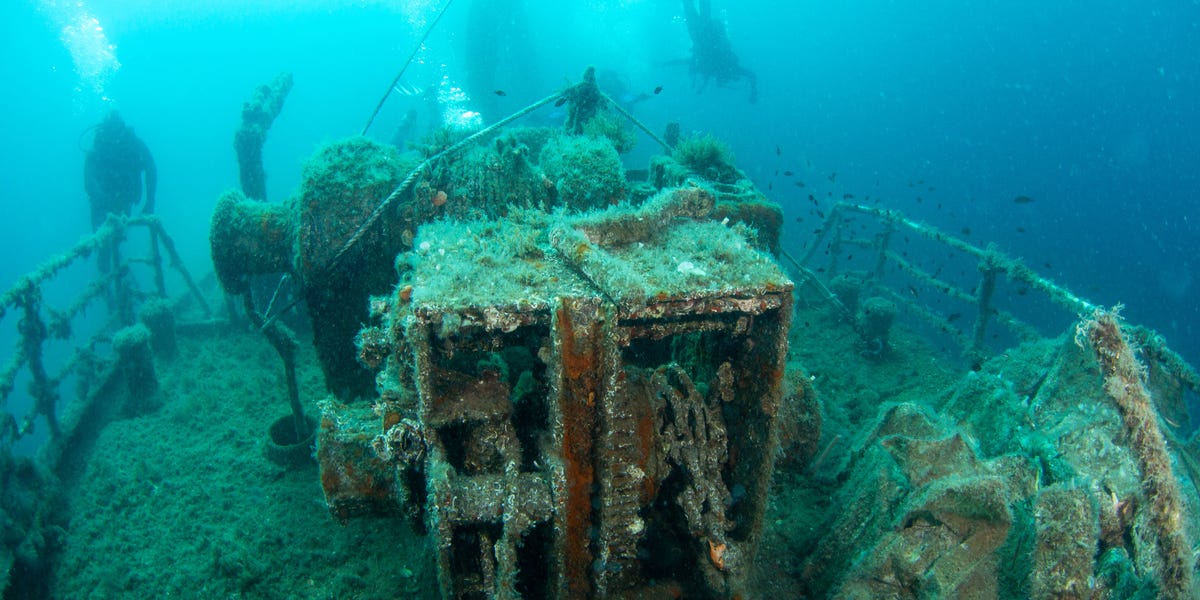
For seven years, a group of volunteer divers scoured historical records and the coast of Maine in search of one of New England’s largest undiscovered World War II shipwrecks. Now the SS Cornwallis has been found. The Nomad Exploration Team located the Canadian merchant vessel, which a German U-boat sank off Mount Desert Rock in 1944. The discovery also helps tell the story of the 43 people aboard the boat who lost their lives in the attack and revives interest in the German spies linked to the sinking.The team used side-scan sonar to map the ocean floor where they believed the Cornwallis might rest, and they nearly overlooked the 400-foot, 5,458-ton vessel. Some of the group’s most harrowing dives later confirmed that the sonar anomaly really was the lost ship. “It was exhilaration,” said Danny Allan, a founding team member, according to Seacoastonline.The nine-member, New Hampshire-based team began the search in 2019 with a rough location about 10 miles southwest of Mount Desert Rock. By drawing on historical records, the ship’s blueprints, and local fishermen’s observations, they narrowed the search to three likely sites. Even so, the work wasn’t going to be easy.“There are big tides up off the Mount Desert area,” team member Jeff Goodreau told the Portland Press Herald. “A lot of weather, a lot of fog … Any way you look at it, the challenge is just getting there, whether it’s a five-hour run from Portsmouth or trailering a boat up there.”In fact, the team nearly missed the wreck twice. On a first pass within 300 feet of it, they didn’t recognize the sonar image. Later, while they were reprogramming the GPS, they almost skipped past it again when it showed up just 100 feet away. “We would’ve written off that whole section as ‘we already looked there’ and wouldn’t have found it,” Allan said.Reaching the wreck, nearly 400 feet down, was just as tricky. Team member Don Ferrara called it the scariest dive he’d ever done, and Goodreau described the site as deep, cold, and full of current. Still, “We were over the moon,” Ferrara said of the find.“You’re the first person to see and touch this wreck literally in 80 years, so you’re ecstatic,” Allan said. “But it’s also extremely sobering because this is a grave. 43 souls lost their lives on this wreck.”The tragedy happened in the Gulf of Maine as the Canadian ship was heading home to Saint John, New Brunswick, after loading sugar and molasses in Barbados. At 6 a.m. on December 3, 1944, the German submarine U-1230 fired a single torpedo that struck the forward cargo hold, and the Cornwallis sank in less than 10 minutes, according to the team. Only five of the 48 people aboard, most of them Canadian, survived. Fishing boats picked up the survivors, and a U.S. Navy vessel then carried them to Rockland, Maine.The Cornwallis wasn’t a target the U-boat had been hunting. “The U-boat wasn’t looking for them,” Ferrara said. “They were just there.”The sinking alerted the U.S. to the U-boat’s presence and prompted an investigation into its mission. By interviewing witnesses in Hancock, the FBI learned about Germany’s Operation Elster (Operation Magpie in English). Just days before the attack, the same submarine had landed two German spies, Erich Gimpel and William Colepaugh, near Hancock Point. Their mission was to gather intelligence in the United States. The pair took a taxi to Bangor, a train to Portland, and then made their way to New York City. In the end, the plot fell apart from within: Colepaugh lost his nerve, confided in a friend, and turned himself in, which led to both men’s capture.This wasn’t the first time the Cornwallis had been torpedoed. The ship was built in Vancouver, British Columbia, in 1921. In 1942, a torpedo struck it while it was anchored at Barbados, and it partially sank in shallow water. After repairs, it returned to service.“For the team, finding the wreck was the culmination of years of persistence,” Allan said in a statement, according to MassLive. “For the families and communities connected to the ship, it brings renewed attention to a largely forgotten tragedy.”The Cornwallis is the latest find for the team, which had already located the USS Eagle 56 and the SS William H. Machen. “I love history,” Allan said. “My father was a history teacher. Other people like to see pretty fish and reefs. For me, I love to go see wrecks.”Tim Newcomb is a journalist based in the Pacific Northwest. He covers stadiums, sneakers, gear, infrastructure, and more for a variety of publications, including Popular Mechanics. His favorite interviews have included sit-downs with Roger Federer in Switzerland, Kobe Bryant in Los Angeles, and Tinker Hatfield in Portland.
Divers Spent 7 Years Hunting a Ghost Ship Linked to a Nazi Spy Plot. They Just Found It.
Full Article
Original Source
Read the full article at Popularmechanics →KhanList aggregates and links to publicly available news content. We do not host full articles from third-party sources. Always verify important information with original sources.