
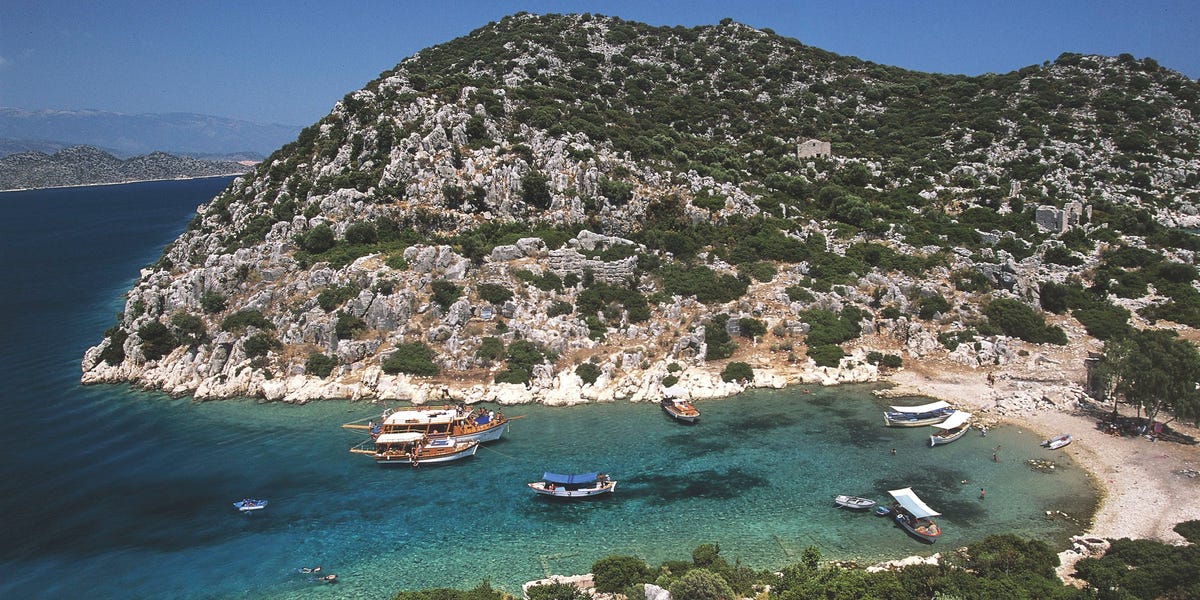
Here’s what you’ll learn when you read this story:Researchers in Turkey announced the discovery of the oldest known shipwreck ever found, a Mediterranean site up to 4,700 years old.The team dated the wreck thanks to the more than 30 pottery vessels found at the underwater location.The only items remaining from the shipwreck are three stone anchors and ceramic amphorae.Archaeologists announced the discovery of the world’s oldest known shipwreck, but they’re missing one key component: the ship. In a find off Kekova Island in Antalya, Turkey, a team of researchers uncovered a wreck site scattered with more than 30 ancient amphorae and three stone anchors, dating the find to as late as 4,700 years ago. That Early Bronze Age certainty comes from the team’s analysis of the ceramic storage pots.The discovery showcases the “deep-rooted history of maritime trade along the Anatolian coasts,” said Mehmet Nuri Ersoy, Turkey’s minister of culture and tourism, in a translated statement, adding that the ceramic vessels transported olive oil or wine, with traces of residue still found inside. But it’s the outside of the jars that gives the discovery its significance: the shape and decoration of the vessels point to amphora production in Jordan Valley workshops and match similar vessels found in Egypt, Troy, and Crete. That evidence led experts to call the find a “100 percent” match to known Early Bronze Age types.Anadolu//Getty ImagesA diver handles a container during underwater archaeological excavations near Kekova Island in Antalya, Turkiye, on October 14, 2026.Because the ship’s wood has fully disintegrated, radiocarbon dating wasn’t an option—but the ceramic vessels and stone anchors date to 2600 to 2400 B.C.E., making the wreck older than the Dokos shipwreck in the Aegean Sea, which sank around 2200 B.C.E., and roughly contemporaneous with the construction of the Great Pyramid of Giza. “The shipwreck is a time capsule at the bottom of the sea,” said Hakan Öniz, who leads the Mediterranean Archaeology Association expedition and teaches at Akdeniz University in Turkey, according to the BBC.The amphorae, which sat about 100 feet below the surface, match Early Bronze Age Levantine types, with two side handles, a middle ridge, and flat bases, according to a study published in the Journal of Maritime Archaeology. “The upper part of this amphora features two parallel lines made with a pointed tool, as well as a zigzag pattern in the middle,” the authors wrote of one particular find.Among the vessels, Ersoy said, one amphora stands out, featuring nine different markings and two holes. Experts believe sailors used it to make butter or cheese—a clue that crews produced their own food during long voyages and potentially brought goats on board to help with the process. “We continue to illuminate Anatolia’s maritime history with new discoveries, preserving our underwater cultural heritage to pass it on to future generations,” Ersoy said.Even without the hull, experts believe they can estimate the ship’s length at about 33 feet. Vessels like it would have regularly ferried goods across the Mediterranean Sea, and this ship’s final voyage likely launched from a port along the Levantine coast, headed toward Troy, in present-day northwestern Turkey, or to Crete. The strong currents and winds around Kekova Island, however, made for dangerous sailing.“Current information suggests that the shipwreck is from a small vessel that sank while sailing east to west during the Early Bronze Age,” the authors wrote.There’s plenty more to learn from the ceramic vessels, thanks to the residue found inside them. “I looked inside and nearly fainted,” said Karin Sowada, an archaeologist from Australia’s Macquarie University who analyzed the recovered pieces, according to the BBC. “I could not believe how much [residue] was visible. It wasn’t just like spots … a lot of this material was still remaining.”Further investigation will reveal whether the substance is olive oil, wine, tree resin, or something else entirely. “It’s possible that [the residue] could actually be the result of reuse of the jars,” Sowada said. “I mean, these jars are huge—they’re not things that you just ship away and then never see again. People would have emptied these jars on arrival and potentially used them for many, many, many years.”Tim Newcomb is a journalist based in the Pacific Northwest. He covers stadiums, sneakers, gear, infrastructure, and more for a variety of publications, including Popular Mechanics. His favorite interviews have included sit-downs with Roger Federer in Switzerland, Kobe Bryant in Los Angeles, and Tinker Hatfield in Portland.
Divers Found the Oldest Shipwreck on Earth 100 Feet Down—Then They Looked Inside Its Jars
Full Article
Original Source
Read the full article at Popularmechanics →KhanList aggregates and links to publicly available news content. We do not host full articles from third-party sources. Always verify important information with original sources.