
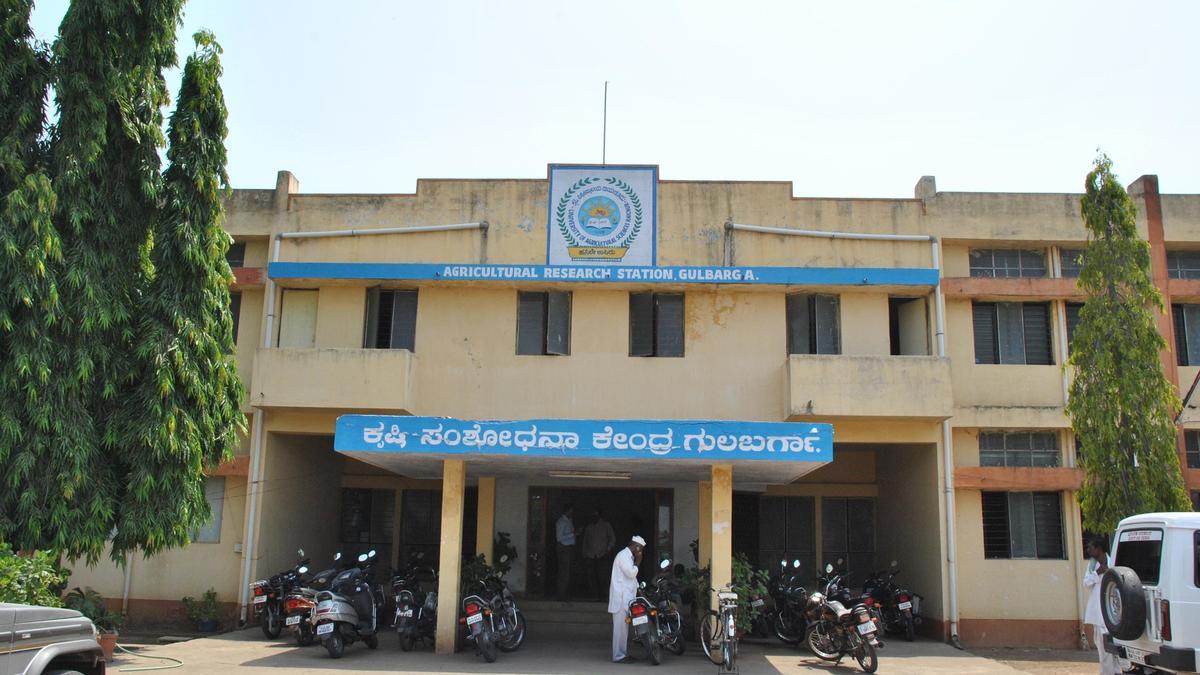
The Zonal Agricultural Research Station on the Krishi Vigyan Kendra campus in Kalaburagi. | Photo Credit: ARUN KULKARNI The Azim Premji Foundation has sought 12 acres of land in Kalaburagi city to establish a 500-bed hospital, following which the district administration identified ZARS land for the proposed project.The proposed diversion of 12 acres from the Zonal Agriculture Research Station (ZARS), Kalaburagi, for a healthcare project of the private foundation has raised serious concerns among agricultural scientists, who say land developed over decades for crop research cannot be treated as surplus when the institution itself is facing an acute shortage of research space.However, the University of Agricultural Sciences-Raichur (UAS-R) has refused to issue a No Objection Certificate (NOC) for the proposed transfer of land belonging to ZARS, in response to correspondence from the district administration seeking the land for the project.“We need more land, not less, for research activities. The existing land is already fully committed to ongoing experiments, long-term trials, crop improvement programmes, and the field-based requirements of agricultural students; the station is already facing a shortage of land for its expanding research responsibilities,” Associate Director for Research B.V. Tembhurne said.The area’s agricultural education and research infrastructure is already spread across limited land. ZARS has 55 acres, the Krishi Vigyan Kendra (KVK) has 50 acres, and the college has 25 acres, besides about four acres occupied by buildings and gardens. Scientists stress that the 55 acres under ZARS are neither vacant nor surplus, as they support long-term experiments, specialised crop research, and the field-based needs of nearly 350 agricultural students.AICC president Mallikarjun Kharge played a vital role in establishing and strengthening ZARS and KVK in Kalaburagi. These institutions were developed through sustained efforts to strengthen agricultural research, education and extension services and to address the needs of farmers in the predominantly rain-fed region.Scientists, requesting anonymity, said the 34-year-old wilt-sick plot at ZARS is at the centre of growing concerns over the proposed land diversion. Scientists describe it as one of only 11 specialised facilities of its kind in the country and the only such facility in South India.The plot is critical to pulse research, particularly red gram and chickpea. Entries collected from across India undergo repeated evaluation for disease resistance, weather adaptability, and yield under different farming systems. They are tested with and without fertilizers, as sole crops and under various multiple-cropping systems.The station has around 900 pulse entries. Varieties such as GRG-152, GRG-811 and TS-3R red gram crops are associated with its research, with the TS-3R variety cultivated across a wide belt from Madhya Pradesh to Keralam.Red gram research is particularly important for the region, where the crop is a major rain-fed pulse and an important source of protein and farm income. Research on disease resistance, yield stability and climate adaptability is crucial for developing varieties that can withstand challenging growing conditions and help farmers reduce crop losses.Scientists state that the three-decade-old wilt-sick plot cannot simply be shifted. Its disease pressure, accumulated observations and successive seasonal trials constitute a unique research environment that would take decades to recreate.The issue, therefore, is not merely the diversion of 12 acres. It is whether critical agricultural research infrastructure, built through decades of public investment and serving farmers across the region and beyond, should be surrendered when the institution itself is already facing a shortage of land. Published - October 04, 2026 07:33 pm IST
District administration seeks agricultural research land for private healthcare project
Full Article
Original Source
Read the full article at Thehindu →KhanList aggregates and links to publicly available news content. We do not host full articles from third-party sources. Always verify important information with original sources.